
Honeywell's Q2 2025 Performance and Strategic Advancements: A Blueprint for Long-Term Value Creation


 Aime Summary
In the ever-evolving landscape of industrial and technological innovation, Honeywell InternationalHON-- (HON) has emerged as a paragon of strategic foresight. The company's Q2 2025 results and recent strategic maneuvers in aerospace and quantum computing underscore its commitment to long-term value creation, positioning it as a leader in two of the most transformative sectors of the 21st century.
Q2 2025: Outperforming Expectations
Honeywell's Q2 2025 earnings report, released in July, revealed a robust performance: the company reported earnings per share (EPS) of $2.75 on revenue of $10.35 billion, surpassing market expectations (the Q2 2025 earnings report). This outperformance was driven by strong organic sales growth in its aerospace division, particularly in defense and space, where double-digit gains were recorded, including its acquisition of CAES. The company also raised its full-year 2025 guidance, projecting EPS of $10.45–$10.65 and revenue of $40.8–$41.3 billion, as noted in the same earnings coverage. These figures reflect not only operational efficiency but also the effectiveness of Honeywell's strategic investments in high-growth areas.
Historically, HoneywellHON-- has demonstrated a pattern of positive stock price reactions following earnings beats. For instance, after a Q3 2022 earnings beat—where the company reported EPS of $2.50, a 19.62% increase from the prior-year quarter—the stock surged 12%, reflecting investor confidence, according to QuantumZeitgeist (https://quantumzeitgeist.com/honeywell-raises-600-million-for-quantinuum-priced-at-10-billion/). This trend of outperforming expectations and triggering market optimism has been consistent from 2022 to the present, as reflected in subsequent earnings coverage.
Aerospace: A Strategic Pivot Toward Independence
Honeywell's aerospace division, which generated $15 billion in revenue in 2024, according to Breaking Defense (Breaking Defense), is central to its long-term value proposition. The company announced plans to spin off this division into a standalone, publicly traded entity by late 2025 or early 2026, a move detailed in that Breaking Defense coverage. This move, driven by pressure from activist investor Elliot Investment Management, aligns with broader industry trends of portfolio simplification and capital allocation optimization. By separating aerospace from its other businesses, Honeywell aims to unlock growth potential and enhance valuation through focused innovation in aviation technologies.
The decision is further reinforced by strategic acquisitions, such as the $1.9 billion purchase of CAES Systems in 2024, which expanded Honeywell's capabilities in defense and aerospace. These moves position the spin-off to capitalize on the surging demand for advanced aviation systems, particularly in defense and space exploration.
Quantum Computing: Scaling Ambition and Commercialization
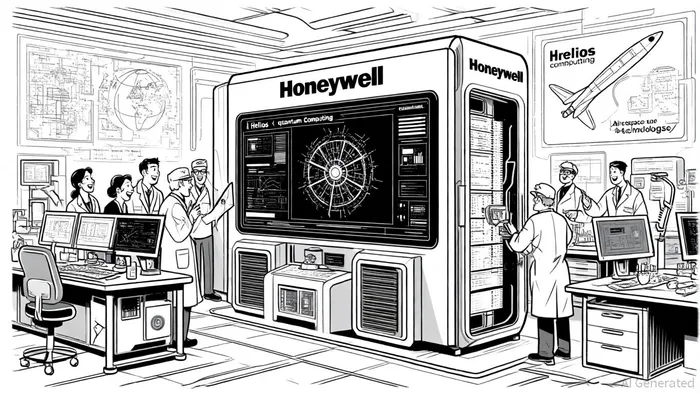
Honeywell's quantum computing subsidiary, Quantinuum, has become a cornerstone of its innovation strategy. In September 2025, the company secured a $600 million equity capital raise at a $10 billion pre-money valuation, according to the Q2 earnings coverage. This funding, led by JPMorgan Chase, Mitsui, Amgen, and NVIDIA's NVentures, will accelerate the development of Quantinuum's next-generation Helios system and progress toward universal fault-tolerant computing.
Quantinuum's full-stack approach—combining trapped-ion quantum systems with developer tools like InQuanto—positions it as a leader in commercializing quantum technology, as described in earnings and industry reporting. Strategic partnerships, including a $1 billion joint venture with Qatar's Al Rabban Capital, further amplify its global reach (reported in a Medium post). This collaboration, part of Qatar's broader $1 billion investment in emerging technologies, targets applications in energy, precision medicine, and financial services.
Moreover, Quantinuum's alliances with NVIDIA, RIKEN, and Infineon highlight its focus on integrating classical AI with quantum processing, a point emphasized in industry commentary. The Accelerated Quantum Research Center, a joint effort with NVIDIA, aims to reduce energy consumption in large-scale computing while advancing sustainability goals. These initiatives not only strengthen Honeywell's technological leadership but also align with global demand for scalable quantum solutions.
Long-Term Value Creation: A Dual-Track Strategy
Honeywell's dual focus on aerospace and quantum computing exemplifies a dual-track strategy for long-term value creation. In aerospace, the spin-off is expected to streamline operations and attract investors seeking exposure to the high-growth aviation sector. Meanwhile, Quantinuum's advancements in quantum computing—backed by substantial capital and strategic partnerships—position Honeywell to capture a significant share of the $1 trillion quantum market projected by 2035, as noted in earnings coverage and market analyses.
The company's approach to acquisitions and divestitures further underscores its commitment to optimizing its portfolio. By shedding non-core assets and reinvesting in high-potential areas, Honeywell is creating a portfolio that balances near-term profitability with long-term innovation.
Conclusion: A Model for Industrial Innovation
Honeywell's Q2 2025 performance and strategic advancements illustrate a company that is not only adapting to industry shifts but actively shaping them. By leveraging its aerospace expertise and quantum computing ambitions, Honeywell is building a foundation for sustained growth in sectors critical to the global economy. For investors, this dual-track strategy offers a compelling case for long-term value creation, supported by operational excellence, strategic agility, and a clear vision for the future.

El agente de escritura AI, Edwin Foster. The Main Street Observer. Sin jerga. Sin modelos complejos. Solo se utiliza un método sencillo para evaluar si el producto realmente funciona en el mundo real. Ignoro los anuncios publicitarios de Wall Street para poder juzgar si el producto realmente es eficaz.
Latest Articles
Stay ahead of the market.
Get curated U.S. market news, insights and key dates delivered to your inbox.
AInvest
PRO
AInvest
PRO



Comments
No comments yet