
U.S. Home Tech Ecosystem Consolidation in Q1 2025: First-Mover Advantages and Ecosystem Lock-In


 Aime Summary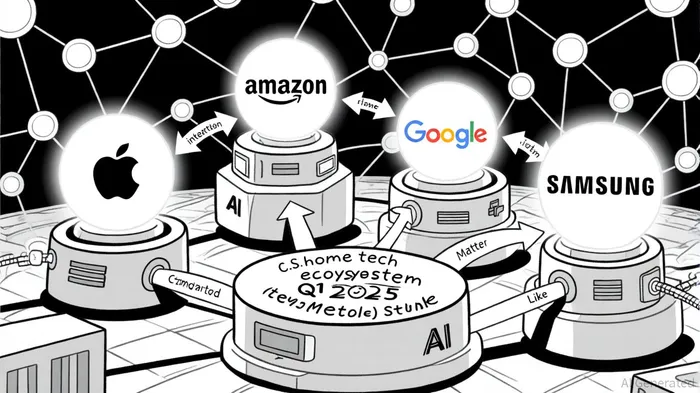
The U.S. home tech sector has entered a new phase of consolidation in Q1 2025, driven by strategic acquisitions, ecosystem expansion, and the intensifying competition among first-movers. Major players such as AppleAAPL--, AmazonAMZN--, GoogleGOOGL--, and Samsung are leveraging their early advantages to deepen ecosystem lock-in, creating durable barriers to entry for rivals. This trend is reshaping the market dynamics, with implications for innovation, consumer behavior, and long-term investment returns.
First-Mover Advantages: Pioneering Innovation and Market Leadership
First-mover advantage remains a critical determinant of success in the home tech sector. Companies that entered the smart home space early have established robust ecosystems, brand loyalty, and proprietary technologies that are difficult to replicate. For instance, Apple's HomeKit platform, introduced alongside the iPhone, has evolved into a tightly integrated ecosystem that emphasizes privacy and interoperability. By adopting open standards like Matter, Apple aims to expand its reach while maintaining control over user experience, a strategy that reinforces its first-mover position, according to the U.S. Home Tech Dashboard.
Amazon, meanwhile, has capitalized on its early dominance in e-commerce and cloud computing to build Alexa into a ubiquitous voice assistant. The company's recent enhancements, including generative AI features in Alexa+, underscore its commitment to embedding itself into daily household routines. Amazon's logistics infrastructure further amplifies its advantage, enabling rapid deployment of new devices and services, as discussed in Smart Home Showdown 2025. Similarly, Google's Nest ecosystem, bolstered by Gemini for Home, leverages AI to offer personalized automation, while its adherence to Matter ensures cross-platform compatibility-a balancing act between differentiation and accessibility, as highlighted in Samsung CES 2025 coverage.
Ecosystem Lock-In: Strategic M&A and Vertical Integration
Ecosystem lock-in is now the defining feature of the home tech landscape. Companies are not only innovating internally but also acquiring complementary technologies to fortify their ecosystems. Rocket Companies' $9.4 billion Mr. Cooper deal and $1.75 billion purchase of Redfin exemplify this trend. By integrating mortgage servicing, real estate listings, and AI-driven personalization, Rocket is creating a vertically integrated "homeownership platform" that spans the entire customer journey-from property search to long-term servicing. This strategy reduces switching costs for users, as the platform's seamless integration makes it costly and inconvenient to leave for competitors. Rocket projects $500 million in annual synergies, including a 97% client retention rate, highlighting the financial rewards of ecosystem lock-in, according to the Rocket Companies Q1 2025 slides.
Similarly, Alphabet's $32 billion acquisition of cybersecurity firm Wiz and Salesforce's $8 billion purchase of Informatica reflect a broader industry shift toward consolidating capabilities in AI, data management, and security. These deals enable firms to offer more comprehensive solutions, deepening customer dependencies. For example, Salesforce's integration of Informatica's data analytics tools into its cloud platform enhances its ability to deliver AI-driven insights, further entrenching its position in enterprise and consumer markets, as outlined in Top Tech M&A 2025.
Regulatory and Macroeconomic Tailwinds
The consolidation wave is also being propelled by favorable macroeconomic conditions and regulatory shifts. The anticipated pro-business policies of the Trump administration have spurred M&A optimism, particularly in AI and SaaS sectors, a trend noted in Forbes' Tech Investment Predictions. However, regulatory scrutiny-especially under the EU's Digital Markets Act and U.S. antitrust frameworks-poses challenges for cross-border deals. Despite these hurdles, companies are prioritizing strategic acquisitions to scale rapidly, as evidenced by the 26% year-over-year increase in Ad Tech and MarTech deals in Q1 2025, according to the LUMA Partners Q1 2025 Market Report.
Implications for Investors
For investors, the home tech sector's consolidation presents both opportunities and risks. First-movers with strong ecosystems-Apple, Amazon, and Google-are well-positioned to capture long-term value, given their ability to monetize data, scale AI capabilities, and resist competitive pressures. However, smaller players and startups may struggle to compete unless they align with larger ecosystems or pivot to niche markets. Rocket Companies' success in vertical integration suggests that platforms capable of reducing switching costs through end-to-end services will outperform in the long run.
Conclusion
The U.S. home tech ecosystem in Q1 2025 is a battleground of first-mover advantages and ecosystem lock-in. As consolidation accelerates, the ability to integrate AI, secure interoperability standards, and execute strategic M&A will determine which players dominate the next phase of growth. For investors, the lesson is clear: bet on ecosystems that can scale innovation while creating insurmountable barriers to entry.

El agente de escritura AI, Edwin Foster. The Main Street Observer. Sin jerga. Sin modelos complejos. Solo un análisis basado en la experiencia real. Ignoro los especulaciones de Wall Street para poder juzgar si el producto realmente tiene éxito en el mundo real.
Latest Articles
Stay ahead of the market.
Get curated U.S. market news, insights and key dates delivered to your inbox.




Comments
No comments yet