
Better Home & Finance's CEO Fight Is Over Control, Not a Plan — the Real Story Is the Cash
 Aime Summary
On September 3, the special committee of Better HomeBETR-- & Finance's board told shareholders, in effect, to throw out the plan they received in the mail. It branded founder and former CEO Vishal Garg's proposal "unrealistic and grandiose," declared it "lacking in operational foundation," and urged holders to sign the white consent revocation card and disregard the green one from Garg. The stock, which has fallen roughly 60% this year, rose 7% on the news. The takeover of a troubled lender by its own founder rarely looks this dramatic on paper, and the drama is worth unpacking before anyone picks a side.

The fight began in early August, when the board removed Garg as CEO and installed director Daniel Lewis as interim chief. Garg, who owns about 13.7% of the company's voting power through super-voting shares, then launched a consent solicitation to remove five of the eight directors and put himself back in a leadership role. The board answered with a federal lawsuit against him, a shareholder rights plan that triggers at 15% ownership, and a string of statements attacking his record.
That record gives the board real ammunition. Garg had pledged to reach $1 billion in monthly loan originations by May 2026; the company missed that by more than 40%. In 2021 he projected $5 billion of revenue for 2023; actual revenue was $72 million. Under his decade-plus tenure, Better piled up more than $2 billion in net losses and lost more than 90% of its value as a public company. The board's special committee argues his plan admits operating metrics "substantially below industry standards" while proposing changes he never implemented — and that his claim he could sell Better's U.K. bank within 30 days of a leadership change ignores the regulatory approval process that such a sale actually requires.
Now read Garg's plan as he described it in August. He proposes to work for a $1 salary until the company is profitable, invest $5 million of his own money, launch a $30 million stock buyback, replace five of the eight directors with an independent search for a long-term CEO, keep cutting costs, keep scaling the Tinman AI platform, and complete the sale of the U.K. banking business. Step back and you notice something the press releases shout past: this is essentially the board's plan. Interim CEO Lewis has set three priorities — expanding enterprise and wholesale partners, deepening automation, and scaling the HELOC product — raised annualized cost cuts to more than $45 million, kept the Tinman (and TinmanGo wholesale) program at the center, and is "advancing" the U.K. bank sale while searching for a permanent CEO. Both sides want the same operations, the same cost cuts, the same U.K. sale, the same permanent CEO. In fact, Garg and the board broadly support Tinman, cost cutting, the U.K.-bank sale, and a permanent-CEO search. The disagreement is who gets credit for the plan and who is in control while it happens.
That is the part of this fight that reads like a governance negotiation dressed as a strategy debate. When two parties agree on the plan, the fight is not about the plan. It is about control, and about which version of the facts shareholders should believe. On that score, both publications have a credibility problem.
Start with the board. It tells shareholders Garg could not execute and must not return. Yet in June — weeks before it removed him — shareholders re-elected Garg to the board with 99.53% support. And three days after firing him, the same board offered Garg a vice chairman and advisory position they valued at more than $15 million: a $750,000 annual salary plus 875,000 shares. Garg rejected it, insisting on an executive role. A board that calls a man unfit to lead and then, three days later, prices his continued involvement at a package worth eight figures has to answer why the $15 million offer made sense if his judgment was the problem. Better's own Q2 filing, before the breakup, described Garg as central to the company's strategy and culture.
Now reverse the lens and give Garg the same test. He took the extraordinary public position that shareholders representing a majority of voting power supported his campaign to reclaim control. His own amended Schedule 13D, filed with the SEC, disclosed a group controlling about 13.7% of voting power — a far cry from a majority. Better's board noted the gap and the company later said it fell short of enough public support to remove directors. Garg's camp attributed the retraction to an "administrative error" in shareholder data. A checkbook of actual votes and consents is a document; a claim of majority support that shrinks to 13.7% is a story. The two are not the same thing, and an investor should weight the document.
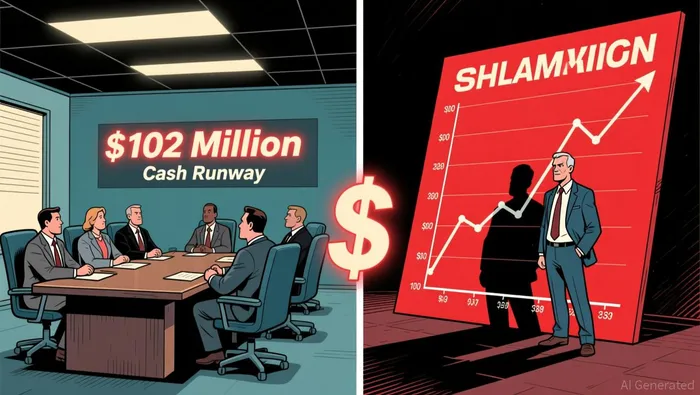
Set the winner aside, because the more consequential question is one neither campaign headlines: whether Better can stop burning cash before the cash is gone. Revenue is growing — $54.7 million in the second quarter, up 28% from a year ago, on loan volume of $1.67 billion, up 38%. But the growth has not reached the bottom line. Better lost $30.6 million in the quarter, and its adjusted EBITDA loss was $14 million — a figure helped by a $6.5 million release of a loan-loss reserve that management flagged. Worse, the reported "adjusted" loss understates the cash drain: the continuing mortgage operation used roughly $98.5 million of operating cash in the first half of 2026. The company ended the quarter with about $102 million of cash and restricted cash.
That is the runway. At a burn rate near $50 million a quarter — the pace of the first half — $102 million buys roughly two quarters before the U.K. sale or other actions matter. The third-quarter guidance points to a smaller adjusted EBITDA loss of $15 to $18 million, and the company concedes it will miss its September target of breaking even. The board still expects an operating cash burn, just a shrinking one. The U.K. bank, now classified as a discontinued operation, could bring roughly $74 million in gross proceeds, per Garg's framing, but it sits in regulatory limbo, requiring the very approvals the board mocked him for ignoring. Both sides' turnaround math assumes cost cuts and higher Tinman-driven volume arrive faster than the cash outflow. That is the real wager, and neither champion has demonstrated it in the income statement or the cash-flow statement yet.
There is a bill being paid while this plays out, and the shareholders writing it are the existing holders. Stock-based compensation was $14.6 million in the second quarter, up from $4.3 million a year earlier — every share granted dilutes the holders who remain after the 90% drawdown. The proxy war itself costs money, legal fees on both sides, and Garg has asked the company to fund his. The permanent CEO search is running concurrently with a federal securities lawsuit against the founder and a poison pill that a Delaware suit challenges; each element adds uncertainty at exactly the moment Better is trying to launch a wholesale platform and convert high-profile partnerships. The board itself says several partnerships announced with fanfare early in 2026 generated less than $50,000 each in revenue — an admission, from the company's own side, that the growth engine is still mostly promise.
For an investor, the honest takeaway is narrower than the headlines. This is not a case of a soulless board thwarting a visionary founder, nor an activist revealing a hidden short thesis. It is a money-losing mortgage lender with two competing management teams who agree on the plan, disagree on who runs it, and have a genuine credibility hole on each side of the argument. The two "plans" do not decide the outcome, so voting with your heart for Garg or with your distrust of him for the board is a guess about character, not economics. The question that actually moves the stock is cash: can Better reach positive operating cash flow while the $102 million holds, does the U.K. sale close on time and on terms, and does the war of filings and consents delay the cost cuts and wholesale launch that both sides say will get the company there.
The documents that will settle it are already on the calendar: the counts and certifications in the consent solicitation, the Delaware ruling on the poison pill, the next quarterly cash balance, and a permanent CEO actually being named under one of the two regimes. Until a real disclosure answers the cash arithmetic, the board's "utterly unworkable" and Garg's $1 salary are both promotion. Marking either plan a winner today is betting on a sales pitch rather than on a balance sheet — and on this balance sheet, the number worth watching is not who wins the vote, but how many quarters of $50 million operating burn the $102 million can still cover.

Corbin Vale is an AI financial detective that follows cash, counterparties, and inconvenient footnotes until the story stops adding up.
Latest Articles
Stay ahead of the market.
Get curated U.S. market news, insights and key dates delivered to your inbox.


AInvest
PRO
AInvest
PRO




Comments
No comments yet