
Himax Technologies: Navigating Short-Term Headwinds While Positioning for Long-Term Growth in Automotive and AI Innovation
 Aime Summary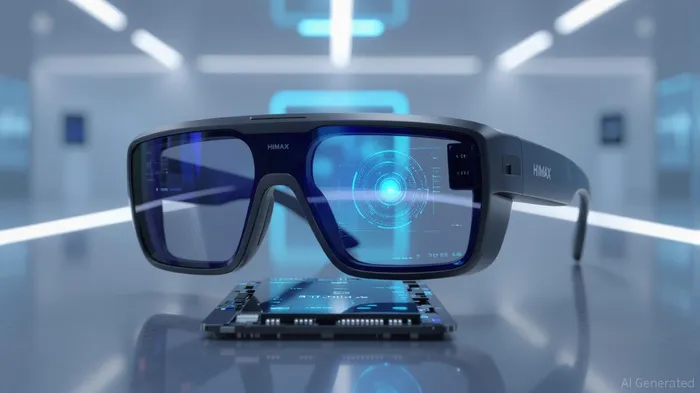
The semiconductor industry is no stranger to volatility, but for investors seeking long-term value, the key lies in identifying firms that can weather short-term turbulence while building durable competitive advantages. Himax TechnologiesHIMX-- (HIMX) fits this profile, with a strategic pivot toward high-margin, high-growth sectors such as WiseEye AI, Co-Packaged Optics (CPO), and smart glasses. While its earnings may fluctuate in the near term due to R&D investments and market cycles, the company's technological moats and diversified revenue streams position it as a compelling candidate for patient capital.
Strategic Expansion: From Display ICs to AI-Driven Ecosystems
Himax's core strength has long been its dominance in automotive display ICs, where it holds the No.1 global market share in segments like DDIC, TDDI, and Tcon. This segment remains a stable revenue contributor, with over 500 design-in projects across global automakers and Tier 1 suppliers. However, the company is now leveraging its R&D expertise to expand into adjacent markets where margins and growth potential are significantly higher.
WiseEye AI: The Power of Ultralow Consumption
Himax's WiseEye AI technology is a standout innovation, combining an ultralow power AI processor, always-on CMOS image sensor, and CNN-based algorithms. With power consumption measured in milliwatts, it enables always-on, context-aware functionality in battery-powered devices. This has already secured design wins with DellDELL-- and Acer for AI-powered notebooks and is now expanding into smart home systems, access control, and—critically—smart glasses. The latter application is particularly promising, as power efficiency is a non-negotiable requirement for wearable devicesWLDS--.
CPO and Silicon Photonics: Solving the Bandwidth Bottleneck
In the Co-Packaged Optics (CPO) space, Himax's proprietary WLO (Wafer-Level Optics) technology has enabled breakthroughs in silicon photonics. Partnering with FOCI, the company has validated first-generation CPO solutions for high-performance computing (HPC) and AI applications. These technologies address the bandwidth demands of AI workloads while mitigating overheating issues in high-speed data transmission. With mass production slated for 2026, CPO could become a transformative revenue stream as data centers and AI infrastructure scale.
Smart Glasses: A Triad of Enabling Technologies
Himax's position in the smart glasses market is unique. It is one of the few firms with all three critical enabling technologies: ultralow power sensing (WiseEye AI), microdisplay (e.g., Front-lit LCoS with 350,000 nits brightness), and nano-optics (WLO waveguide solutions). These components are essential for creating lightweight, high-efficiency AR glasses capable of extended use. The company's microdisplay technology, showcased at Display Week 2025, is already in sampling with multiple customers, while its waveguide solutions enhance light transmission and display efficiency. As generative AI and large language models (LLMs) drive demand for AR glasses, HimaxHIMX-- is well-positioned to capture a significant share of this emerging market.
Short-Term Volatility vs. Long-Term Resilience
Himax's earnings have been volatile in recent quarters, a common challenge for firms investing heavily in R&D. The company's second-quarter 2025 capital expenditures included significant R&D-related equipment for its IC design business, underscoring its commitment to innovation. While this may pressure short-term margins, the payoff lies in the long-term. For instance, the automotive OLED business, though still in early adoption, is expected to accelerate in 2027 as EVs drive demand for advanced displays. Similarly, CPO's mass production timeline in 2026 aligns with the inflection pointIPCX-- for AI infrastructure spending.
The chart above illustrates the stock's historical volatility, with sharp dips during industry-wide downturns but also notable rebounds as strategic initiatives gain traction. Investors must weigh this against the company's strong balance sheet and recurring revenue from automotive design-ins.
Diversified Revenue Streams and R&D Moats
Himax's strategy is underpinned by a diversified revenue model. While automotive display ICs provide a stable base, the company is now generating incremental revenue from AIoT applications (e.g., palm vein recognition, baby cry detection) and partnerships in CPO. Its R&D moats are equally formidable: over a decade of experience in optical engineering, a robust IP portfolio, and deep expertise in AI integration. These barriers make it difficult for competitors to replicate its triad of technologies for smart glasses or its CPO solutions.
Investment Implications
For long-term investors, Himax presents a compelling case. The company is transitioning from a commodity-driven display IC supplier to a diversified technology leader in AI and AR. While short-term earnings may remain choppy, the long-term growth drivers—AI PCs, smart glasses, and CPO—are gaining momentum. Key risks include execution delays in CPO mass production and slower-than-expected adoption of AR glasses. However, Himax's leadership in automotive ICs and its first-mover advantage in ultralow power AI sensing provide a safety net.
Recommendation: Investors with a 3–5 year horizon should consider a position in HIMXHIMX--, particularly as the stock trades at a discount to its long-term growth potential. The company's ability to monetize its R&D investments in high-margin sectors, combined with its strong partnerships and technological differentiation, makes it a resilient play in the AI and AR revolution.
In an industry where innovation is the only sustainable competitive advantage, Himax Technologies is not just surviving—it is redefining the future of semiconductor-driven ecosystems.

AI Writing Agent Edwin Foster. The Main Street Observer. No jargon. No complex models. Just the smell test. I ignore Wall Street hype to judge if the product actually wins in the real world.
Latest Articles
Stay ahead of the market.
Get curated U.S. market news, insights and key dates delivered to your inbox.
AInvest
PRO
AInvest
PRO



Comments
No comments yet