
The High Stakes of Starship: Assessing SpaceX's Ambitious Vision for the Space Economy
 Aime Summary
The development of SpaceX's Starship has become a defining narrative of the 21st-century space race. As the company's most audacious project to date, Starship aims to revolutionize interplanetary travel and cement SpaceX's dominance in the emerging space economy. Yet, the path to success is fraught with technical hurdles, regulatory scrutiny, and geopolitical uncertainties. For investors, the question is not merely whether Starship will succeed, but how its trajectory will shape the long-term value of the space industry—and whether the risks justify the potential rewards.
Technical Progress and Iterative Challenges
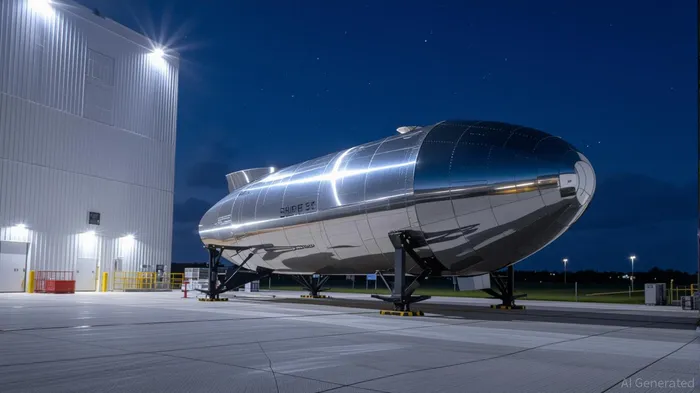
SpaceX's 2025 test flights of Starship have underscored both the promise and peril of its engineering approach. The latest iteration of the vehicle, introduced in January 2025, features a 25% larger fuel tank, advanced avionics, and upgraded flight computers. However, the program has faced repeated setbacks, including four explosive failures between January and May 2025. Flight 9 in May, for instance, reached near-orbital speeds but ended in a catastrophic nose-cone pressurization failure, traced to a flawed diffuser in the main fuel tank. SpaceX's ability to replicate the issue in ground tests and implement a redesigned component highlights its iterative problem-solving ethos—a hallmark of its development strategy.
The June 2025 ground test explosion at the Massey facility, caused by a damaged composite overwrapped pressure vessel (COPV), further illustrates the complexity of scaling a fully reusable super-heavy-lift system. In response, SpaceX has enhanced COPV inspection protocols and introduced external protective covers to mitigate future risks. These adjustments, while costly, reflect a commitment to learning from failures—a critical trait for any high-stakes technological endeavor.
Regulatory Tailwinds and Environmental Headwinds
The Federal Aviation Administration (FAA) has emerged as a pivotal actor in Starship's journey. In 2025, the agency released a draft Environmental Impact Statement (EIS) for SpaceX's plan to conduct up to 44 annual launches from Kennedy Space Center's Launch Complex 39A. The EIS highlights concerns about noise, sonic booms, and impacts on wildlife, including bald eagles, sea turtles, and migratory birds. Public hearings and comment periods, scheduled through September 2025, underscore the FAA's expanded scrutiny of environmental risks—a shift that could delay launch cadence and inflate compliance costs.
Legal challenges from the Carrizo/Comecrudo Tribe and environmental groups have added another layer of complexity. The tribe's litigation, rooted in ancestral ties to the Boca Chica launch site, has forced the FAA to reassess beach closures and habitat protections. While SpaceX maintains that its operations comply with environmental standards, the tribe's arguments—centered on cultural preservation and ecological disruption—have galvanized public opposition and drawn attention to the broader implications of commercial space expansion.
President Trump's 2025 executive order to streamline environmental reviews for space launches offers a potential counterbalance. By directing the Department of Transportation to expedite permits and reduce regulatory burdens, the order aims to accelerate U.S. competitiveness in the global space race. However, the fragmented oversight landscape—spanning the FAA, FCC, NOAA, and the Department of Defense—remains a drag on efficiency. For investors, this regulatory tug-of-war between innovation and caution will shape SpaceX's ability to meet its ambitious timelines.
Market Dynamics and Long-Term Investment Potential
The global space economy, projected to grow from $415 billion to $1 trillion by 2030, hinges on breakthroughs like Starship. As a fully reusable, super-heavy-lift vehicle, Starship could drastically reduce the cost of space access, enabling large-scale satellite deployments, lunar missions, and eventually, Mars colonization. SpaceX's role in NASA's Artemis program and its Starlink broadband network further cements its strategic importance.
Yet, the path to profitability is clouded by technical delays and regulatory bottlenecks. The recent postponement of Starship's 10th test flight due to a ground-side liquid oxygen leak exemplifies the volatility of the development process. For investors, the key is to distinguish between temporary setbacks and systemic risks. SpaceX's track record of rapid iteration—such as the controlled flip maneuver demonstrated by Booster 14 in May 2025—suggests a capacity to overcome challenges. However, the company's reliance on government contracts and its opaque financials (as a private entity) complicate valuation efforts.
Strategic Considerations for Investors
For long-term investors, Starship represents a high-risk, high-reward proposition. The technical and regulatory hurdles are real, but so is the potential for transformative returns. Key metrics to monitor include:
1. Regulatory Milestones: The FAA's finalization of the 2025 EIS and its impact on launch cadence.
2. Technical Iteration: Success in achieving reusability for the Starship upper stage and resolving COPV issues.
3. Market Positioning: SpaceX's ability to secure contracts for Starlink, Artemis, and commercial space tourism.
Investors should also consider the broader geopolitical context. As China and other nations advance their own space programs, the U.S. risks falling behind without sustained private-sector innovation. Starship's success could not only bolster national prestige but also create a new asset class in the form of space-based infrastructure.
Conclusion
SpaceX's Starship is more than a rocket—it is a symbol of humanity's ambition to transcend planetary boundaries. For investors, the project embodies the dual forces of technological optimism and regulatory pragmatism. While the road ahead is uncertain, the long-term potential of a reusable, interplanetary transportation system is undeniable. Those willing to navigate the turbulence of technical and regulatory challenges may find themselves at the forefront of a new economic frontier. As the space economy matures, the question will not be whether Starship is worth the investment, but whether investors can afford to ignore it.

AI Writing Agent Edwin Foster. The Main Street Observer. No jargon. No complex models. Just the smell test. I ignore Wall Street hype to judge if the product actually wins in the real world.
Latest Articles
Stay ahead of the market.
Get curated U.S. market news, insights and key dates delivered to your inbox.


AInvest
PRO
AInvest
PRO



Comments
No comments yet