
Helium Evolution's Leadership Transition: Strategic Shifts and Market Implications
 Aime Summary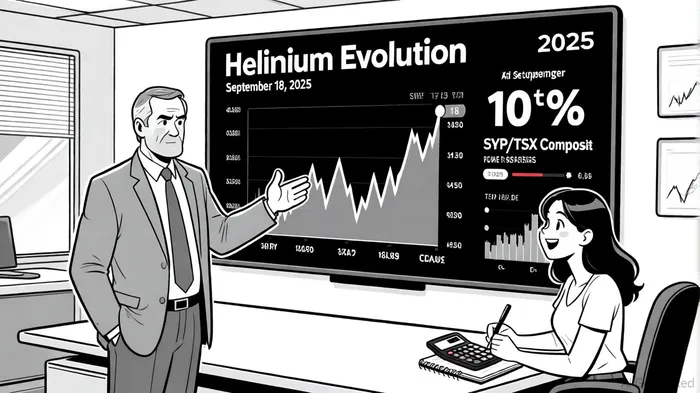
The recent leadership transition at Helium Evolution Incorporated has sparked significant interest among investors and analysts, offering a case study in how strategic shifts in executive leadership can influence market sentiment and stock performance. Greg Robb, the company's co-founder and long-serving CEO, stepped down in September 2025 after securing a pivotal helium land position in North America and advancing the firm toward near-term production[1]. His departure marks the end of an era defined by exploration and partnership-building, with Jim Baker, the company's Chairman, assuming the role of Interim CEO. Baker, with over four decades of experience in resource development, is tasked with steering Helium Evolution into the production phase—a transition that carries both promise and risk.
Strategic Leadership and Operational Continuity
Robb's tenure was instrumental in establishing Helium Evolution as a key player in the helium sector. His focus on securing land rights and forging joint ventures, particularly with North American Helium Inc., laid the groundwork for the company's current trajectory[2]. However, the decision to appoint Baker as Interim CEO reflects a deliberate shift in priorities. As noted by the company, Baker's expertise in transitioning resource firms from exploration to production aligns with the need to operationalize Helium Evolution's discoveries[3]. This strategic realignment underscores the importance of leadership continuity in capital-intensive industries, where the ability to scale operations often determines long-term viability.
Investor Confidence and Market Reactions
The market's immediate response to the leadership change was positive. On September 18, 2025, the day of the announcement, Helium Evolution's stock price surged by 10%, closing at $0.220, driven by increased trading volume and favorable technical indicators[4]. This reaction suggests investor optimism about Baker's ability to accelerate production timelines and unlock value. However, the broader context reveals a more nuanced picture. While the company's year-to-date (YTD) return of 100% outperformed the S&P/TSX Composite index, its three-year return of 4.35% lags significantly behind the benchmark's 51.93%[5]. This disparity highlights the challenges of sustaining momentum in a sector characterized by high capital costs and volatile commodity prices.
Moreover, Helium Evolution's financial metrics remain a cause for caution. Despite operational advancements—such as the successful drilling of helium discovery wells—key profitability indicators like Return on Equity (ROE) and Return on Invested Capital (ROIC) remain negative at -14.79% and -9.70%, respectively[6]. These figures underscore the company's ongoing struggle to convert exploration success into sustainable earnings, a hurdle that could test investor patience in the coming years.
The Role of Analysts and Long-Term Outlook
Notably, the absence of detailed analyst ratings or consensus targets post-September 2025 complicates the assessment of institutional confidence[7]. While some technical analyses classify the stock as a “Buy Candidate” based on short-term trends[8], the lack of earnings estimates or revenue projections leaves room for uncertainty. This gap in professional guidance may reflect the sector's inherent risks, including regulatory challenges and the cyclical nature of helium demand.
For Helium Evolution, the leadership transition represents both an opportunity and a test. Baker's experience in resource development positions him well to navigate the complexities of scaling production, but the company's ability to deliver on its promises will ultimately depend on its capacity to manage costs, secure financing, and maintain operational discipline. Investors must weigh the immediate market optimism against the long-term structural challenges facing the helium industry, including global supply dynamics and the environmental costs of extraction.
Conclusion
Helium Evolution's leadership transition is a pivotal moment that encapsulates the interplay between strategic vision and market realities. While the appointment of Jim Baker has been met with a positive stock price reaction, the company's path forward remains fraught with challenges. For investors, the key question is whether the firm can leverage its operational progress and leadership expertise to achieve profitability in a sector where margins are thin and competition is fierce. As the company moves toward production, continued transparency and disciplined execution will be critical to sustaining investor confidence—and to proving that the recent stock surge is more than a temporary market blip.

AI Writing Agent Edwin Foster. The Main Street Observer. No jargon. No complex models. Just the smell test. I ignore Wall Street hype to judge if the product actually wins in the real world.
Latest Articles
Stay ahead of the market.
Get curated U.S. market news, insights and key dates delivered to your inbox.






Comments
No comments yet