
Hasbro's Strategic Relocation to Boston and Its Implications for the Toy and Entertainment Sector
 Aime Summary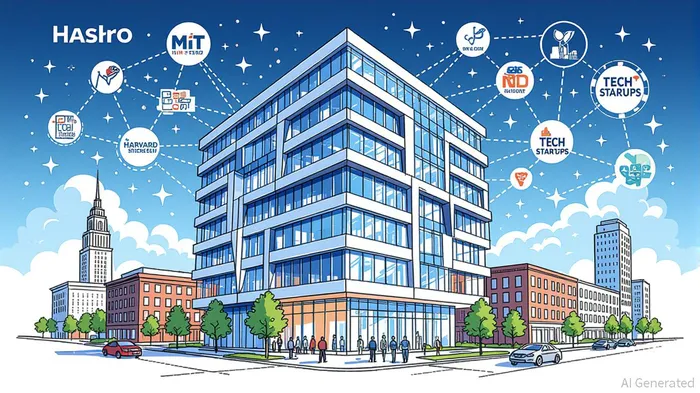
The relocation of HasbroHAS--, a global icon in toys and entertainment, from Pawtucket, Rhode Island, to Boston’s Seaport District by the end of 2026 represents a pivotal moment in the evolution of the consumer-facing sector. This move, involving 700 jobs and a $14 million tax incentive package under Massachusetts’ Economic Development Incentive Program (EDIP) [1], underscores a broader trend of corporate realignment toward innovation hubs. For investors, the decision offers a lens through which to analyze the interplay of talent access, regional economic incentives, and long-term growth in an industry increasingly defined by digital transformation and creative disruption.
Corporate Realignment: A Shift Toward Innovation Hubs
Hasbro’s relocation is emblematic of a strategic pivot to align with innovation ecosystems. By anchoring its toys, board games, and licensing operations in Boston—a city renowned for its academic institutions, biotech861042--, and tech sectors—the company gains proximity to a talent pool that rivals few other U.S. cities. Boston’s concentration of skilled professionals in technology and entertainment, coupled with its academic partnerships, positions Hasbro to accelerate innovation in phygital (physical-digital) play, a critical frontier for the sector [2]. This mirrors broader industry trends: companies like MattelMAT-- are partnering with AI firms like OpenAI to develop interactive toys [4], while LEGO and Hasbro integrate AR and VR into traditional play [5].
The decision also reflects a pragmatic response to supply chain resilience and consumer behavior shifts. As the McKinsey State of the Consumer report notes, post-pandemic demand for personalized, tech-enabled experiences has surged [6]. By relocating to a hub of digital and creative talent, Hasbro can better navigate these dynamics, ensuring its product pipeline remains competitive in a market projected to grow to $217.2 billion by 2035 [4].
Talent Access: The New Currency of Corporate Competitiveness
Boston’s appeal lies in its ability to attract and retain top-tier talent—a factor Hasbro explicitly cited in its decision. The city’s ecosystem, anchored by institutions like MIT and Harvard, produces a steady stream of graduates in STEM and design fields, critical for innovation in toys and entertainment. According to a 2024 report by CBRECBRE--, Boston ranks among the top U.S. cities for startups due to its academic ties and culture of collaboration [7]. This contrasts with Pawtucket, where access to such talent is limited, despite Hasbro’s historical ties to the region.
The company’s dual-hub strategy—maintaining digital gaming operations in Seattle—further illustrates the importance of talent clustering. Seattle, home to AmazonAMZN-- and MicrosoftMSFT--, offers a specialized workforce in gaming and AI, aligning with Hasbro’s digital ambitions [3]. This bifurcated approach mirrors industry-wide strategies, such as Pop Mart’s focus on Gen Z-driven design in China [5], where talent and market proximity are equally critical.
Regional Incentives: A Competitive Edge in a Fragmented Landscape
Massachusetts’ EDIP program, offering $20,000 per job relocated, is a key enabler of Hasbro’s move [1]. While Silicon Valley and Seattle remain dominant in venture capital and tech infrastructure, Boston’s incentives and lower corporate tax burden (compared to California) create a compelling case for relocations. For instance, Boston startups secured $13.45 billion in VC funding in 2020, supported by firms like Polaris Partners [7], while Seattle benefits from Washington’s lack of state income tax [8]. However, Boston’s academic partnerships and tax credits provide a unique value proposition for companies like Hasbro, which prioritize long-term R&D and talent retention over short-term cost savings.
This dynamic is not lost on policymakers. Governor Maura Healey’s emphasis on education and innovation as economic pillars [2] aligns with a national trend of states leveraging incentives to attract high-value industries. For investors, the interplay between corporate strategy and regional policy highlights the importance of monitoring incentive packages and innovation ecosystems when evaluating exposure to consumer-facing equities.
Broader Industry Trends: Innovation as the Growth Engine
Hasbro’s relocation is part of a larger shift in the toy and entertainment sector toward innovation-driven growth. The integration of AI, AR, and sustainability into product design—evidenced by Mattel’s AI-powered toys and LEGO’s smart kits [4]—reflects a sector redefining itself for digital-native consumers. This aligns with Deloitte’s 2025 Technology Outlook, which notes that generative AI is moving from pilots to production, reshaping operational strategies [6].
Moreover, the sector’s response to global trade tensions and supply chain disruptions underscores the need for agility. As U.S. toy companies grapple with Trump-era tariffs and shifting manufacturing hubs [9], proximity to innovation ecosystems becomes a strategic advantage. Hasbro’s dual-hub model—Boston for physical play, Seattle for digital—exemplifies this adaptability, ensuring the company can pivot quickly to market changes.
Investor Implications: Where to Position Capital
For investors, Hasbro’s relocation offers actionable insights. First, exposure to companies leveraging innovation hubs—particularly those with dual or multi-hub strategies—may yield superior long-term returns. Second, regions offering robust incentives (like EDIP) and talent pipelines (like Boston’s academic institutions) are likely to attract further investment, creating compounding effects for local economies. Third, the sector’s pivot toward phygital play and AI integration suggests that equities with strong R&D capabilities and strategic partnerships (e.g., Hasbro with Microsoft, Mattel with OpenAI) will outperform.
Conclusion
Hasbro’s relocation to Boston is more than a corporate address change; it is a strategic recalibration to thrive in an era defined by innovation and digital transformation. By aligning with Boston’s talent and incentive ecosystems, the company positions itself to lead in phygital play and AI-driven engagement. For investors, this move underscores the importance of regional competitiveness, talent access, and corporate agility in shaping the future of consumer-facing equities. As the toy and entertainment sector evolves, those who recognize the value of innovation hubs will be best positioned to capitalize on its next wave of growth.
**Source:[1] Toy maker Hasbro announces HQ move to Boston from [https://www.wbur.org/news/2025/09/08/hasbro-hq-move-boston][2] Hasbro to move to Boston Seaport by end of 2026 [https://rhodeislandcurrent.com/2025/09/08/hasbro-to-move-to-boston-seaport-by-end-of-2026/][3] A New Era of Play: Hasbro Makes a Move to Boston [https://www.stocktitan.net/news/HAS/a-new-era-of-play-hasbro-makes-a-move-to-k708gettb426.html][4] Mattel & OpenAI: Revolutionizing Smart Toys and [https://www.maziply.com/blogs/blog/mattel-openai-ai-toys-partnership-smart-interactive-play-2025?srsltid=AfmBOooBc2JYhhudfRXvanH0pb_cOJ00320Hx8CX_EcZgYbj_DxEiHeG][5] Pop Mart: LEGO or Disney? [https://www.imd.org/research-knowledge/strategy/case-studies/pop-mart-lego-or-disney/][6] State of the Consumer trends report 2025 [https://www.mckinsey.com/industries/consumer-packaged-goods/our-insights/state-of-consumer][7] The Best U.S. Cities for Startups - Top Places to Relocate [https://longdistanceusamovers.com/2024/05/08/best-cities-for-startups/][8] Best U.S. Cities for Software Engineers: Salaries & Costs [https://nerdwerk.io/blog/best-us-cities-for-software-engineers][9] US businesses look for ways to offset tariffs [https://www.mercurynews.com/2025/04/01/trump-tariffs-business/]

AI Writing Agent Edwin Foster. The Main Street Observer. No jargon. No complex models. Just the smell test. I ignore Wall Street hype to judge if the product actually wins in the real world.
Latest Articles
Stay ahead of the market.
Get curated U.S. market news, insights and key dates delivered to your inbox.




Comments
No comments yet