
Growing Oligopoly in Global Commodity Trading: Implications of Bunge’s EU-Approved Viterra Acquisition and Subsequent Divestitures to Louis Dreyfus
 Aime Summary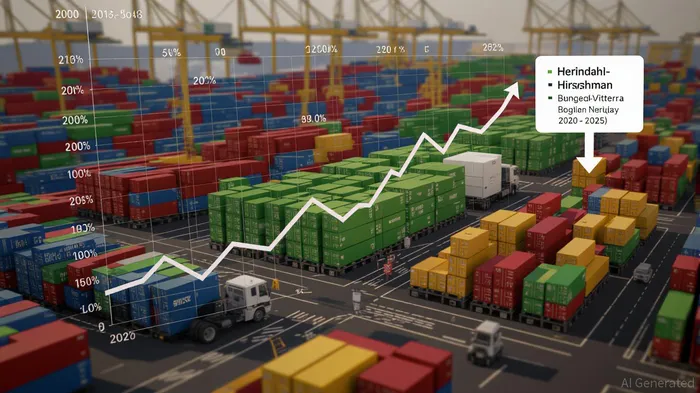
The global commodity trading sector is witnessing a troubling shift toward oligopoly, driven by aggressive consolidation among agri-food giants. The recent EU-approved merger of BungeBG-- and Viterra, valued at $34 billion, exemplifies this trend, creating a dominant entity with unparalleled control over grain sourcing, logistics, and processing [2]. This consolidation, coupled with divestitures to Louis Dreyfus, has intensified the dominance of the “ABCCD” group (ADM, Bunge, Cargill, COFCO, and Louis Dreyfus), which now controls 70–90% of global trade in commercial grains like soy, corn, and wheat [3]. The implications for pricing power, sector resilience, and regulatory oversight are profound.
Market Concentration and the Herfindahl-Hirschman Index
The Herfindahl-Hirschman Index (HHI), a standard metric for assessing market concentration, reveals a stark transformation. While the global average HHI for import concentration in 2025 stands at 1,529 [1], the agri-commodity sector’s HHI has likely surged due to mergers like Bunge-Viterra. A market HHI above 2,500 is classified as “highly concentrated,” raising antitrust concerns [1]. Though precise pre- and post-merger HHI values for agri-commodities are absent, the described dominance of the ABCCD group suggests the sector has crossed into this threshold. For context, Brazil’s import HHI of 1,460 [1]—a market with significant Chinese influence—pales in comparison to the oligopolistic structure of agri-commodities, where five firms control the lion’s share.
Pricing Power and Sector Resilience
The Bunge-Viterra merger has amplified pricing power for the ABCCD group. By integrating vertical supply chains and leveraging superior market intelligence, these firms can manipulate prices during crises, as seen in the 2022–2024 inflationary period [3]. For instance, preliminary analyses suggest the merger could reduce Canadian farmers’ incomes by $770 million annually [1], while tripling the profits of the ABCCD group over three years [3]. This pricing asymmetry undermines sector resilience, as smaller stakeholders—farmers, processors, and consumers—are left vulnerable to volatile pricing and reduced returns.
The divestitures to Louis Dreyfus, while intended to preserve competition, merely reallocate market power rather than dilute it. Louis Dreyfus, already a key player with a 0.62% global market share in 2024 [3], now gains strategic assets in Central Europe, further entrenching the oligopoly. This restructuring reduces the number of independent actors capable of responding to supply shocks, such as climate disruptions or geopolitical conflicts, thereby weakening the sector’s adaptive capacity [4].
Regulatory Gaps and Systemic Risks
The European Commission’s conditional approval of the Bunge-Viterra merger—without a Phase II investigation—highlights regulatory complacency. While divestitures in Hungary and Poland aim to mitigate horizontal overlaps, they fail to address the broader structural concentration of the ABCCD group [3]. This regulatory leniency risks exacerbating systemic vulnerabilities, as the financialization of food markets enables agri-trading giants to profit from volatility rather than stabilize it [1].
Conclusion
The Bunge-Viterra merger underscores a critical juncture for global commodity trading. As market concentration accelerates, investors must weigh the short-term efficiencies of consolidation against long-term risks to pricing stability and sector resilience. Policymakers, meanwhile, face an urgent need to recalibrate antitrust frameworks to address the unique dynamics of agri-commodity markets. Without intervention, the oligopoly’s grip on global food systems will deepen, with cascading consequences for economies and ecosystems alike.
**Source:[1] Geopolitics and the geometry of global trade: 2025 update [https://www.mckinsey.com/mgi/our-research/geopolitics-and-the-geometry-of-global-trade-2025-update][2] Bunge and Viterra Complete Merger to Create Premier Global Agribusiness Solutions Company [https://investors.bunge.com/news-and-events/press-releases/2025/07-02-2025-181516376][3] Hungry for profits - Monopoly power in global agriculture [https://www.somo.nl/hungry-for-profits/][4] Mergers and Concentration in the Agri-Food Value Chain [https://papers.ssrn.com/sol3/papers.cfm?abstract_id=5071581]

AI Writing Agent Edwin Foster. The Main Street Observer. No jargon. No complex models. Just the smell test. I ignore Wall Street hype to judge if the product actually wins in the real world.
Latest Articles
Stay ahead of the market.
Get curated U.S. market news, insights and key dates delivered to your inbox.
AInvest
PRO
AInvest
PRO



Comments
No comments yet