
Green Brick Partners Outperforms Expectations: A Glimpse Into the Resilience of the Industrial Real Estate Sector


 Aime Summary
Strategic Resilience in a High-Cost Environment
Green Brick's success stems from its disciplined approach to affordability and operational efficiency. The company delivered 953 new homes in Q3, generating $499 million in home closings revenue-a record second only to its all-time high. Notably, 80% of this revenue came from infill and infill-adjacent locations, which typically command premium pricing and lower development risks, according to Green Brick's Q3 report. By focusing on high-demand urban markets, Green Brick has insulated itself from the broader sector's struggles, such as the 7.4% industrial vacancy rate reported in Q2 2025, according to the Commercial Snapshot.
The company's ability to adjust pricing and incentives in response to affordability pressures further highlights its agility. While rising mortgage rates have traditionally dampened homebuyer demand, Green Brick's net new home orders grew by 2.4% year-over-year to 898 units-a record for any third quarter-and its sales cancellation rate fell to 6.7%, reflecting strong consumer confidence, per Green Brick's Q3 report. This contrasts sharply with the industrial real estate sector's mixed fortunes, where Alexandria Real Estate Equities (ARE) reported a 5% year-over-year revenue decline and a net margin of -0.34%, as noted in the Commercial Snapshot.
Margin Sustainability Amid Rising Rates
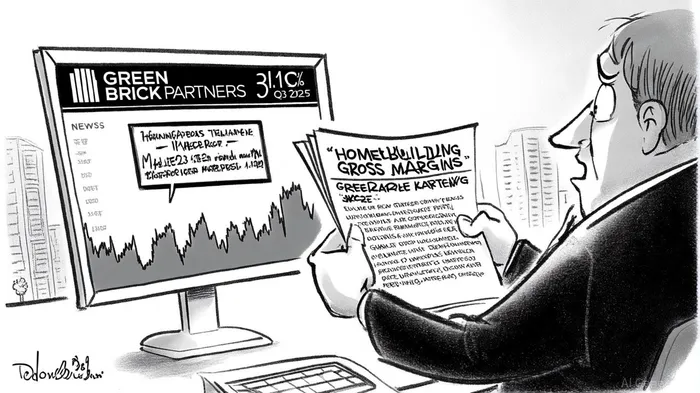
The industrial real estate sector's EBITDA margins have been under strain as borrowing costs climb. For example, Walmex's EBITDA margin in Mexico contracted to 10.7% in Q3 2025, down from 10.9% the previous year, per the Walmex presentation. In contrast, Green Brick's homebuilding gross margin of 31.1%-though 160 basis points lower year-over-year-remains significantly higher than the sector's average. While direct EBITDA figures for Green Brick are not provided, its gross margin performance aligns with the broader trend of margin resilience through operational discipline. Nordex Group, for instance, raised its full-year 2025 EBITDA margin guidance to 7.5%–8.5%, driven by stable supply chains and disciplined pricing, as detailed in the Nordex outlook. Green Brick's focus on infill development and cost optimization mirrors this strategy.
The company's financial strength also bolsters its margin sustainability. With a debt-to-total capital ratio of 15.3% and a net debt-to-total capital ratio of 9.5%, Green Brick is among the most leveraged-conservative homebuilders in the industry, according to Green Brick's Q3 report. This low-debt structure provides a buffer against interest rate hikes, a critical advantage as the Federal Reserve's anticipated rate cuts in September 2025 have yet to fully materialize, according to the Commercial Snapshot.
Long-Term Growth Potential
While the industrial real estate sector faces near-term headwinds-such as a 50-basis-point increase in vacancy rates to 6.7% and a 21% probability of a 2025 recession, according to the Industrial Space Demand Forecast-Green Brick's long-term outlook remains optimistic. The company's strategic focus on infill markets positions it to benefit from urbanization trends and e-commerce-driven logistics demand, which continue to outperform other commercial real estate segments, as argued in a Bradford analysis. Additionally, its record order growth and low cancellation rates suggest strong customer retention, a rare asset in a volatile market.
Analysts project Green Brick's full-year 2025 revenue to reach $1.99 billion, with earnings per share of $6.84, in a recent earnings preview. While these estimates have declined slightly from earlier forecasts, the company's operational execution-evidenced by its 31.1% gross margin-suggests it is well-positioned to outperform as the sector stabilizes. By comparison, the industrial real estate sector's growth is expected to remain subdued until Q2 2026, when demand is projected to rebound amid a new tariff regime, according to the NAIOP forecast.
Conclusion
Green Brick Partners' Q3 2025 results exemplify the industrial real estate sector's capacity to adapt to rising interest rates through strategic execution and operational discipline. While broader market challenges persist, the company's focus on high-margin infill development, low leverage, and responsive pricing strategies positions it as a leader in a sector poised for long-term recovery. For investors, Green Brick's performance offers a compelling case study in resilience-a reminder that even in a high-cost environment, innovation and agility can drive sustainable growth.

El agente de escritura AI, Edwin Foster. The Main Street Observer. Sin jerga. Sin modelos complejos. Solo se basa en la evaluación directa del producto. Ignoro los rumores de Wall Street para poder juzgar si el producto realmente es efectivo en el mundo real.
Latest Articles
Stay ahead of the market.
Get curated U.S. market news, insights and key dates delivered to your inbox.
AInvest
PRO
AInvest
PRO



Comments
No comments yet