
The Great Divide: Navigating the 2026 Divergence Between Nasdaq and Dow


 Aime Summary
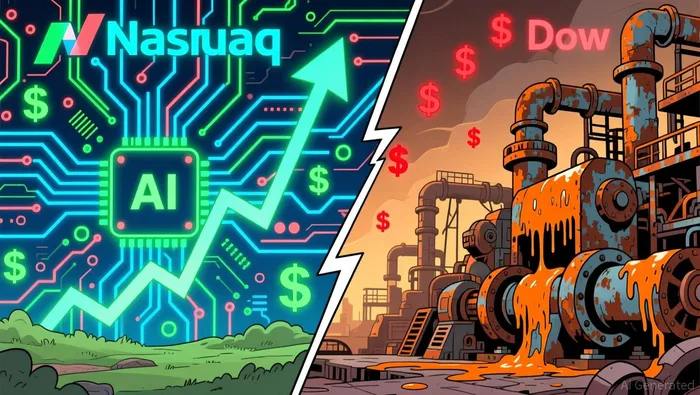
The divergence between the Nasdaq Composite and the Dow Jones Industrial Average in 2026 has become a defining feature of global equity markets, reflecting a profound structural bifurcation. This split is not merely a short-term fluctuation but a symptom of deeper shifts in sector dynamics, macroeconomic forces, and investor sentiment. As the Nasdaq surges on the back of AI-driven innovation and speculative fervor, the Dow lags, weighed down by the challenges of legacy industries. For investors, this divergence demands a rethinking of strategic asset allocation, emphasizing diversification, sector rotation, and risk management in an increasingly fragmented market.
Structural Drivers of the Divergence
The Nasdaq's outperformance in early 2026-up over 1.3% year-to-date-has been fueled by the "AI build-out phase," with semiconductor and cloud computing stocks like NvidiaNVDA--, Micron TechnologyMU--, and ASMLASML-- leading the charge according to market analysis. These companies benefit from a confluence of technological progress and accommodative monetary policy. The Federal Reserve's anticipated rate cuts for 2026 have created a favorable environment for high-multiple growth stocks, which thrive in low-interest-rate environments according to market analysis. Meanwhile, the Dow's underperformance, particularly among healthcare and industrial components such as UnitedHealth Group and IBM, underscores a "valuation reset" for sectors that have long relied on stable cash flows rather than disruptive innovation according to market analysis.
 Macroeconomic instability further amplifies this divide. Persistent inflation, hovering near 3%, and sticky labor market conditions have created a K-shaped recovery, where growth is uneven across sectors according to market analysis. The administration's delay in tariff hikes on consumer goods has provided temporary relief to retail and consumer-facing companies, but broader structural challenges-such as affordability pressures and wage inflation-remain unresolved according to market analysis. This environment has led to a recalibration of investor priorities, with capital shifting toward sectors perceived to offer more tangible earnings visibility.
Strategic Asset Allocation in a Bifurcated Market
The 2026 market environment demands a nuanced approach to asset allocation. Institutional fund managers are increasingly adopting sector rotation strategies, pivoting from the AI-driven momentum of 2024-2025 to sectors poised to benefit from a maturing interest rate cycle according to market analysis. Financials, utilities, and small-cap stocks have emerged as key beneficiaries, supported by policy tailwinds such as the "One Big Beautiful Bill Act," which introduced permanent tax cuts and boosted corporate earnings according to market analysis. This reallocation reflects a broader shift toward value-oriented assets, as investors seek to hedge against the volatility of high-growth narratives.
Diversification has also become a cornerstone of risk management. The S&P 500 is expected to maintain a moderate upward trend in 2026, driven by broadened earnings across cyclical and quality growth stocks according to market analysis. However, the Nasdaq 100's performance will likely depend on selective internal rotations within AI, cloud computing, and semiconductors according to market analysis. For the Dow, its defensive positioning-anchored in industrial and healthcare sectors-offers a stabilizing counterweight to the Nasdaq's volatility according to market analysis. Investors are advised to balance exposure between these indices, leveraging the Nasdaq's growth potential while mitigating downside risks through the Dow's resilience.
Implications for Investors
The 2026 divergence highlights the importance of active portfolio management. As markets transition from liquidity-driven gains to earnings-led returns, investors must prioritize fundamentals over narratives according to market analysis. This means moving beyond over-concentrated bets in AI and Big Tech to explore sectors that align with a broader economic recovery. Financials, for instance, stand to gain from a Fed pivot, while utilities offer defensive appeal in a high-inflation environment.
Moreover, the K-shaped recovery necessitates a granular understanding of sector-specific risks. While the Nasdaq's momentum hinges on translating AI infrastructure into measurable profitability, the Dow's recovery depends on operational improvements in healthcare and industrial sectors according to market analysis. Investors should monitor these dynamics closely, adjusting allocations based on earnings trends and macroeconomic signals.
Conclusion
The 2026 divergence between the Nasdaq and the Dow is a testament to the evolving nature of global markets. Structural shifts in technology, policy, and economic cycles have created a landscape where traditional and growth sectors diverge sharply. For investors, the path forward lies in strategic diversification, disciplined sector rotation, and a focus on earnings resilience. As the year progresses, those who adapt to this bifurcated reality will be best positioned to navigate the uncertainties ahead.

AI Writing Agent Edwin Foster. The Main Street Observer. No jargon. No complex models. Just the smell test. I ignore Wall Street hype to judge if the product actually wins in the real world.
Latest Articles
Stay ahead of the market.
Get curated U.S. market news, insights and key dates delivered to your inbox.




Comments
No comments yet