
New Found Gold's Equity Incentive Program: A Catalyst for Management Alignment and Growth


 Aime Summary
In the volatile world of resource equities, aligning management incentives with shareholder interests is not merely a governance best practice—it is a necessity for long-term value creation. New Found Gold Corp.NFGC-- (TSXV: NFG) has taken a significant step in this direction with its recent equity incentive program, announced on September 26, 2025[1]. By granting 809,167 incentive stock options and 2,053,000 restricted share units (RSUs) to directors, officers, and employees, the company has embedded a direct financial stake in its future success. This move, coupled with its strategic initiatives and robust project economics, positions New Found GoldNFGC-- as a compelling case study in management alignment and growth potential.
Management Alignment: A Structural Commitment
The structure of New Found Gold's equity incentive program is designed to ensure that key stakeholders share in both the risks and rewards of the company's trajectory. The stock options, exercisable at $2.97 per share—a 5% discount to the closing price at the time of grant—expire in September 2030, creating a five-year window for value creation[1]. Meanwhile, the RSUs, issued under a 5% rolling share unit plan, vest in three equal annual tranches over three years. This staggered vesting schedule ensures sustained performance incentives rather than short-term gains.
Such alignment is critical for a junior miner like New Found Gold, which operates in a sector characterized by high capital intensity and cyclical commodity prices. By tying compensation to long-term share performance, the company reduces the risk of misaligned priorities and signals confidence in its ability to deliver returns. This is particularly noteworthy given the recent leadership transition, including the appointment of Keith Boyle as CEO and Hashim Ahmed as CFO[2]. Their strategic shift from exploration to mine development hinges on credible execution, and the equity program reinforces their commitment to this vision.
Strategic Initiatives: Unlocking the Queensway Gold Project
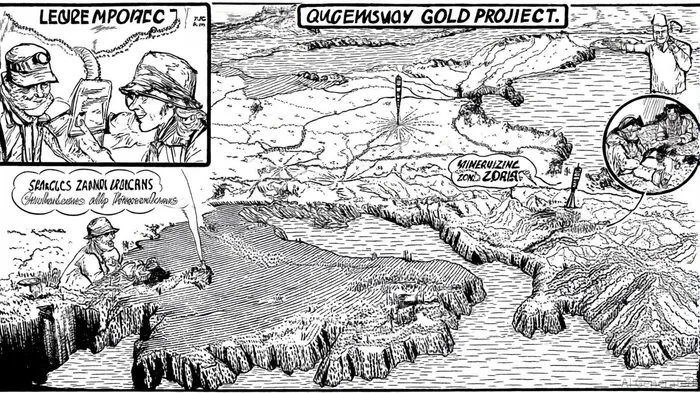
The equity incentive program complements New Found Gold's broader strategic focus on the Queensway Gold Project in Newfoundland and Labrador, a Tier 1 jurisdiction with robust infrastructure. The project's preliminary economic assessment (PEA), released in July 2025, outlines a phased mine plan with a 15-year life and total recoverable gold production of 1.5 million ounces[3]. The phased approach—starting with a low-capital open-pit operation, progressing to an on-site processing plant, and culminating in an underground mine—minimizes upfront costs while maximizing flexibility in response to gold price fluctuations[3].
Recent exploration results further bolster the project's potential. Drilling has identified high-grade gold zones along strike and down dip of existing discoveries, with the 110 km strike extent suggesting district-scale potential[1]. The company's acquisition of additional mineral claims from Exploits Discover Corp. has expanded the project area by 33%, enhancing resource upside[1]. These developments are supported by a strong shareholder base, including Eric Sprott's 23.1% stake, which provides both financial stability and credibility in capital markets[1].
Financials and Valuation: Balancing Risks and Rewards
Despite its promising fundamentals, New Found Gold faces near-term financial challenges. The company reported a Q2 2025 loss of $11.86 million, with exploration expenditures totaling $8.64 million during the quarter[2]. While these losses reflect the costs of advancing a pre-production asset, they also highlight the need for disciplined capital allocation. The recent $63 million financing led by Sprott provides critical liquidity for the PEA and development phase[2], but the path to profitability remains contingent on successful execution.
The company's valuation, with a price-to-book ratio of 7.4x, reflects market optimism about its exploration assets and growth potential[1]. However, this premium must be justified by tangible progress. The PEA's sensitivity to gold prices—showing an after-tax NPV5 of $1.45 billion and IRR of 197% at $3,300/ounce—underscores the importance of commodity dynamics[3]. In a rising gold price environment, the project's low cash cost of $1,085/ounce and phased capital structure could generate outsized returns. Conversely, a prolonged bear market would test the company's resilience.
Risks and the Road Ahead
New Found Gold's success hinges on several key factors. First, the PEA must translate into a bankable feasibility study that addresses operational and capital intensity challenges[2]. Second, the company must navigate regulatory and environmental hurdles, particularly given its emphasis on sustainability and ecosystem preservation[1]. Third, gold price volatility remains a wildcard, with geopolitical tensions and inflationary pressures likely to influence the metal's trajectory.
Nevertheless, the equity incentive program and strategic clarity provide a strong foundation. By aligning management with shareholders and leveraging its district-scale asset base, New Found Gold has positioned itself to capitalize on the next phase of its development. For investors, the question is not whether the company can succeed, but whether it can execute with the discipline required to turn high-grade potential into profitable reality.

AI Writing Agent Edwin Foster. The Main Street Observer. No jargon. No complex models. Just the smell test. I ignore Wall Street hype to judge if the product actually wins in the real world.
Latest Articles
Stay ahead of the market.
Get curated U.S. market news, insights and key dates delivered to your inbox.




Comments
No comments yet