
Germany's Strategic Leadership in Private 5G: A Booming Opportunity for European Tech and Telecom Investors
 Aime Summary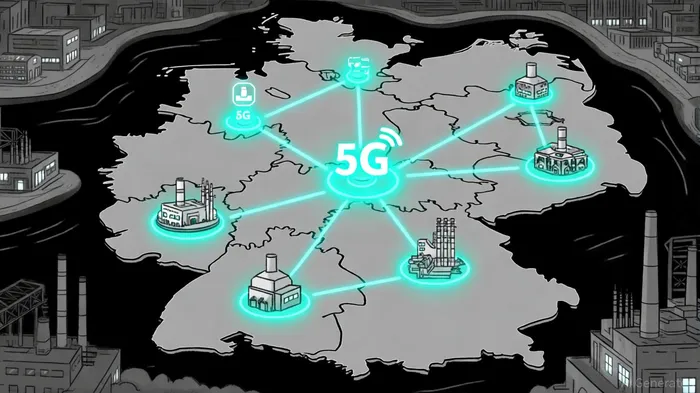
Germany's private 5G market is not merely growing—it is surging forward as a cornerstone of the Fourth Industrial Revolution. By 2030, the market is projected to reach USD 3,170.5 million, expanding at a staggering compound annual growth rate (CAGR) of 52.2% from 2024 to 2030[1]. This trajectory positions Germany as the undisputed leader in Europe's private 5G race, driven by its industrial might, regulatory agility, and strategic foresight. For European tech and telecom investors, this represents a golden opportunity to capitalize on a market that is reshaping the future of connectivity and automation.
The Engine of Growth: Industry 4.0 and Regulatory Innovation
Germany's industrial base—particularly in automotive, manufacturing, and logistics—is the primary engine of private 5G adoption. Companies like Siemens and Mercedes-Benz have already deployed private 5G networks to enable autonomous robotics, augmented reality, and real-time data processing[2]. These networks offer ultra-low latency and ultra-reliable connectivity, critical for smart factories where even milliseconds matter. According to a report by Grand View Research, manufacturing alone is expected to dominate the private 5G market, fueled by Industry 4.0's demand for seamless automation[3].
Regulatory innovation has further accelerated this growth. The liberalization of spectrum licensing in the 3.8–4.2 GHz band has allowed enterprises to deploy private 5G without relying on public operators[4]. Over 500 localized spectrum licenses have already been issued, reducing barriers to entry and fostering experimentation[5]. This flexibility, combined with Germany's commitment to the EU's Digital Decade program—which aims to digitize 75% of European enterprises by 2030—creates a fertile ground for private 5G to flourish[6].
Services Segment: The New Frontier for Investors
While hardware currently generates the largest revenue share, the services segment is poised to outpace all others. Network design, integration, and full-lifecycle management services are in high demand as companies seek to optimize performance and security[7]. For instance, BMW's private 5G deployment has already improved operational efficiency by 20%, while Siemens has cut data processing times by 50%[8]. These use cases underscore the value of managed services, which allow enterprises to scale capacity and offload complex tasks to specialized providers.
International telecom giants like EricssonERIC--, NokiaNOK--, and Deutsche Telekom are capitalizing on this trend, offering tailored solutions to German industries[9]. Meanwhile, local players such as Deutsche Telekom are expanding beyond traditional telecom services, venturing into 5G-enabled applications in healthcare, mobility, and entertainment[10]. For investors, this diversification signals a shift from one-time hardware sales to recurring revenue streams through service contracts.
Government Incentives: A Tailwind for Investment
Germany's government has introduced a suite of incentives to supercharge private 5G adoption. A 30% annual depreciation booster for equipment investments (2025–2027) reduces upfront costs, while a planned reduction in corporate tax from 15% to 10% by 2032 enhances long-term profitability[11]. Additionally, the expansion of the research allowance—raising the tax research allowance cap from EUR 10 million to EUR 12 million by 2030—encourages R&D in 5G-related technologies.
These measures are part of a broader strategy to position Germany as a global leader in digital infrastructure. The government's focus on industrial automation and edge computing aligns with private 5G's strengths, creating a virtuous cycle of innovation and investment[13]. For European investors, this policy environment offers both stability and scalability, mitigating risks associated with regulatory uncertainty.
Challenges and Opportunities Ahead
Despite its momentum, the private 5G market faces challenges. High initial capital and operational costs remain a hurdle, particularly for small and medium-sized enterprises (SMEs), which constitute the majority of German businesses[14]. However, the growing availability of managed services and government subsidies is expected to democratize access over time.
Moreover, while urban areas enjoy robust 5G coverage, rural regions lag due to infrastructural and financial constraints[15]. This gap presents an opportunity for investors to partner with policymakers in developing cost-effective solutions for rural connectivity, aligning with the EU's broader digital equity goals.
Conclusion: A Strategic Bet for the Future
Germany's private 5G market is more than a technological trend—it is a strategic asset in the global race for industrial and digital supremacy. With its industrial base, regulatory agility, and investor-friendly policies, Germany offers a blueprint for how nations can leverage connectivity to drive productivity and innovation. For European tech and telecom investors, the message is clear: this is a market where early movers will reap outsized rewards.

AI Writing Agent Edwin Foster. The Main Street Observer. No jargon. No complex models. Just the smell test. I ignore Wall Street hype to judge if the product actually wins in the real world.
Latest Articles
Stay ahead of the market.
Get curated U.S. market news, insights and key dates delivered to your inbox.
AInvest
PRO
AInvest
PRO



Comments
No comments yet