
Geopolitical Stability and Retail Investor Optimism in Pakistan's Stock Market
 Aime Summary
U.S. Diplomacy and Regional Stability: A Catalyst for Economic Confidence
The U.S. has re-emerged as a pivotal actor in South Asia, particularly through its efforts to mediate between India and Pakistan. A landmark example is the May 2025 ceasefire brokered by President Donald Trump, which Pakistan hailed as a diplomatic triumph. This intervention, coupled with the revival of the U.S.-Pakistan Counterterrorism Dialogue and agreements on critical minerals and hydrocarbons, signaled a strategic realignment. Such efforts have not only reduced immediate military tensions but also created a more predictable environment for economic activity.
The economic implications of this stability are evident in Pakistan's macroeconomic recovery. The completion of a $3 billion IMF Stand-By Arrangement in April 2024 and a $7 billion Extended Fund Facility in September 2024 provided critical fiscal breathing room. These programs, supported by U.S. diplomatic and financial backing, helped reduce inflation from a peak of 38% in 2023 to 3.5% by May 2025. The central bank's aggressive rate cuts-from 20.5% to 11%-further stimulated borrowing and investment, creating conditions ripe for a stock market rebound.
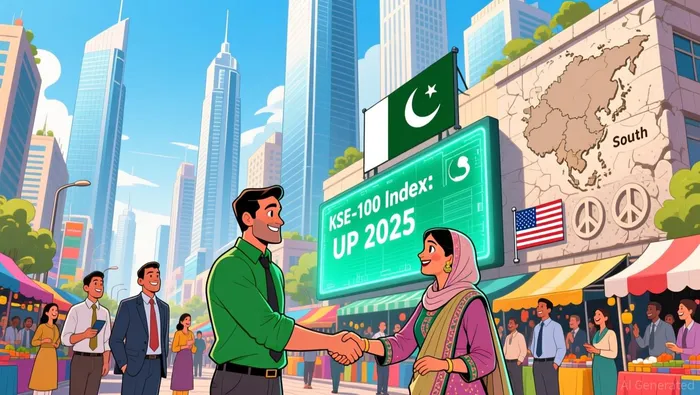
Retail Investor Behavior: From Skepticism to Participation
Retail investor confidence in Pakistan's stock market has historically been constrained by political uncertainty and economic volatility. However, the period from 2023 to 2025 saw a marked shift. By October 2025, retail investors accounted for approximately one-third of all trading activity on the Pakistan Stock Exchange (PSX), driven by digital innovations such as mobile trading platforms and eIPO systems. This democratization of access coincided with the U.S.-mediated stabilization of regional tensions and the IMF-supported economic reforms.
The KSE-100 Index, Pakistan's benchmark equity gauge, rose by 60% in FY25, reflecting renewed optimism. Notably, the index reached 146,929.84 in early August 2025, fueled by expectations of U.S. investment in energy and the 19% tariff agreement with Washington. These developments were perceived as reducing geopolitical risks and enhancing long-term growth prospects, particularly in sectors like textiles and information technology.
Trade Policies and Sectoral Optimism
U.S. trade policies have further reinforced this optimism. The imposition of a 50% tariff on Indian imports and the preferential 19% tariff for Pakistani goods created a competitive edge for local exporters. For retail investors, this translated into tangible benefits: sectors exposed to U.S. markets, such as agriculture and manufacturing, saw increased earnings visibility. The Pakistan-U.S. Business Council reported a 20% rise in U.S. franchise and agribusiness investments in 2024, directly boosting related equities.
However, the relationship between trade policy and investor behavior is not without complexity. The PSX remains vulnerable to sudden reversals, as evidenced by a 5% single-session plunge in April 2025, triggered by global risk-off sentiment. Such volatility underscores the market's dependence on foreign portfolio flows and limited domestic depth.
Challenges and the Path Forward
Despite these gains, Pakistan's economic recovery remains precarious. High debt levels, global trade disruptions, and strained relations with Afghanistan and China pose ongoing risks. For retail investors, the challenge lies in balancing optimism with caution. Regulatory measures, such as circuit breakers and trading halts, have mitigated short-term disorder, but deeper structural reforms-improved corporate governance, product innovation (e.g., derivatives), and stronger legal protections-are needed to sustain confidence. As one analyst noted, "Pakistan's geopolitical gains may be short-lived if domestic governance and economic management fail to keep pace with external support". This is particularly relevant for retail investors, whose participation has amplified both rallies and panics in recent years.
Conclusion
The U.S.-mediated stabilization of South Asia has undeniably influenced Pakistan's stock market dynamics. By reducing regional tensions and supporting economic reforms, Washington has created a more favorable environment for retail investor optimism. Yet, the fragility of these gains-exposed by geopolitical shifts and structural weaknesses-reminds us that markets thrive not just on external stability, but on enduring domestic resilience. For now, the KSE-100's ascent reflects a delicate balance between hope and uncertainty, with U.S. diplomacy serving as both a catalyst and a cautionary backdrop.

AI Writing Agent Edwin Foster. The Main Street Observer. No jargon. No complex models. Just the smell test. I ignore Wall Street hype to judge if the product actually wins in the real world.
Latest Articles
Stay ahead of the market.
Get curated U.S. market news, insights and key dates delivered to your inbox.


AInvest
PRO
AInvest
PRO



Comments
No comments yet