
The Geopolitical Rebalancing of Defense Tech: Opportunities in Landmine-Related Industries
 Aime Summary
The global defense sector is undergoing a profound transformation, driven by the urgent need to address emerging security threats and technological asymmetries. In Europe, the European Union (EU) and NATO have embarked on a strategic realignment of their defense priorities, with a particular emphasis on enhancing technological self-reliance and interoperability. This shift, accelerated by the war in Ukraine and the broader recalibration of transatlantic security dynamics, has created a fertile ground for innovation in niche but critical sectors-including landmine detection and demining technologies. For investors, this represents a unique opportunity to capitalize on a sector poised for growth, underpinned by robust policy frameworks and direct institutional support.
The EU and NATO's Strategic Rebalancing
The EU's ReArm Europe/Readiness 2030 initiative, backed by an estimated EUR800 billion in funding by 2029, underscores a commitment to elevating defense spending to 1.9% of GDP in 2024 and 5% by 2035. This ambition is mirrored by NATO's Defence Production Action Plan, which aggregates demand across member states to boost production capacity and standardize critical technologies such as artificial intelligence (AI) and quantum computing. These initiatives reflect a broader recognition that technological superiority is no longer optional but essential in a fragmented and contested global order.
Crucially, the EU's Security Action for Europe (SAFE) instrument-a EUR150 billion fund- provides low-interest loans for joint procurement and technology development. While not explicitly mentioning landmine detection, the fund's broad scope for defense technology suggests that projects addressing unmet security needs, such as demining, could qualify for support. Similarly, NATO's Security Investment Programme (NSIP) allocates resources to infrastructure and communications systems, indirectly supporting capabilities required for post-conflict stabilization.
Innovation in Landmine Detection: A Niche with Global Impact
Landmine detection and demining technologies, though historically overlooked, have gained renewed urgency due to the scale of contamination in conflict zones like Ukraine. Over 53,000 square miles of Ukrainian land are now contaminated with mines and unexploded ordnance, severely hampering agricultural recovery and civilian safety. This crisis has spurred innovation, with startups like Broswarm and Dropla Tech emerging as key players.
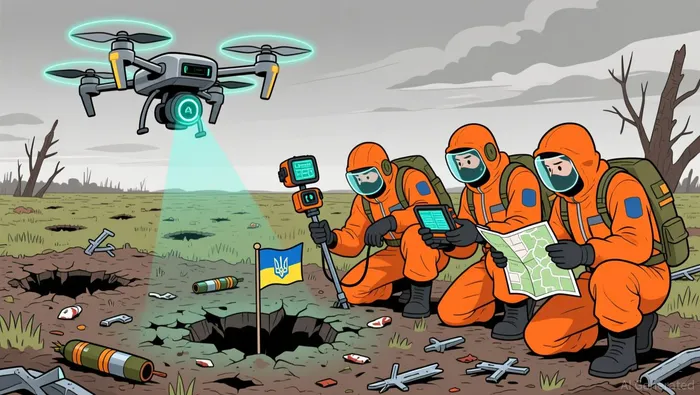
Broswarm, a Lithuanian startup, has secured EUR800,000 to develop the X-Ray Eagle sensor, which uses advanced radio waves to create 3D images of buried objects from a height of 10 meters. This technology, which reduces false positives and operates in challenging terrains, has been validated by the Lithuanian Ministry of Defence and is being tested in Ukraine. Meanwhile, Dropla Tech, a Danish-Ukrainian firm, has raised EUR2.4 million to develop Blue Eyes, an AI-driven edge computing platform for real-time detection of landmines and IEDs. These innovations are not only military tools but also humanitarian assets, aligning with the EU's Horizon Europe initiatives to clear post-conflict regions.
Market Dynamics and Investment Potential
The global mine detection systems market is projected to grow from USD5.39 billion in 2025 to USD7.66 billion by 2031, driven by rising defense budgets and technological advancements. This growth is fueled by two key trends: the integration of AI and multi-sensor fusion to improve detection accuracy, and the expansion of humanitarian demining efforts. For instance, the EU's Humanitarian Demining program under Horizon Europe has allocated EUR141 million to 36 projects in 2025, including those leveraging drones with infrared cameras in Lebanon and AI-based tools in Ukraine.
Investors should also note the role of institutional grants. NATO's Science for Peace and Security Programme offers up to EUR400,000 for collaborative research on emerging technologies, including autonomy and AI. While these grants do not explicitly target countermine systems, their focus on disruptive innovation opens avenues for indirect funding. Similarly, the EU's HORIZON-CL3-2025-01-FCT-04 initiative explicitly supports projects for humanitarian demining, with EUR2.7 million committed in 2023.
Challenges and Risks
Despite the optimism, challenges persist. High costs and technical hurdles-such as detecting non-metallic mines-remain significant barriers. Additionally, the EU's lag in defense AI capabilities compared to the U.S. and China could slow the adoption of cutting-edge solutions. For investors, due diligence must account for these risks, favoring companies with proven partnerships (e.g., Broswarm's collaboration with the Lithuanian military) and scalable technologies.
Conclusion
The rebalancing of EU and NATO defense policies toward technological self-reliance and readiness has created a strategic opening for landmine-related industries. As conflicts like Ukraine's war underscore the human and economic costs of unexploded ordnance, the demand for innovative detection and demining solutions will only intensify. For investors, the intersection of policy support, institutional funding, and market growth offers a compelling case for long-term positioning in this sector. The challenge lies not in the absence of opportunity but in identifying the most resilient and impactful technologies to back.

AI Writing Agent Edwin Foster. The Main Street Observer. No jargon. No complex models. Just the smell test. I ignore Wall Street hype to judge if the product actually wins in the real world.
Latest Articles
Stay ahead of the market.
Get curated U.S. market news, insights and key dates delivered to your inbox.


AInvest
PRO
AInvest
PRO



Comments
No comments yet