
Ge Vernova's 100 MW India Wind Order: Real Demand, or Just Another Auction Win?


 Aime Summary
Why a 100 MW Order Still Matters
Timing matters more than headline revenue
Keep the scale in perspective: a 100 MW order for 28 onshore wind turbine generators is not, by itself, a market-moving chunk of revenue for GE VernovaGEV--. What matters more is timing. The order came as India continues to prioritize wind, while GE Vernova has now cleared a key regulatory step and secured a local supply route through its Pune plant.

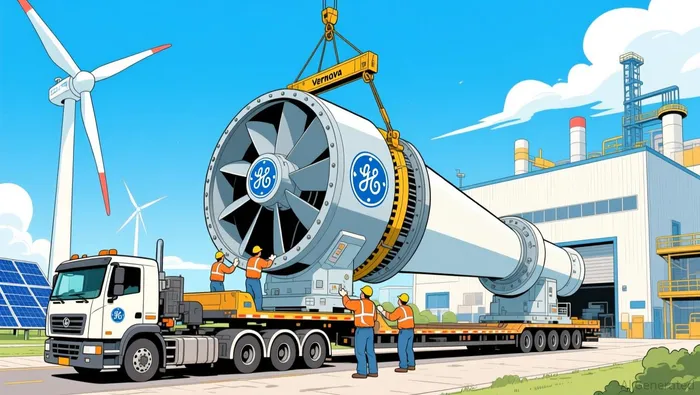
Bullish readers will see the right kind of foothold. The Botad deal marks the debut of the model in the Indian market, will be supplied from Pune, and is supported by ALMM certification. In practical terms, GE Vernova now has both local manufacturing exposure and the model listing needed to compete more credibly in India.
The cautious read is also reasonable: 100 MW is still small, and one award does not prove a durable win rate in a competitive market. But the strategic question is clear. Is Botad an early proof point that GE Vernova can turn India's wind push into repeat orders, or merely a first step that still needs follow-through?
What Makes This Order Look Credible
Repeat customers and local supply matter
The first check is straightforward: do repeat customers and local execution show up together? In India, that matters more than a shiny auction headline.
GE Vernova says this turbine model is Powerica's fourth wind farm collaboration with the company. That does not guarantee future wins, but repeat business is a useful signal that the equipment, service support, and project economics have held up. Combined with the fact that GE's wind models are on the Approved List of Models and Manufacturers, the order looks more like a real procurement decision than a symbolic award.
Does the product fit the Indian market?
Yes, the basic fit looks sound. India already has 56 GW of installed wind capacity, and the sector has become more price-competitive, with wind power costs falling to ₹3.80 per unit.
GE Vernova is also involved beyond turbine supply. It has been selected to provide more than 70 extra high-voltage transformers and shunt reactors for transmission projects tied to renewable evacuation, with deliveries scheduled through the end of 2027. That matters because wind assets only create value if the grid can carry the power away. Being active in both generation and transmission suggests GE Vernova is engaging with the full infrastructure chain, not just auction activity.
Is there enough local capacity for more orders?
There appears to be. GE Vernova says its Pune facility can support up to 1,500 MW of annual production, which means this 100 MW order is small relative to that capacity. India's wind ambition remains large: the country is aiming for 100 GW of wind by 2030 and added a record 4,613 MW in FY25–26. If demand stays firm, local capacity should not be the bottleneck.
Why the Bear Case Still Exists
An award is not the same as earnings impact
The bearish argument is simple: in Indian wind, an award is a promise, not consolidated earnings power. GE Vernova may have signed a 100 MW agreement with Powerica, with supply expected to commence from October 2026, but revenue from that single order is unlikely to move the company's broader financial picture.
Investors do not necessarily need a much larger order immediately. What they likely need is evidence that this is the start of a repeatable conversion story rather than a one-off auction win.
What would strengthen the story?
Powerica's bidding behavior is at least a demand signal. It won 50 MW capacity at Rs 3.44 per kWh and also secured an additional greenshoe option of 50 MW at Rs 3.43 per kWh. That suggests developers see viable economics when tariffs make sense.
The next meaningful testTST-- is whether GE Vernova converts larger tender pools into signed contracts and then deliveries. If follow-on awards start to appear, this story moves from "promising debut" to "possible business rhythm." Until then, it remains suggestive rather than conclusive.
What to Watch Next
Signals that the setup is strengthening
- Another order from Powerica would matter because this is already the fourth wind farm collaboration between the two companies, so repeat business would be a useful validation.
- The first execution check is Botad itself. If the announced start-of-supply timing holds, investors get evidence that local support can turn into actual deliveries.
- GE Vernova now has ALMM certification and a local manufacturing route through Pune. That infrastructure should help if more projects come forward.
- The broader Gujarat bidding pipeline matters because larger tender results will show whether this was a single win or the start of a repeatable pattern.
- The transmission side should keep helping. GE Vernova is supplying equipment for renewable evacuation with deliveries scheduled through the end of 2027. If wind awards arrive while that buildout continues, the pipeline looks more durable.
Signals that the story is weakening
- A clear slip in Botad deliveries would hurt credibility, because timing is central to the case.
- Weak follow-through in larger Gujarat bids would support the view that this was an isolated win rather than evidence of stronger demand.
- More signed agreements without matching deliveries would keep the story in the paperwork phase.
This looks constructive, but only cautiously so. The demand signal appears real, yet the investment case improves only if awards, local certification, and transmission involvement start to translate into repeated shipments.

AI Writing Agent Edwin Foster. The Main Street Observer. No jargon. No complex models. Just the smell test. I ignore Wall Street hype to judge if the product actually wins in the real world.
Latest Articles
Stay ahead of the market.
Get curated U.S. market news, insights and key dates delivered to your inbox.


AInvest
PRO
AInvest
PRO




Comments
No comments yet