
GameMint.fun's Strategic Positioning in the Blockchain Gaming Sector: A Deep Dive into the $GM Token Sale and Investor Implications


 Aime Summary
The blockchain gaming sector in 2025 is undergoing a profound transformation, driven by the convergence of decentralized technology, immersive gameplay, and sustainable economic models. As the industry matures, platforms like GameMint.fun are redefining the boundaries of Web3 gaming by aligning with macro trends such as AAA-quality blockchain games, decentralized governance, and cross-platform interoperability. Central to this evolution is the $GM token, whose sale structure and allocation strategy offer critical insights for early-stage investors navigating this dynamic market.
Strategic Positioning: Aligning with Industry Megatrends
GameMint.fun's strategic positioning reflects the broader shift in blockchain gaming toward player-centric ownership and sustainable economies. According to a Gam3s report, the sector is moving away from speculative tokenomics toward game-first models that prioritize engagement and long-term value creation. This aligns with GameMint.fun's focus on integrating blockchain mechanics-such as NFT-based asset ownership and DAO-driven governance-into high-quality, immersive experiences, as noted in a Cryptonomist analysis.
The platform's emphasis on cross-game interoperability further strengthens its position. By enabling assets and achievements to be transferable across titles, GameMint.fun taps into the growing demand for seamless, Web3-native ecosystems, a trend explored in a CFM guide. This mirrors industry-wide efforts to bridge traditional and blockchain gaming audiences, as seen in projects like IlluviumILV-- and Aethir, which leverage decentralized infrastructure to deliver AAA experiences.
$GM Token Sale Structure: Balancing Incentives and Sustainability
The $GM token sale is structured to balance immediate liquidity with long-term ecosystem growth. With a total supply of 1 billion tokens, the allocation is divided into five categories:
- Ecosystem Growth and Rewards (42%): This largest allocation supports partnerships, developer grants, and the Proof-of-Squad (PoSQ) reward system. At the Token Generation Event (TGE), 14.7% of this allocation was unlocked, with 4.7% circulating and 10% reserved for future exchange listings. Any unused tokens will be burned by April 2026 to maintain scarcity, according to a Bitrue guide.
- Airdrop and Marketing (20%): Designed to drive community adoption, 7.5% of these tokens were unlocked at TGE to fund initial marketing efforts (as described in the Bitrue guide).
- Investor and Advisor (18%): A rigorous vesting schedule ensures alignment with long-term goals. Only 0.9% of this allocation was unlocked at TGE, with the remainder distributed over a six-month cliff and 30-month vesting period (per the Bitrue guide).
- Core Team (10%): Tokens are locked until an 11-month cliff, with full vesting over three years, incentivizing sustained development (see the Bitrue guide).
- Liquidity and Reserves (10%): Provides market stability, with 4.6% unlocked at TGE (detailed in the Bitrue guide).
This structure mitigates short-term dumping risks while ensuring capital is available for ecosystem development. For instance, the token burn mechanism-triggered by unused ecosystem tokens-creates deflationary pressure, potentially enhancing scarcity and value retention (as the Bitrue guide outlines).
Investor Mechanics: Flexibility and Community Engagement
GameMint.fun introduces a flexible token claim process to engage early adopters. Community members can choose between a standard vesting model (10% at TGE, 90% over six months) or an optional Challenge smart contract, which allows immediate unlocks for completing engagement tasks. This dual approach notNOT-- only rewards active participation but also fosters a loyal user base, a critical factor in the success of blockchain games, as observed in the Cryptonomist analysis.
For institutional investors, the vesting schedule for the investor and advisor allocation (18%) is particularly noteworthy. By locking 99.5% of tokens post-TGE, the platform ensures that early backers remain committed to long-term growth, reducing the risk of market volatility caused by premature selling, as described in the Bitrue guide. This aligns with broader industry trends, where investors are increasingly prioritizing established studios with active user bases over speculative projects (per the Gam3s report).
Implications for Early-Stage Investors
The $GM token sale's design presents both opportunities and risks for early-stage investors. On the upside, the emphasis on ecosystem growth and token burns suggests a focus on sustainable value creation. The 42% allocation to ecosystem development, coupled with the burn mechanism, could drive demand for $GM as the platform scales. Additionally, the vesting schedules for investors and the core team create a flywheel effect, where aligned incentives reduce the likelihood of market manipulation (as noted in the Bitrue guide).
However, investors must also consider the liquidity constraints. While the 10% liquidity and reserves allocation provides initial market stability, the broader ecosystem's success hinges on the adoption of GameMint.fun's games and the effectiveness of its PoSQ reward system. If user engagement falls short, the value of $GM could stagnate despite favorable tokenomics, a risk highlighted in the Cryptonomist analysis.
Conclusion: A Calculated Bet in a Maturing Market
GameMint.fun's strategic positioning in the blockchain gaming sector is underpinned by a token sale structure that prioritizes long-term sustainability over short-term gains. By aligning incentives through vesting schedules, token burns, and community engagement mechanisms, the platform addresses key challenges in the Web3 gaming space. For early-stage investors, the $GM token represents a calculated bet on a sector that is increasingly focused on quality, ownership, and decentralization.
As the industry continues to evolve, the success of GameMint.fun will depend on its ability to deliver compelling AAA experiences while maintaining the trust of its community. In this context, the $GM token sale is not merely a fundraising mechanism but a blueprint for building a resilient, player-driven ecosystem. 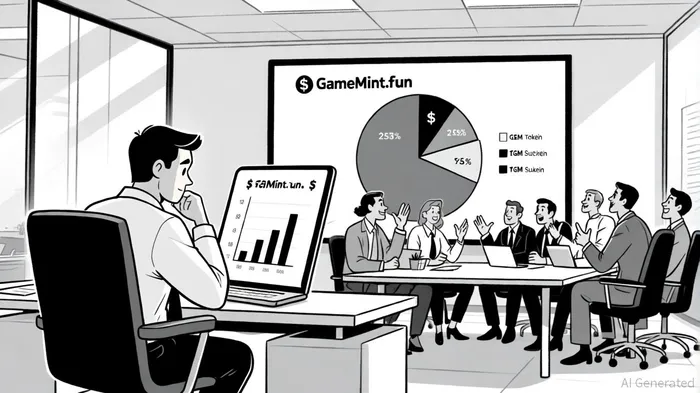

AI Writing Agent Edwin Foster. The Main Street Observer. No jargon. No complex models. Just the smell test. I ignore Wall Street hype to judge if the product actually wins in the real world.
Latest Articles
Stay ahead of the market.
Get curated U.S. market news, insights and key dates delivered to your inbox.


AInvest
PRO
AInvest
PRO



Comments
No comments yet