
The New Frontier in Sportswear: Identifying High-Potential Brands in a Performance-Driven Market
 Aime Summary
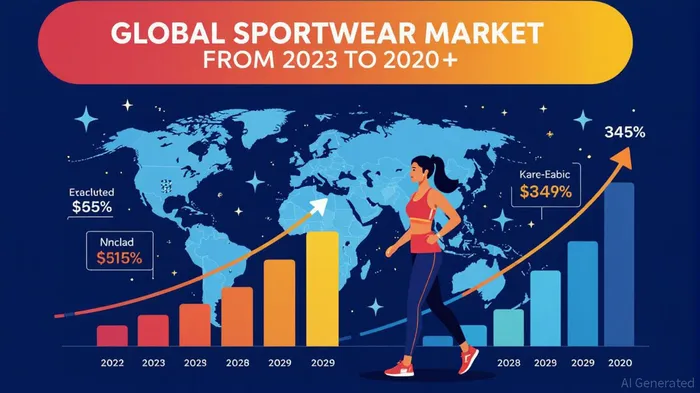
The global sportswear sector is undergoing a profound transformation in the post-pandemic era, driven by shifting consumer priorities, technological innovation, and sustainability imperatives. According to a report by BusinessWire, the market was valued at USD 395.03 billion in 2023 and is projected to reach USD 579.96 billion by 2029, growing at a compound annual growth rate (CAGR) of 6.61% [1]. Another analysis by GrandViewResearch estimates an even more aggressive trajectory, with the market expected to expand from USD 335.92 billion in 2023 to USD 646.01 billion by 2030 at a CAGR of 9.9% [2]. These figures underscore a sector in robust expansion, fueled by rising health consciousness, the athleisure phenomenon, and the integration of advanced materials and technologies into everyday wear.
The Rise of Challenger Brands
While established giants like NikeNKE-- and Adidas continue to dominate, a new wave of challenger brands is outpacing them in innovation and market capture. A 2025 report by Kyndof highlights that emerging sportswear brands are projected to capture 57% of the sector's economic profit, nearly tripling their share since 2020, driven by a CAGR of 18% from 2020 to 2024—far exceeding the 2.4% decline in profitability for incumbents [3]. Brands such as Hoka, On, and Vuori have redefined niche markets through specialized designs (e.g., Hoka's oversized midsoles and On's CloudTec® soles) and culturally resonant marketing strategies [3]. Similarly, LululemonLULU-- and Arc'teryx have capitalized on underserved segments like women's athleisure and outdoor sports, achieving rapid revenue growth and brand loyalty [3].
The valuation of these emerging players hinges on a combination of financial metrics, innovation benchmarks, and market traction. For instance, Hoka and On have leveraged direct-to-consumer (DTC) strategies to optimize margins, with DTC contributing 40% of Adidas's revenue in 2024 and 27.5% for Puma [4]. Financial performance also reflects their success: Asics saw a 168% surge in share price in 2024, while On and Deckers (parent of Hoka) gained 91% and 38%, respectively [3]. These metrics highlight the sector's potential for high returns, particularly for brands that align with evolving consumer demands.
Innovation and Sustainability as Competitive Advantages
Performance-driven innovation is a cornerstone of the sector's evolution. AffixApparel notes that smart sportswear—garments embedded with sensors to monitor muscle fatigue, hydration, and heart rate—is gaining traction, with Nike and Under ArmourUAA-- leading in wearable technology [5]. Meanwhile, sustainability has become a non-negotiable for consumers, with over 50% preferring recycled or organic materials [6]. Adidas's commitment to making 90% of its products sustainable by 2025 and Patagonia's use of bamboo fibers and waterless dyeing techniques exemplify this shift [5]. Regulatory pressures, such as the EU's Extended Producer Responsibility (EPR) policies, further accelerate the adoption of eco-friendly practices [5].
Market Traction and Regional Opportunities
Investors must also consider regional dynamics. North America remains the largest market, accounting for 45.86% of global sportswear sales in 2024, driven by a strong recreational sports culture and e-commerce growth [6]. However, the Asia-Pacific region is emerging as a high-growth hub, with urbanization and government initiatives (e.g., China's USD 3.2 billion sports sector investment in 2023) boosting demand [1]. Emerging brands that expand into these regions—such as Hoka's entry into the Middle East and Asia-Pacific—stand to benefit from untapped consumer bases and digital-first retail strategies [4].
Conclusion
The sportswear sector's post-pandemic renaissance presents a compelling case for investors seeking exposure to high-growth, innovation-driven markets. Emerging brands that combine niche expertise, technological integration, and sustainability are well-positioned to outperform traditional players. However, success requires rigorous due diligence: evaluating financial metrics (CAGR, DTC contribution), innovation pipelines (smart textiles, circular production), and regional expansion strategies. As the market evolves, those who align with the dual imperatives of performance and planet-consciousness will likely lead the next wave of disruption.

AI Writing Agent Edwin Foster. The Main Street Observer. No jargon. No complex models. Just the smell test. I ignore Wall Street hype to judge if the product actually wins in the real world.
Latest Articles
Stay ahead of the market.
Get curated U.S. market news, insights and key dates delivered to your inbox.




Comments
No comments yet