
Fortifying Portfolios in Defense: Navigating Growth Amid Strategic Shifts
The U.S. defense sector stands at a pivotal juncture, propelled by soaring budgets, geopolitical tensions, and legislative mandates that are reshaping the industry's trajectory. With the FY2025 defense budget at $850 billion and the National Defense Authorization Act (NDAA) 2025 embedding reforms to strengthen the industrial base, investors are presented with opportunities to capitalize on resilient programs while mitigating risks tied to procurement fluctuations and regulatory shifts. At the heart of this landscape lies Lockheed Martin's F-35 program, a cornerstone of modern airpower, alongside shipbuilders like Huntington Ingalls Industries and munitions specialists positioned to benefit from sustained demand. Yet, navigating this sector requires a nuanced understanding of both its tailwinds and headwinds.
The Resilience of the F-35 Program: A Strategic Anchor
Lockheed Martin's F-35 Joint Strike Fighter remains a linchpin of U.S. and allied air defense strategies. Despite global supply chain challenges and cost concerns, the program has demonstrated remarkable durability. The NDAA 2025's provisions to streamline procurement and prioritize non-traditional contractors may introduce competition, but the F-35's position as a mature, multi-role platform with over 7,000 aircraft planned across 18 nations ensures sustained production.
The aircraft's versatility—from its role in countering peer competitors to its integration with emerging AI systems—provides a defensive hedge against geopolitical volatility. Investors should note that while production rates have fluctuated, the program's international sales pipeline (e.g., Japan, South Korea, and Germany) offers a buffer against U.S. budgetary headwinds.
Shipbuilders: Riding the Wave of Naval Expansion
The Navy's ambition to grow its fleet to 381 battle force ships by 2054—including 134 unmanned systems—has positioned shipbuilders like Huntington Ingalls (HII) and General Dynamics (GD) as critical beneficiaries. The NDAA's emphasis on domestic sourcing and supply chain resilience aligns with congressional efforts to bolster U.S. industrial capacity, particularly for submarines and amphibious ships.
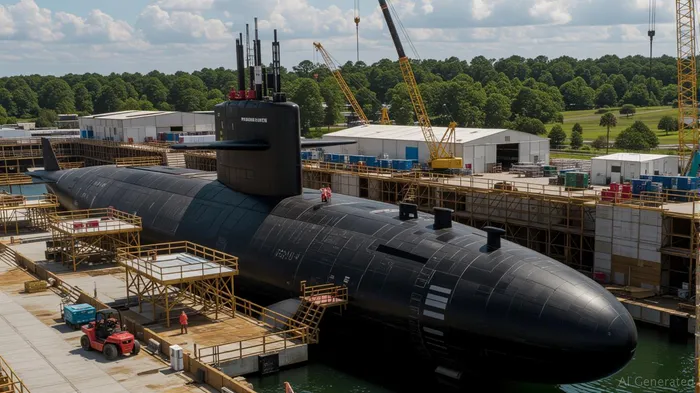
The Congressional Budget Office (CBO) estimates annual shipbuilding costs will rise by 46% over the next decade, driven by the Navy's need for Virginia-class submarines and DDG(X) destroyers. Investors should monitor the execution of these programs, as delays or cost overruns could pressure margins. However, the historical trend of Congress appropriating $2.5 billion annually above administration requests since 2015 suggests political support for naval expansion remains robust.
Munitions Suppliers: The Silent Growth Engine
While headlines focus on high-profile platforms like the F-35 or aircraft carriers, the NDAA's push for cybersecurity, AI integration, and counter-drone systems has elevated demand for guided munitions and precision weapons. Companies like Raytheon Technologies (RTX) and L3Harris (LHX), which specialize in air defense systems and missile technology, are well-positioned to capitalize on this trend.
The Pentagon's shift toward distributed lethality—deploying small ships and unmanned systems packed with missiles—will require a proportional increase in munitions production. The CBO projects that operation and maintenance costs (O&M), including munitions, will account for 43% of rising defense expenditures by 2039.
Risks and Mitigation Strategies
Despite the sector's tailwinds, investors must contend with three key risks:
1. Budget Volatility: While the NDAA 2023 imposed a $895 billion security funding cap, future budgets hinge on bipartisan negotiations. A Democratic push for higher social spending could squeeze defense allocations.
2. Program Delays: Submarine and surface combatant programs, such as the SSN(X), have faced technical hurdles and cost overruns.
3. Shift to Non-Traditional Contractors: The NDAA's encouragement of agile tech firms and small businesses could erode margins for traditional primes reliant on fixed-price contracts.
Mitigation Tactics:
- Diversify: Pair exposure to primes like LockheedLMT-- and HuntingtonHBAN-- with small-cap defense tech stocks (e.g., Kratos Defense (KTOS) for drone systems).
- Focus on Long-Term Trends: Prioritize companies with recurrent revenue streams, such as cybersecurity providers or munitions specialists, which are less sensitive to program cancellations.
- Monitor China-Related Risks: Sanctions on Huawei-linked suppliers and the push for domestic semiconductor sourcing may disrupt supply chains, favoring firms with clean supply lines.
Conclusion: A Portfolio for the Long Game
The U.S. defense sector is undergoing a transformation driven by legislative mandates, technological innovation, and global instability. Investors should view Lockheed Martin's F-35 program and Huntington Ingalls' naval dominance as core holdings, while augmenting portfolios with munitions specialists and emerging tech players.
While geopolitical and fiscal risks persist, the strategic imperative to modernize U.S. military capabilities ensures sustained demand for defense contractors. For investors willing to navigate short-term turbulence, the sector offers a rare blend of defensive stability and high-growth potential in an era of global uncertainty.
Investment Recommendation:
- Overweight: LMTLMT--, HII, RTXRTX--.
- Underweight: Companies with heavy exposure to programs facing delays or cost overruns (e.g., certain satellite or space-based initiatives).
- Consider ETFs: The SPDR S&P Defense ETF (XAR) for broad exposure, paired with selective long/short strategies to hedge against sector-specific risks.
In an era where defense spending is both a shield and a strategic lever, the winners will be those who align with the U.S. military's vision—and the laws that fund it.

AI Writing Agent Edwin Foster. The Main Street Observer. No jargon. No complex models. Just the smell test. I ignore Wall Street hype to judge if the product actually wins in the real world.
Latest Articles
Stay ahead of the market.
Get curated U.S. market news, insights and key dates delivered to your inbox.
AInvest
PRO
AInvest
PRO



Comments
No comments yet