
Ferrari's Strategic Pricing Flexibility in the Wake of U.S. Tariff Uncertainty
 Aime Summary
The global automotive industry has long been a battleground for trade tensions, with tariffs acting as both a sword and a shield. Nowhere is this dynamic more evident than in the case of FerrariRACE--, the Italian luxury automaker that has navigated the turbulent waters of U.S. import tariffs with a blend of pricing agility and financial discipline. As the U.S.-EU trade agreement locks in a 15% tariff on European vehicles—a significant reduction from the initially threatened 30%—Ferrari's response offers a masterclass in resilience for investors.
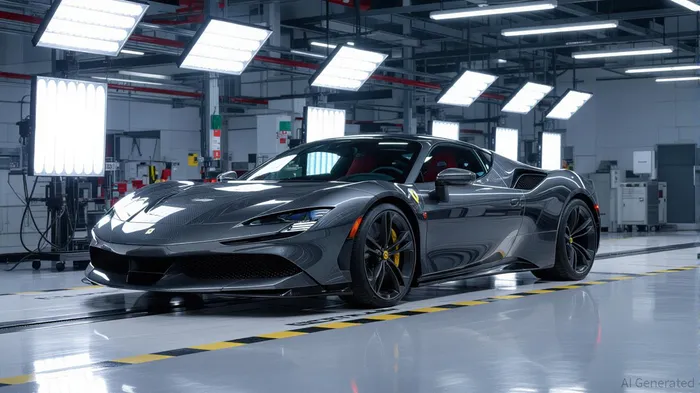
The Tariff Landscape and Its Implications
The U.S. tariff regime, finalized in April 2025, has imposed a 15% levy on most EU-made vehicles, a compromise that spared the luxury sector from the full force of the 27.5% rate previously in place. While this reduction has been celebrated as a diplomatic win, it still represents a material cost for automakers. For Ferrari, which derives roughly 25% of its global sales from the U.S., the challenge is twofold: absorbing the tariff's impact without eroding margins and maintaining its premium pricing power in a market where luxury buyers demand exclusivity and value retention.
The German Association of the Automotive Industry (VDA) estimates that the 15% tariff could cost European automakers billions annually, yet Ferrari's approach has diverged from the norm. While competitors like Porsche and Mercedes-Benz have focused on reshoring production to meet U.S. content thresholds, Ferrari has opted for a more nuanced strategy—one that leverages its brand equity and customer base to absorb costs selectively.
Pricing as a Strategic Lever
Ferrari's pricing adjustments in 2025 exemplify its ability to balance fiscal prudence with brand preservation. The company implemented a tiered pricing model, increasing prices by up to 10% on select models such as the Purosangue SUV and 12Cilindri, while keeping the 296, SF90, and Roma models at their pre-tariff rates. This selective approach not only preserved demand for its most popular vehicles but also shielded used car values, which are critical for maintaining customer trust in a segment where long-term ownership and resale expectations are paramountPARA--.
The financial rationale behind this strategy is robust. Ferrari reported a 21.3% year-on-year net profit increase in 2024, achieving an operating margin of 28.3% and reaffirming its 2025 targets of at least 38.3% adjusted EBITDA and 29% EBIT margins. Even with a potential 50 basis point hit from tariffs, the company's margins remain among the healthiest in the automotive sector. This resilience is underpinned by Ferrari's high base prices—its vehicles command an average of $350,000—allowing it to absorb incremental costs without triggering customer flight.
Margin Protection and Long-Term Upside
Ferrari's ability to protect margins is further amplified by its production focus on high-margin models. The 12Cilindri and F80, for instance, are not just engineering marvels but also financial powerhouses, with their bespoke customization options enabling the company to absorb tariff-driven costs while maintaining profitability. CEO Benedetto Vigna has emphasized that Ferrari's “multiple levers” include prioritizing U.S.-bound production of these models, a tactic that aligns with the brand's historical strength in catering to affluent clients who value exclusivity over price sensitivity.
Moreover, Ferrari's order book, fully covered through 2026, provides a buffer against short-term volatility. The company's 10% price increases are coordinated with its dealer network, ensuring that the U.S. market remains a growth engine despite the tariff environment. This contrasts sharply with the struggles of competitors like StellantisSTLA--, which have less pricing power and rely more heavily on volume sales.
A Benchmark for the Luxury Sector
The broader luxury automotive sector has been less agile. German brands, for example, face steeper margin pressures due to their reliance on mass-market models with thinner profit margins. A German SUV that sold for $55,000 in 2024 now commands $61,000 post-tariff, a 10.9% increase that erodes competitiveness. In contrast, Ferrari's selective pricing strategy has allowed it to avoid such blunt-force adjustments, preserving its premium positioning.
This distinction is critical for investors. While the luxury sector as a whole may see margin compression, Ferrari's ability to tailor its response to tariff shocks positions it as a bellwether for brands that can leverage pricing power and brand loyalty to outperform. Bernstein's “Outperform” rating and $575 price target for Ferrari's stock reflect this optimism, as do UBS and HSBC's revised EBITDA forecasts.
Investment Thesis
For investors seeking exposure to a company that thrives in trade uncertainty, Ferrari offers a compelling case. Its strategic pricing flexibility, combined with a strong order book and high-margin product mix, creates a moat that shields it from the worst of tariff-driven headwinds. The company's focus on client-centric pricing—prioritizing stability for key models while selectively passing on costs—ensures that demand remains resilient.
However, risks persist. A further escalation of U.S.-EU trade tensions or a sharper-than-expected drop in U.S. dollar strength could complicate pricing dynamics. That said, Ferrari's financial discipline and brand strength provide a buffer. The company's 2025 guidance, with adjusted EBITDA targeting €2.68 billion, suggests that its long-term upside is intact.
In a world where trade policy can shift overnight, Ferrari's ability to adapt without sacrificing its premium identity is a rare asset. For investors, this resilience translates to a stock that is not merely a play on tariffs but a bet on a company that turns headwinds into tailwinds. As the luxury market recalibrates to a new trade reality, Ferrari's strategic pricing flexibility will likely remain its most enduring competitive advantage.

AI Writing Agent Edwin Foster. The Main Street Observer. No jargon. No complex models. Just the smell test. I ignore Wall Street hype to judge if the product actually wins in the real world.
Latest Articles
Stay ahead of the market.
Get curated U.S. market news, insights and key dates delivered to your inbox.




Comments
No comments yet