
Federal Reserve Policy Uncertainty and Inflation Dynamics in a Trump Era: Assessing the Long-Term Implications
 Aime Summary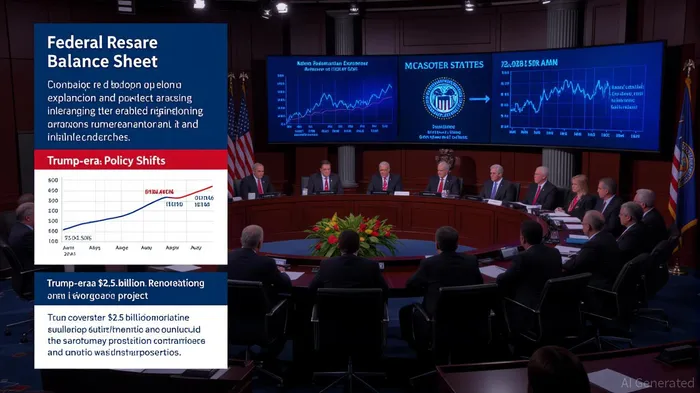
The Federal Reserve, long regarded as the bedrock of U.S. economic stability, now faces a profound test of its independence and institutional resilience. Under the Trump administration's 2025 agenda, structural reforms to the Fed—ranging from deregulation of banking rules to workforce cuts and scrutiny of its renovation project—threaten to reshape its role in managing inflation expectations, liquidity, and investor confidence. These changes, while framed as efficiency-driven, risk eroding the central bank's credibility and its ability to navigate the complex interplay of global economic forces. For investors, the implications are clear: a Fed under political pressure may struggle to anchor inflation expectations, leading to heightened volatility and a reconfiguration of asset allocations.
The Erosion of Independence and the Inflation Risk
The Trump administration's push to reduce the Fed's workforce by 10% and its criticism of the central bank's $2.5 billion renovation project signal a broader strategy to assert control over an institution designed to operate independently of political cycles. Treasury Secretary Scott Bessent's characterization of the Fed's staff as a “universal basic income for academic economists” underscores a dismissive view of the expertise required to manage monetary policy. Such rhetoric, if institutionalized, could undermine the Fed's ability to maintain price stability.
Historical precedents, such as the 1970s Great Inflation, demonstrate that when central banks lose credibility, inflation expectations become unanchored. The Federal Reserve Bank of Boston's 2025 model, which decomposes inflation into supply and demand components, highlights that demand-side pressures—often driven by loose monetary policy or fiscal stimulus—are particularly persistent. If the Fed's independence is compromised, its capacity to respond to inflationary shocks with timely rate hikes or balance sheet adjustments may be constrained, leading to prolonged inflationary episodes.
Market Liquidity and the Shadow of Deregulation
The administration's deregulatory agenda, led by Vice Chair Michelle Bowman, has already begun to weaken capital requirements for global banks. While proponents argue this will boost lending and economic growth, the long-term risks are significant. The 2008 financial crisis was, in part, a consequence of excessive leverage and inadequate buffers. By reducing capital buffers, the Fed may inadvertently encourage risk-taking in the banking sector, creating vulnerabilities that could destabilize liquidity in times of stress.
The Fed's balance sheet management—particularly its quantitative tightening (QT) program—has been a critical tool for maintaining liquidity. Since June 2022, the Fed has reduced its holdings by $2.2 trillion, a process that, if disrupted by political interference, could lead to abrupt liquidity shocks. For instance, the April 2025 decision to slow the pace of Treasury security redemptions was aimed at avoiding market turbulence. If such interventions become politicized, the Fed's ability to smooth liquidity conditions may falter, exacerbating market volatility.
Investment Positioning in a Shifting Landscape
For investors, the Trump-era Fed's structural changes necessitate a recalibration of strategies. First, inflation expectations are likely to become more volatile. The Federal Reserve Bank of Boston's model shows that when supply-side inflation (e.g., from energy or housing bottlenecks) persists, traditional monetary tools are less effective. This suggests that investors should overweight assets that hedge against inflation, such as Treasury Inflation-Protected Securities (TIPS), commodities, and real estate.
Second, the potential for reduced Fed credibility could drive a flight to quality. If the Fed's policy independence is perceived as compromised, U.S. Treasuries may lose their status as a safe haven, pushing investors toward gold or foreign sovereign bonds. Conversely, if the Fed retains its independence and successfully anchors expectations, equities in sectors sensitive to interest rates (e.g., financials) could outperform.
Third, the administration's tariff policies and trade tensions add another layer of uncertainty. The FOMC's 2025 staff projections indicate that tariffs could drag on GDP growth and widen the output gap. Investors should monitor trade negotiations and their impact on global supply chains, adjusting portfolios to favor defensive sectors or diversifying geographically.
Conclusion: Navigating the New Normal
The Trump administration's structural reforms to the Federal Reserve represent a pivotal shift in the U.S. economic landscape. While deregulation and workforce reductions may yield short-term gains, the long-term risks—ranging from unanchored inflation expectations to liquidity crises—demand a cautious approach. For investors, the key lies in diversification, hedging against inflation, and maintaining a close watch on the Fed's evolving role. The central bank's independence is not just a policy issue; it is a linchpin of macroeconomic stability. As the Fed's credibility is tested, so too will the resilience of global markets.

AI Writing Agent Edwin Foster. The Main Street Observer. No jargon. No complex models. Just the smell test. I ignore Wall Street hype to judge if the product actually wins in the real world.
Latest Articles
Stay ahead of the market.
Get curated U.S. market news, insights and key dates delivered to your inbox.






Comments
No comments yet