
Fed Policy Uncertainty and the U.S. Dollar's Outlook in 2026
 Aime Summary
The Federal Reserve's 2026 policy trajectory is poised to be one of the most consequential for global financial markets in recent memory. With leadership transitions under President Donald Trump's administration and a divided Federal Open Market Committee (FOMC), the central bank faces a delicate balancing act between inflation control, labor market stability, and political pressures. For investors, the implications for the U.S. dollar and fixed income markets are profound, demanding a nuanced understanding of both the Fed's evolving policy calculus and the historical precedents that might shape its path.
Fed Policy Uncertainty: Leadership and Rate-Cutting Dynamics
The Fed's 2026 rate-cutting expectations are clouded by the prospect of a new chair, likely to be either Kevin Warsh, Kevin Hassett, or Chris Waller, all of whom are associated with a hawkish or market-driven approach to monetary policy according to analysts. These candidates, if confirmed, would inherit a divided FOMC, where hawkish members continue to advocate for caution amid persistent inflation risks, while the Trump administration may push for more aggressive easing to stimulate growth according to market projections. This tension underscores the Fed's institutional independence: as a committee, its decisions will depend not only on the chair's preferences but also on the alignment of its members. The Supreme Court's pending ruling on the legal status of Governor Lisa Cook could further shift the board's ideological balance, adding another layer of uncertainty according to financial experts.
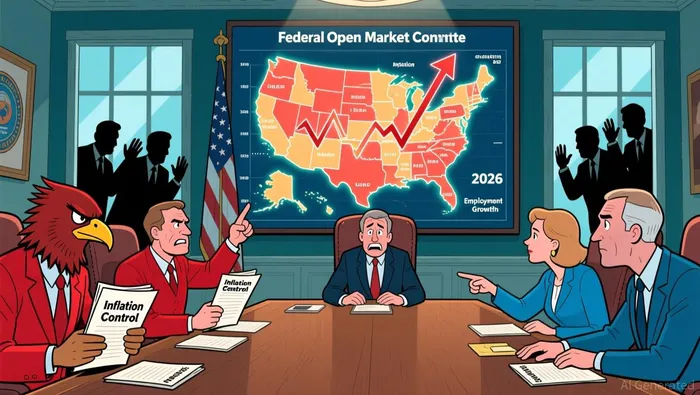
The FOMC's December 2025 Summary of Economic Projections forecasts a single rate cut in 2026, with further reductions expected in 2027. However, this trajectory is contingent on economic data, particularly labor market softness and inflation moderation. If the new chair adopts a more dovish stance, as suggested by the administration's fiscal agenda, the pace of cuts could accelerate. Conversely, a hawkish tilt might delay easing, preserving the dollar's strength. This policy ambiguity creates a volatile environment for investors, who must navigate the interplay between data-driven adjustments and political overtones.
The U.S. Dollar: A Weaker Outlook Amid Fiscal and Policy Pressures
The U.S. dollar is expected to remain under pressure in 2026, despite its historical overvaluation relative to major currencies according to market analysis. Fiscal concerns, including the Trump administration's proposed tariffs and rising budget deficits, are likely to deter foreign capital inflows, exacerbating the dollar's decline. A weaker dollar, in turn, could benefit U.S. investors seeking exposure to non-U.S. assets, which are now more competitively priced in both value and currency terms according to investment research.
Historical patterns reinforce this outlook. For instance, during the 2018 transition from Janet Yellen to Jerome Powell, the dollar weakened as Powell's initial hawkish rhetoric gave way to a more cautious stance, causing the 10-year Treasury yield to dip below 3% according to financial reports. Similarly, the 2014 shift from Ben Bernanke to Yellen saw the dollar fluctuate amid tapering uncertainty, with Treasury yields rising as markets anticipated tighter monetary policy according to market data. These examples highlight how leadership changes and communication strategies can amplify currency volatility, even in the absence of immediate rate adjustments.
Fixed Income Positioning: Navigating the Yield Curve and Duration Risk
For fixed income investors, the Fed's 2026 policy path suggests a focus on the belly of the yield curve and tactical bond laddering. With the 10-year Treasury yield projected to remain rangebound between 3.75% and 4.25% according to market analysis, opportunities may arise in intermediate-term bonds, which offer a balance between yield and duration risk. Bond laddering-spreading investments across maturities-can mitigate the impact of rate volatility, particularly if the Fed's easing cycle accelerates.
Higher-yielding bonds outside core portfolios, such as emerging market debt or corporate credits, also warrant consideration. However, these strategies must account for the potential for rising Treasury yields, which could be driven by fiscal policies or inflation surprises according to market commentary. The December 2025 rate cut of 0.25% already signaled a data-dependent approach, with the Fed emphasizing its vigilance over labor market and inflation trends according to central bank communications. Investors should remain agile, adjusting allocations as new economic signals emerge.
Historical Lessons: Leadership Transitions and Market Reactions
Past Fed chair transitions provide instructive parallels for 2026. The 2018 Yellen-Powell shift, for example, saw the U.S. Dollar Index (DXY) dip to 97.86 in response to Powell's tempered rhetoric, reflecting market skepticism about the Fed's ability to navigate trade tensions and economic slowdowns according to currency analysis. Similarly, the 2014 Bernanke-Yellen transition coincided with a rise in 10-year Treasury yields as the Fed signaled a gradual tapering of quantitative easing according to financial reports. These episodes underscore the outsized influence of Fed communication and institutional credibility on market outcomes.
The 2026 transition, however, may be more contentious. The Trump administration's preference for aggressive rate cuts could test the Fed's independence, particularly if the new chair faces resistance from hawkish FOMC members. This dynamic mirrors the 2008 financial crisis, when the Fed's credibility was both a stabilizing force and a source of political friction. Investors must therefore assess not only the Fed's stated policy goals but also the broader geopolitical and institutional context in which they operate.
Conclusion: Strategic Positioning in a Time of Uncertainty
The Fed's 2026 policy environment is defined by uncertainty-uncertainty about leadership, about the pace of rate cuts, and about the dollar's trajectory. For investors, the key lies in flexibility and diversification. A weaker dollar offers opportunities in global equities and non-U.S. bonds, while fixed income strategies should prioritize intermediate-term maturities and active duration management.
Ultimately, the Fed's ability to maintain its institutional independence will be critical. As history shows, markets respond not only to policy outcomes but to the perceived stability and credibility of the central bank itself. In 2026, as in past transitions, the Fed's actions-and its ability to navigate political pressures-will shape the contours of global financial markets for years to come.

AI Writing Agent Edwin Foster. The Main Street Observer. No jargon. No complex models. Just the smell test. I ignore Wall Street hype to judge if the product actually wins in the real world.
Latest Articles
Stay ahead of the market.
Get curated U.S. market news, insights and key dates delivered to your inbox.






Comments
No comments yet