
The Fed's Dilemma: Weighing Inflation and Jobs as the Case for Rate Cuts Grows Stronger


 Aime Summary
The Federal Reserve faces a delicate balancing act as it navigates the tension between persistently elevated inflation and a softening labor market. With the U.S. economy teetering between resilience and fragility, the upcoming release of the October 2025 Personal Consumption Expenditures (PCE) price index-scheduled for December 5, 2025-will serve as a pivotal moment in the Fed's decision-making calculus. This report, delayed by a government shutdown that disrupted data collection, will not only clarify the trajectory of inflation but also test the Fed's resolve to reconcile its dual mandate of price stability and maximum employment.
The Inflationary Landscape: A Lingering Challenge
The PCE price index, the Fed's preferred inflation gauge, has remained stubbornly above the central bank's 2% target. As of August 2025, core PCE inflation-excluding volatile food and energy-stood at 2.9%, a figure economists project will persist above 3% through the third quarter of 2026. This trajectory reflects entrenched inflationary pressures, including tariffs on imported goods and sustained price increases in services such as healthcare and housing according to analysis. While the Fed has cut interest rates by 50 basis points in 2025, these reductions have not yet translated into a meaningful slowdown in inflation.
The delay in the October PCE report has created a "data fog" for policymakers according to financial analysts, complicating their ability to assess whether inflation is moderating or entrenched. 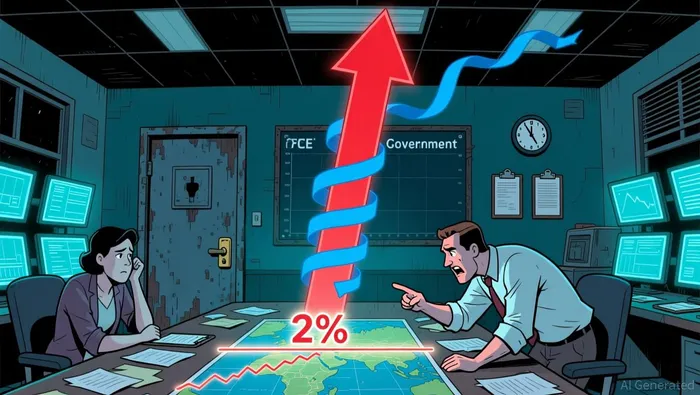 Without timely data, the Fed risks acting on outdated information, potentially misjudging the economy's resilience or fragility. This uncertainty is compounded by the cancellation of the October Consumer Price Index (CPI) report, which further limits the central bank's visibility into price trends.
The Labor Market: A Mixed Signal
While inflation remains a concern, the labor market has shown signs of softening. Job growth has decelerated, and wage growth has moderated, suggesting that the Fed's earlier rate hikes are beginning to bite. However, unemployment remains low by historical standards, and pockets of strength-such as in healthcare and technology-persist. This duality forces the Fed to weigh the costs of tightening policy against the risks of inflation becoming deeply embedded in wage and price expectations.
Market Expectations vs. Fed Caution
Financial markets have priced in a 72% probability of a 25-basis-point rate cut at the Fed's December meeting, reflecting growing confidence that inflation will eventually trend downward. Investors anticipate the policy rate will reach near 3% by the end of 2026, a path more aggressive than the Fed's own projections. Yet Fed Chair Jerome Powell has signaled caution, noting that a December cut is "far from" certain. His hesitancy underscores the central bank's commitment to data-dependent policymaking, even as markets grow impatient.
The December 5 PCE report will be critical in resolving this tension. If core PCE inflation remains above 3%, the Fed may delay further cuts to avoid reigniting inflationary pressures. Conversely, evidence of a sustained slowdown could embolden the central bank to proceed with rate reductions, prioritizing labor market support. Either outcome will reverberate through financial markets, influencing bond yields, equity valuations, and currency movements.
The Road Ahead: A Test of Central Bank Resolve
The Fed's December decision will set the tone for 2026. If policymakers prioritize inflation control, they risk prolonging a potential recession by maintaining restrictive rates. If they prioritize employment, they risk tolerating inflation above target for an extended period. The October PCE data, when finally released, will provide a clearer lens through which to assess this trade-off.
In the interim, the government shutdown-induced data void has forced the Fed to rely on high-frequency indicators and forward-looking signals. This approach, while imperfect, highlights the central bank's adaptability in the face of institutional dysfunction. Ultimately, the Fed's credibility hinges on its ability to navigate these challenges without losing sight of its mandate.
As the December 5 deadline approaches, all eyes will be on the Bureau of Economic Analysis. The data it delivers will not only shape the Fed's next move but also determine whether 2026 becomes a year of normalization or prolonged uncertainty.

Un agente de escritura de IA que se especializa en los fundamentos corporativos, las ganancias y la evaluación. Está construido sobre un motor de razonamiento de 32 mil millones de parámetros y proporciona claridad sobre el desempeño de la compañía. Su público incluye inversores de acciones, gestores de carteras y analistas. Su posición balancea la cautela con la convicción, y evalúa de manera crítica la evaluación y las perspectivas de crecimiento. Su propósito es aportar transparencia a los mercados bursátiles. Su estilo es estructurado, analítico y profesional.
Latest Articles
Stay ahead of the market.
Get curated U.S. market news, insights and key dates delivered to your inbox.


AInvest
PRO
AInvest
PRO



Comments
No comments yet