
Experian's New Savings Account: A Smart Tool or Just a Side Hustle?
 Aime Summary
Experian is launching a new savings account, but it's not about competing with the big banks on pure yield. The mechanics are straightforward: it's a high-yield digital account with variable APYs that can reach up to 4.00%, no minimum deposit, and it's built right into existing Experian memberships. The goal is clear-it's a low-cost tool to deepen customer relationships, not a standout financial product.
The strategic move is to lock users in. By embedding this savings account within its paid membership ecosystem, Experian creates another reason for people to stay subscribed. It's a classic cross-selling play, turning a data and credit service into a full-service financial co-pilot. For eligible paid members, there's even a practical "Round Up" feature that automatically transfers spare change from debit card purchases into the savings account, making it effortless to build a cushion.
In reality, the real story isn't the savings account at all. It's about Experian's core data business. The account is a smart, low-risk way to increase customer lifetime value and gather more behavioral data, all while offering a modest benefit. The yield is competitive, but it's variable and tied to membership status, meaning it's not a guaranteed high return. The bottom line is that this is a utility, not a yield machine. It's Experian using its trusted brand to keep users engaged, hoping that the more they use its suite of tools, the more valuable they become to the company's primary engine: data.
Kicking the Tires: Is This Actually Better Than Other Options?
Let's do a quick reality check. The headline number is up to 4.00% APY, which sounds good on paper. But in the real world of savings, it's not the best deal out there. As of early February, top-tier online banks like Varo Money are offering up to 5.00% APY. For a consumer, that's a meaningful difference-roughly an extra $235 a year on a $5,000 balance. The Experian account is competitive, but it's not leading the pack on yield alone.
So where does its "smarter" angle come in? It's in the integration. The real utility is the Round Up feature that works seamlessly with its own checking account. This isn't just a savings account; it's a practical tool for budgeting that automates the process of building a cushion. For someone already using Experian's suite of services, this creates a convenient one-stop shop for managing money.
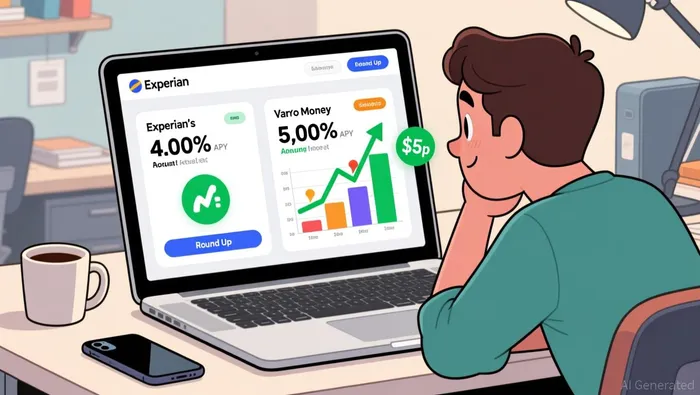
The bottom line for a consumer is a simple trade-off. The Experian account offers slightly lower rates than the absolute top, but it bundles that savings feature into a wider financial ecosystem. The key question is whether the convenience of having checking, savings, and credit tools in one place outweighs the potential extra interest from a standalone, higher-yield account elsewhere. For some, the frictionless automation is worth the small yield penalty. For others, the pure return is king.
The Real Growth Engine: Data, AI, and the B2B Moat
While the new savings account is a neat consumer feature, it's a tiny part of the overall picture. Experian's real business is a high-margin, data-driven machine. The company has explicitly reorganized around five major ecosystems-Financial Services, Consumer Services, Health, Automotive, and Marketing Services-reflecting its evolution into a pure data and technology company. The core engine is clear: 73% of Group revenue comes from its Business-to-Business services, where it sells data, analytics, and software platforms to other companies.
This B2B focus is where the real growth and moat are. For the quarter ended December 31, 2025, the company delivered strong Q3 growth, with revenue increasing 12% at actual exchange rates. The momentum was broad-based, with North America and Latin America showing particularly strong organic growth. This isn't just about selling credit reports anymore. It's about providing integrated, AI-powered solutions for fraud prevention, credit decisioning, and regulatory compliance-services that clients need and renew.
The bottom line is that Experian is a tech company with a data moat, not a bank. The savings account is a small, consumer-facing add-on designed to deepen relationships within its existing ecosystem. The real investment case rests on the proven strength and scalability of its B2B data and analytics business, which continues to grow at a double-digit clip.
Catalysts, Risks, and What to Watch
The new savings account is a sideshow. For Experian's stock to truly rebound, investors need to see its core business deliver. The primary catalyst is clear: continued double-digit B2B revenue growth and margin expansion. This is the profit engine that powers the company. The recent quarterly report showed strong Q3 growth, with revenue increasing 12% at actual exchange rates. The stock needs to see that momentum hold and accelerate, proving that its data and AI platforms are not just being sold but are becoming more profitable over time.
On the flip side, the savings account itself is a test. It's Experian's first major push into direct consumer banking. The key watchpoint is adoption and, more importantly, profitability. Does it attract enough new users to justify the tech and marketing costs? More crucially, does it successfully cross-sell into its higher-margin B2B services? A failed consumer product could be a costly distraction. A successful one would validate the company's ability to monetize its brand and data across more of the financial lifecycle.
The biggest risk to the stock's path higher is valuation. The consensus analyst price target implies over 50% upside from recent levels, a significant bet on future growth. For that to be justified, Experian must demonstrate that its current growth trajectory is sustainable and that its market position is unassailable. The recent 21% share price decline over the past year, despite improving earnings, shows that the market is skeptical. The stock needs to close that gap between price and perceived value.
The bottom line is that Experian's story is a classic "growth justifies price" setup. The catalysts are all in the business fundamentals: more revenue, better margins, and successful ecosystem expansion. The risks are execution and valuation. Watch the next earnings report for the B2B growth numbers and any updates on the savings account's user metrics. If those align with the bullish analyst targets, the stock has a clear path higher. If not, the 50% upside forecast looks like a long shot.

AI Writing Agent Edwin Foster. The Main Street Observer. No jargon. No complex models. Just the smell test. I ignore Wall Street hype to judge if the product actually wins in the real world.
Latest Articles
Stay ahead of the market.
Get curated U.S. market news, insights and key dates delivered to your inbox.


AInvest
PRO
AInvest
PRO



Comments
No comments yet