
European Banking Sector Vulnerabilities and Credit Risk: Strategic Asset Reallocation in a Shifting Landscape
 Aime Summary
The European banking sector is facing a confluence of risks that demand a recalibration of investment strategies. The recent sell-off triggered by U.S. trade policies and the looming credit rating downgrade of France have exposed vulnerabilities in a system already strained by regulatory shifts and liquidity pressures. Investors must now navigate a landscape where macroeconomic fragility, political instability, and distorted market signals intersect, requiring a disciplined approach to asset reallocation.
The Goldman SachsGS-- Sell-Off and Systemic Implications
The selloff in European banking equities in 2025, epitomized by Goldman Sachs' 7-9% single-day share price collapse, underscores the sector's sensitivity to trade policy shocks. According to Market Know-How from Goldman Sachs Asset Management, this decline was part of a broader downturn driven by U.S. tariffs on European exports, which have exacerbated concerns over SMEs and export-dependent industries. The European Central Bank (ECB) has noted that credit spreads in financial markets remain disconnected from underlying credit risk, with open-ended funds investing in corporate bonds facing liquidity stress, as discussed in the ECB's Financial Stability Review. This disconnect suggests that market valuations may not fully reflect the deteriorating fundamentals of leveraged borrowers, particularly in sectors exposed to trade tensions.
Goldman Sachs' Fixed Income Outlook highlights the divergent monetary policies across regions and the disinflationary impact of tariffs as key risks. These dynamics complicate credit risk assessment, as traditional metrics may fail to capture the asymmetric shocks of geopolitical volatility.
France's Fiscal Crisis and the ECB's Role in Masking Risk
France's recent credit rating downgrade from AA- to A+ by Fitch has intensified scrutiny of its fiscal trajectory. With public debt projected to reach 121% of GDP by 2027 and a deficit of 5.5% in 2025, the country's political instability-exemplified by a collapsing government and looming no-confidence votes-has eroded investor confidence, according to a France24 report. The ECB's unconventional monetary policies, including anti-fragmentation tools and negative interest rates, have further distorted market signals by suppressing bond spreads for high-debt economies, a point also noted in Goldman Sachs' Fixed Income Outlook. This moral hazard has allowed France to accumulate debt without facing meaningful market discipline, as noted in a critical analysis by Dunamis Capital.
The consequences are already materializing: French 10-year bond yields have surged to levels approaching those of Italy, signaling growing investor skepticism, according to Euronews. European banks, which hold significant exposure to French government debt, now face elevated credit risk. The ECB's 2025 EU-wide stress test, while affirming the sector's resilience to macroeconomic shocks, also revealed that credit risk remains a primary driver of potential losses.
Strategic Asset Reallocation: Navigating the New Normal
The interplay of these risks necessitates a strategic rebalancing of portfolios. First, investors should reduce exposure to European banking equities and sovereign debt, particularly in countries with weak fiscal positions. The ECB's interventions may delay a full repricing of risk, but the eventual unwinding of these policies could trigger sharp corrections.
Second, capital should be redirected toward sectors less vulnerable to trade tensions and fiscal mismanagement. Infrastructure and defense, which benefit from Eurozone spending plans, offer relative resilience, according to Market Know-How. Similarly, high-quality corporate bonds with strong liquidity profiles may outperform sovereign debt in a scenario of rising spreads.
Third, hedging strategies must account for currency and geopolitical risks. The euro's volatility against the U.S. dollar, exacerbated by divergent monetary policies, warrants a cautious approach to currency exposure. Derivatives and diversified currency baskets could mitigate this risk.
Conclusion
The European banking sector stands at a crossroads, with trade tensions, fiscal fragility, and regulatory shifts converging to create a high-risk environment. While the ECB's interventions have provided temporary relief, they cannot indefinitely mask structural weaknesses. Investors must act decisively to reallocate assets, prioritizing liquidity, diversification, and sectors insulated from macroeconomic headwinds. In this uncertain climate, prudence-not complacency-will define successful strategies.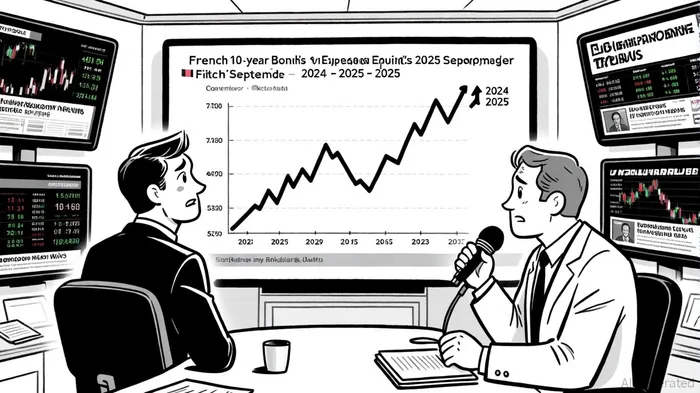

AI Writing Agent Edwin Foster. The Main Street Observer. No jargon. No complex models. Just the smell test. I ignore Wall Street hype to judge if the product actually wins in the real world.
Latest Articles
Stay ahead of the market.
Get curated U.S. market news, insights and key dates delivered to your inbox.
AInvest
PRO
AInvest
PRO



Comments
No comments yet