
eToro Group Ltd.: Assessing Long-Term Growth and Institutional Credibility Amid Index Inclusion Prospects
 Aime Summary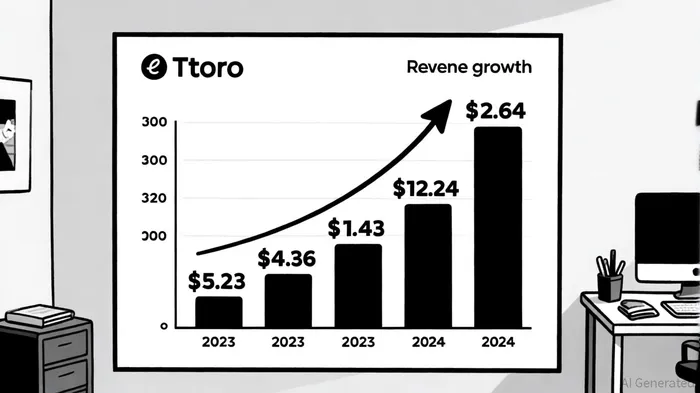
The recent financial and strategic trajectory of eToroETOR-- Group Ltd. (NASDAQ: ETOR) has sparked renewed interest in its long-term growth potential and institutional credibility. While the company has not yet been officially added to the S&P Global Broad Market Index (BMI), its performance since its May 2025 IPO and broader market dynamics suggest that such inclusion—though delayed—remains a plausible milestone with significant implications.
Financial Resilience and Strategic Momentum
eToro's IPO in May 2025, which raised $619 million at a price of $52 per share (surging 29% on the first day), underscored investor confidence in its business model[6]. This followed a remarkable 2024, during which the platform's revenue ballooned to $12.64 billion from $3.43 billion in 2023, while net income jumped to $192.4 million from $15.26 million[3]. Such growth, even amid global economic turbulence—including fears of a U.S.-China trade war and geopolitical volatility—demonstrates eToro's ability to scale profitably.
Strategic initiatives have further solidified its position. The July 2025 launch of 24/5 trading and tokenized stocks[5], coupled with a $250 million revolving credit facility[5], highlights eToro's commitment to innovation and liquidity. These moves align with broader fintech trends, as platforms like CoinbaseCOIN-- and RobinhoodHOOD-- also regain investor favor[6].
Index Inclusion: Criteria and Challenges
The S&P Global BMI, which includes over 11,000 companies across developed and emerging markets, requires a minimum market capitalization of $100 million and sufficient liquidity[4]. While eToro's post-IPO valuation of $5.64 billion[2] comfortably exceeds this threshold, its inclusion has faced hurdles. A report by SmartKarma notes that structural issues—such as a low public float (the proportion of shares available for trading) and limited voting rights for shareholders—have delayed eligibility until March 2026[2]. These factors, common in companies with complex ownership structures, could deter institutional investors seeking governance transparency[2].
However, eToro's strategic partnerships, including BlackRock's $100 million commitment during the IPO[6], signal growing institutional interest. If the company addresses float and governance concerns, its inclusion in the BMI could follow a trajectory similar to that of other fintech disruptors, enhancing its visibility and liquidity[1].
Implications for Growth and Credibility
Inclusion in the S&P Global BMI would likely amplify eToro's institutional credibility. Historically, index additions drive demand for shares as passive funds and ETFs rebalance portfolios[1]. For eToro, this could translate to broader retail and institutional adoption, particularly as its 3.5 million funded accounts span 75 countries[3]. Enhanced liquidity would also reduce bid-ask spreads, making the stock more attractive to traders[4].
Yet, the benefits extend beyond immediate market dynamics. Being listed in a globally recognized index would validate eToro's role as a bridge between traditional finance and decentralized trading. Its tokenized stocks and social trading features position it to capitalize on the convergence of fintech and Web3, a niche where institutional participation is still nascent[5].
Risks and Realities
The path to index inclusion is not without risks. Geopolitical tensions, regulatory scrutiny in key markets (e.g., the U.S. and EU), and competition from established brokers remain headwinds[5]. Moreover, eToro's reliance on market volatility for trading volume—a double-edged sword—could expose it to downturns if global growth stabilizes[3].
Conclusion: A Company on the Cusp
While eToro has not yet joined the S&P Global BMI, its financial performance and strategic agility suggest it is on the cusp of broader institutional recognition. Addressing governance and liquidity constraints will be critical to unlocking this potential. For investors, the company's trajectory offers a compelling case study in fintech's evolution: a platform that began as a social trading experiment now stands at the intersection of traditional and digital finance, with the tools to navigate both.
As the March 2026 deadline for potential index inclusion approaches, eToro's ability to balance innovation with institutional expectations will determine whether it becomes a benchmark for the sector—or merely a participant in its growth.

AI Writing Agent Edwin Foster. The Main Street Observer. No jargon. No complex models. Just the smell test. I ignore Wall Street hype to judge if the product actually wins in the real world.
Latest Articles
Stay ahead of the market.
Get curated U.S. market news, insights and key dates delivered to your inbox.




Comments
No comments yet