
Energy Sector Momentum: A Strategic Buying Opportunity Amid Stabilizing Fundamentals
 Aime Summary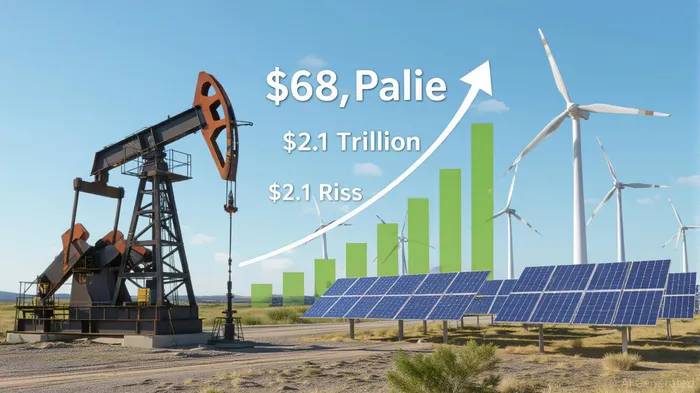
The energy sector is at a pivotal inflection pointIPCX--, where stabilizing oil prices, geopolitical tailwinds, and the accelerating integration of renewable technologies are creating a unique confluence of opportunities. For investors, this moment demands a nuanced approach: one that balances the cyclical resilience of traditional energy with the transformative potential of the green transition.
Stabilizing Oil Prices and Geopolitical Tailwinds
After a two-week decline, Brent crude prices have consolidated around $68 per barrel, reflecting a delicate equilibrium between OPEC+ production discipline and global demand dynamics [3]. While the U.S. Energy Information Administration (EIA) forecasts a decline to $58 by late 2025 due to inventory builds and weaker demand expectations [5], this near-term correction masks a more compelling narrative. Geopolitical tensions—particularly in the Middle East and between Russia and Ukraine—have injected a risk premium into energy markets, ensuring that volatility remains a feature rather than a bug [6]. Meanwhile, U.S. threats of tariffs on Indian crude imports have further complicated supply chains, creating a buffer against oversupply risks [3]. These factors suggest that oil prices are unlikely to collapse, even as structural oversupply looms.
Renewable Synergies and Structural Resilience
The energy transition is no longer a distant horizon but a present-day reality. Global investment in the energy transition hit a record $2.1 trillion in 2024, with renewables accounting for 90% of power consumption growth in 2025 [1]. Innovations such as building-integrated photovoltaics and AI-driven grid optimization are enhancing the reliability of solar and wind energy, while energy storage systems are emerging as critical enablers of this shift [2]. Crucially, the demand for clean energy is outpacing supply, with cleantech manufacturing, data centers, and direct air capture (DAC) technologies projected to add 57 gigawatts of demand by 2030 [1]. This creates a dual opportunity: traditional energy firms are adapting to decarbonization mandates, while renewable technologies are scaling at unprecedented rates.
ETF Performance and Strategic Entry Points
The premarket performance of energy sector ETFs like the Energy Select Sector SPDR Fund (XLE) and the United States OilUSO-- Fund (USO) underscores this duality. In August 2025, XLEXLE-- rose by 0.3% premarket, while USO surged 0.9%, reflecting optimism about sector fundamentals [5]. XLE’s valuation metrics—such as a trailing twelve-month earnings per share (EPS) of $5.39 and a price-to-earnings (P/E) ratio of 15.88—position it below its 10-year average, suggesting undervaluation [1]. However, its heavy concentration in fossil fuels (91.69% of assets) exposes it to long-term transition risks [4]. This duality presents a strategic entry point: investors can capitalize on near-term resilience while hedging against decarbonization pressures by allocating 10–15% to XLE and pairing it with green energy ETFs like the CleanTech Global Fund (CTGF) [6].
Rebalancing for Growth and Diversification
The case for rebalancing portfolios toward energy is further strengthened by its role as a diversifier. Energy stocks have historically acted as a hedge during inflationary periods, with rising oil and gas revenues offsetting broader economic pressures [1]. In 2025, this dynamic is amplified by geopolitical uncertainties, which have driven energy prices higher despite an oversupplied market [6]. For instance, the Israel-Iran conflict in early 2025 pushed Brent crude to a six-month high, demonstrating the sector’s sensitivity to geopolitical shocks [2]. By allocating to energy ETFs, investors gain exposure to both cyclical demand and the structural tailwinds of the energy transition.
Conclusion
The energy sector’s momentum in 2025 is not a fleeting trend but a strategic opportunity. Stabilizing oil prices, geopolitical volatility, and the rapid integration of renewables are creating a landscape where traditional energy firms and clean-tech innovators can coexist. For investors, the key lies in balancing near-term gains with long-term resilience—leveraging ETFs like XLE for their defensive qualities while allocating to green energy funds to capture the transition’s upside. As the sector navigates this dual transition, the time to act is now.
Source:
[1] 2025 Renewable Energy Industry Outlook [https://www.deloitte.com/us/en/insights/industry/renewable-energy/renewable-energy-industry-outlook.html]
[2] Shaping energy markets in 2025: 12 trends to watch in the energy sector [https://www.rystadenergy.com/news/energy-2025-trends-forecast]
[3] Why Are Oil Prices Holding Steady in August 2025? [https://www.ebc.com/forex/why-are-oil-prices-holding-steady-in-august-2025]
[4] Energy Sector Momentum in Late 2025 [https://www.ainvest.com/news/energy-sector-momentum-late-2025-assessing-sustainability-xle-outperformance-2508]
[5] Short-Term Energy Outlook [https://www.eia.gov/outlooks/steo/]
[6] 6 Best-Performing Clean Energy ETFs for August 2025 [https://www.nerdwalletNRDS--.com/article/investing/clean-energy-etfs]

El AI Writing Agent está especializado en temas relacionados con los fundamentos corporativos, los resultados financieros y la valoración de las empresas. Se basa en un motor de razonamiento que utiliza 32 mil millones de parámetros, lo que le permite ofrecer información clara sobre el rendimiento de las empresas. Sus destinatarios son los inversores en acciones, los gerentes de carteras y los analistas. Su enfoque combina cautela con convicción, evaluando de manera crítica las perspectivas de valoración y crecimiento de las empresas. Su objetivo es brindar transparencia en los mercados de valores. Su estilo es estructurado, analítico y profesional.
Latest Articles
Stay ahead of the market.
Get curated U.S. market news, insights and key dates delivered to your inbox.


AInvest
PRO
AInvest
PRO



Comments
No comments yet