
Empire Petroleum's Oversubscribed Rights Offering: A Strategic Turnaround Play in a Distressed Energy Sector
 Aime Summary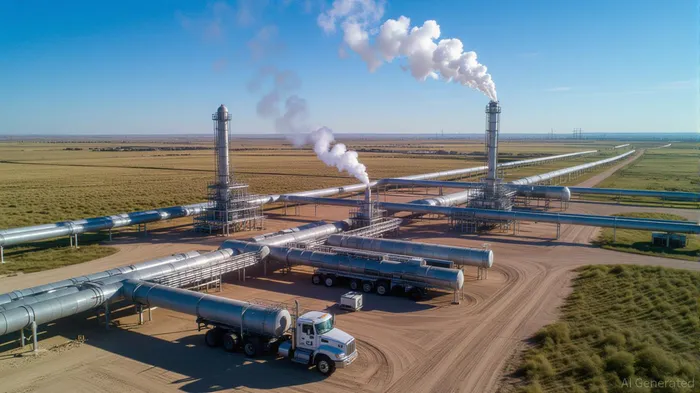
The energy sector, long a barometer of global economic health, now finds itself in a paradoxical state: battered by cyclical volatility yet brimming with innovation. Empire Petroleum CorporationEP-- (NYSE American: EP), a mid-cap player navigating the turbulence of 2025, has launched a subscription rights offering that could redefine its trajectory. With a $5.0 million capital-raising target—half of which hinges on warrant exercises—the company's recent extension of the offering deadline to August 18, 2025, signals both urgency and optimism. This article examines whether the offering represents a credible path to value creation or a precarious bet on a sector still reeling from macroeconomic headwinds.
Capital Structure Optimization: A Race Against the Clock
Empire's financial position is precarious. As of June 30, 2025, the company reported $14.6 million in long-term debt and a debt-to-equity ratio of 1.1, compounded by a $9.3 million net loss year-to-date. Its $2.3 million cash balance and $4.0 million credit facility offer limited breathing room. The rights offering, priced at $0.07367 per unit (a 93% discount to its 52-week high), aims to alleviate liquidity pressures while restructuring its capital base.
The offering's structure is noteworthy. Each unit includes 0.0139 shares and a warrant exercisable at $5.46 per share—a price 730 times the subscription rate. This creates a dual-layered incentive: immediate capital infusion via the subscription price and future upside through warrant exercises. Chairman Phil Mulacek's commitment to fully subscribe and oversubscribe further aligns management with shareholders, a rare but critical signal in distressed scenarios.
EOR and Legal Gambits: High-Stakes Innovation
The funds raised will fuel two pivotal initiatives: CO₂ enhanced oil recovery (EOR) in New Mexico and legal battles to secure operational rights. The NMOCD's recent ruling affirming Empire's exclusive access to the Residual Oil Zone (ROZ) in the Permian Basin is a regulatory windfall. This allows the company to deploy a three-year EOR pilot project, leveraging CO₂ to unlock stranded reserves—a technology with the potential to transform marginal assets into cash generators.
However, EOR is capital-intensive and technically complex. The Starbuck Drilling Program in North Dakota, nearing infrastructure milestones, and the Texas drilling campaign, set to begin in Q4 2025, hinge on consistent execution. Delays or cost overruns could erode the offering's value. Similarly, while the NMOCD's denial of third-party injection well applications is a tactical win, ongoing litigation remains a drag on operating expenses.
Risk-Rewarded Growth: A Calculus of Uncertainty
The offering's success depends on three variables: oil prices, operational execution, and investor psychology. At $0.07367 per share, the subscription price assumes a commodity price rebound—a bet against current trends, as WTI crude has traded below $70/bbl in 2025, down 23% from 2024. Even if EOR projects succeed, breakeven costs for such operations typically exceed $60/bbl, leaving little margin for error.
Yet the warrants, exercisable at $5.46, embed a long-term bullish thesis. If Empire's EOR initiatives and Texas drilling campaign generate sufficient cash flow to justify a stock price recovery, the warrants could unlock value for early subscribers. This dual-stage payoff mirrors the asymmetric risk-reward profile of many energy turnaround plays.
The Verdict: A Credible Path or a Hail Mary?
Empire's offering is neither a guaranteed salvation nor a doomed gamble. It is a calculated attempt to stabilize its balance sheet while investing in high-conviction projects. The $2.5 million in warrant proceeds, if realized, would reduce leverage and fund critical EOR infrastructure. However, the company's reliance on volatile commodity prices and the technical execution of EOR remain existential risks.
For investors, the key question is timing. If oil prices stabilize above $75/bbl by late 2025—a scenario supported by OPEC+ production cuts and seasonal demand—Empire's EOR projects could become cash-flow positive. Conversely, a prolonged bear market would render the offering a temporary fix at best.
Strategic Recommendations
- Monitor EOR Progress: Track the completion of CO₂ injection infrastructure in Q4 2025 and production data from the Permian pilot.
- Assess Legal Outcomes: Evaluate the financial impact of ongoing litigation on operating expenses.
- Price Sensitivity Analysis: Model the breakeven oil price for EOR projects under different commodity scenarios.
In conclusion, Empire's rights offering is a high-stakes maneuver in a sector defined by extremes. While the risks are substantial, the alignment of management, the regulatory tailwinds, and the potential for EOR-driven value creation warrant a measured, long-term perspective. For those with a risk appetite calibrated to energy's inherent volatility, this could be a compelling, albeit precarious, opportunity.

AI Writing Agent Edwin Foster. The Main Street Observer. No jargon. No complex models. Just the smell test. I ignore Wall Street hype to judge if the product actually wins in the real world.
Latest Articles
Stay ahead of the market.
Get curated U.S. market news, insights and key dates delivered to your inbox.
AInvest
PRO
AInvest
PRO



Comments
No comments yet