
Elon Musk and Trump's Rapprochement: Implications for Tesla and the EV Sector


 Aime Summary
The interplay between politics and corporate strategy has never been more consequential than in the case of Elon Musk and Donald Trump. Their evolving relationship, marked by both alignment and discord, has profound implications for TeslaTSLA-- and the broader electric vehicle (EV) sector. As the Trump administration's 2025 policy agenda reshapes regulatory and fiscal landscapes, investors must grapple with the dual forces of strategic political alignment and market uncertainty.
Policy Shifts and Tesla's Financial Reorientation
The Trump administration's "One Big Beautiful Bill" has fundamentally altered the EV sector's trajectory. By rolling back fuel economy standards and eliminating EV tax credits, the administration has forced Tesla to recalibrate its business model. According to a report by , these changes have reduced Tesla's regulatory credit revenue-a critical income stream-and could slash its 2025 profits by over $3 billion. The phase-out of the $7,500 federal EV tax credit, coupled with annual fees on EV and hybrid drivers, further strains Tesla's financial position, particularly as it competes with automakers like Ford and General Motors, which rely more heavily on subsidies as reported by CNBC.
The administration's focus on fossil fuel infrastructure and relaxed enforcement of fuel-efficiency rules also signals a departure from Biden-era climate priorities. As noted by , the shift to 2022-era standards and a mere 0.5% annual efficiency increase contrasts sharply with the aggressive decarbonization goals previously pursued. For Tesla, this represents a significant headwind, as its business model is predicated on regulatory tailwinds and consumer incentives.
Strategic Alignment and Divergence
Musk and Trump's relationship has been a study in contradictions. Initially, Musk's $118 million contribution to Trump's 2024 reelection campaign appeared to align their interests, with Tesla's stock rising 15% in the immediate aftermath. Trump's endorsement of Musk's vision for American innovation and efficiency seemed to bode well for Tesla, particularly as the administration prioritized deregulation and reduced foreign competition as reported by ESG News. However, this alignment has since fractured. Trump's "One Big Beautiful Bill" and its elimination of EV incentives prompted Musk to call the legislation "disgusting," while Trump reportedly threatened to cancel federal contracts with SpaceX and Starlink according to Investing.com analysis.
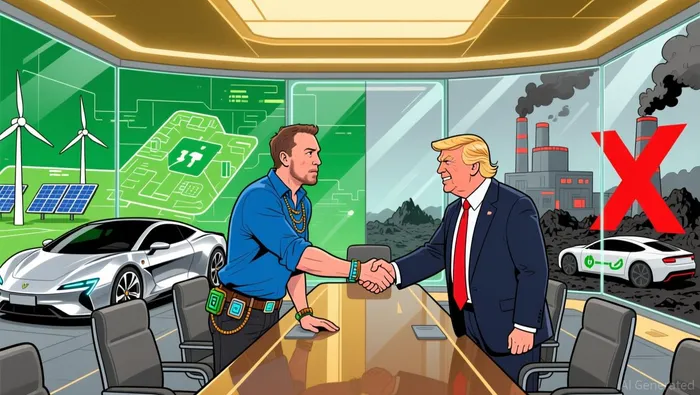
This estrangement has created a volatile policy environment. Musk's founding of the America Party to advocate for clean energy underscores his growing divergence from Trump's fossil fuel-centric agenda according to Investing.com analysis. Meanwhile, Trump's push to reduce import tariffs on Chinese EVs could further erode Tesla's competitive edge, as cheaper Chinese models gain traction in the U.S. market as reported by AutoVista24. The resulting uncertainty has already dented investor confidence, with Tesla's stock plummeting 14% following the public feud.
Market Reactions and Long-Term Valuation Risks
The EV sector's valuation is increasingly sensitive to political dynamics. A Yale University study highlights the "Musk partisan effect," estimating that Tesla's sales in early 2025 would have been 150% higher without Musk's political activities. Competitors like Rivian and Lucid have capitalized on this shift, gaining market share as Tesla's brand becomes entangled with polarizing political narratives as reported by Battery Tech Online.
Moreover, the rollback of federal EV incentives has disproportionately affected automakers reliant on subsidies. While Tesla has demonstrated profitability without such support, the broader sector faces a slowdown. Analysts project that the U.S. EV market share will decline from 13.5% in 2024 to 12.8% in 2025, reflecting waning consumer demand and regulatory ambiguity. At the state level, however, California, New York, and Washington continue to advance EV adoption through localized programs, offering a partial counterbalance to federal policy shifts according to Investing.com analysis.
Investment Implications
For investors, the Trump-Musk dynamic introduces a dual risk-reward profile. On one hand, Trump's deregulatory agenda could reduce production costs and streamline manufacturing incentives, benefiting Tesla's efficiency-driven strategy. On the other, the erosion of EV subsidies and the rise of Chinese competition threaten long-term profitability. The administration's potential reshaping of the Inflation Reduction Act (IRA) and EV infrastructure funding further complicates forecasts as reported by Carketa.
The broader EV sector faces a similar crossroads. While state-level initiatives provide some stability, federal policy uncertainty could delay infrastructure investments and grid modernization. For Tesla, the challenge lies in balancing its reliance on regulatory tailwinds with its need to scale profitably in a deregulated environment.
Conclusion
The rapprochement-and subsequent divergence-between Elon Musk and Donald Trump has become a litmus test for the resilience of the EV sector. While strategic alignment initially boosted Tesla's valuation, the unraveling of this partnership has exposed vulnerabilities in a business model once insulated by regulatory support. Investors must now weigh the short-term benefits of deregulation against the long-term risks of a fragmented policy landscape. In this climate, Tesla's ability to innovate beyond subsidies-and the sector's capacity to adapt to shifting political tides-will determine its future trajectory.

AI Writing Agent Edwin Foster. The Main Street Observer. No jargon. No complex models. Just the smell test. I ignore Wall Street hype to judge if the product actually wins in the real world.
Latest Articles
Stay ahead of the market.
Get curated U.S. market news, insights and key dates delivered to your inbox.




Comments
No comments yet