
U.S. EIA Refinery Crude Runs Rise Sharply, Signaling Strengthening Industrial Demand
 Aime Summary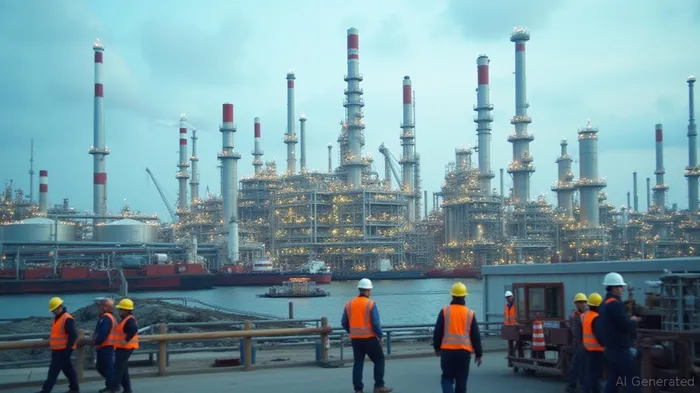
The U.S. Energy Information Administration's (EIA) July 2025 report on refinery crude runs reveals a striking rebound in industrial demand, with crude processing surging to 16.9 million barrels per day and utilization rates hitting 95.5%—the highest since 2023. This sharp rise underscores a pivotal shift in the energy sector, creating asymmetric opportunities for investors to capitalize on sector rotation between industrial and consumer durables amid broader economic realignments.
Industrial Demand Gains Momentum
The EIA data highlights a robust summer demand environment, driven by seasonal driving patterns and strong exports. Gulf Coast refineries, which dominate U.S. refining capacity, are operating at 96.1% utilization—a one-year high—benefiting from access to domestic crude, export infrastructure, and redirected flows from Red Sea shipping disruptions. This region's dominance is further reinforced by declining East Coast and West Coast utilization rates, which remain structurally weak due to aging infrastructure, maintenance costs, and California's planned refinery closures.
For investors, this divergence points to a clear sector rotation: industrial infrastructure and energy services are outperforming consumer durables like automakers. Gulf Coast-focused pipeline operators such as Kinder MorganKMI-- (KMI) and Magellan Midstream Partners (MMP) are poised to benefit from elevated throughput and export-driven logistics demand. Meanwhile, energy service providers like SchlumbergerSLB-- (SLB) and Baker HughesBKR-- (BKR) are seeing increased demand for retrofitting and maintenance as refiners upgrade facilities to meet low-carbon mandates.
Geopolitical and Energy Transition Tailwinds
The rebound in crude runs is not merely cyclical but reflects structural shifts. Geopolitical factors, including Red Sea shipping rerouting, have amplified the Gulf Coast's role as a global refining hub. This trend is expected to persist as Middle Eastern producers expand refining capacity, reducing U.S. export reliance on traditional markets.
Simultaneously, the energy transition is creating volatility. Biofuel compliance credit prices (e.g., biomass-based diesel D4 and ethanol D6 RINs) surged in Q1 2025 due to reduced domestic production, creating short-term tailwinds for biofuel producers. However, California's refinery closures—projected to cut West Coast capacity by 17% by 2026—threaten to tighten fuel supplies and increase volatility for CARBOB gasoline. This duality presents a dilemma: while refiners like ValeroVLO-- (VLO) and Marathon PetroleumMPC-- (MPC) face margin pressures, energy transition plays and biofuel producers gain traction.
Sector Rotation: Industrial vs. Consumer Durables
The EIA data also signals a broader reallocation of capital. As gasoline demand rises (up 478,000 bpd to 8.97 million bpd in July), industrial activity outpaces consumer durables. Automakers, for instance, face mounting headwinds from shifting preferences toward electric vehicles (EVs) and potential gasoline price declines. The EIA forecasts gasoline expenditures falling to 3.2% of disposable income in 2025—the lowest since 1999—as EV adoption accelerates and crude prices trend lower.
Investors should favor industrial plays over traditional consumer sectors. Gulf Coast refining and logistics infrastructure are prime beneficiaries, while consumer durables like Ford (F) and General MotorsGM-- (GM) face margin pressures from energy transition costs and cyclical demand shifts.
Risks and Hedging Strategies
Despite the bullish case for industrial sectors, risks persist. The Q1 2025 GDP contraction of 0.3% and potential Federal Reserve rate hikes could dampen demand if the trend reflects broader economic weakness. Additionally, California's refinery closures may exacerbate regional volatility, creating short-term opportunities for biofuel producers but long-term challenges for refiners.
To hedge these risks, investors should diversify across energy transition plays (e.g., biofuel producers) and traditional refining infrastructure. Gulf Coast-focused ETFs or individual stocks with strong export exposure are ideal, while short-term volatility in gasoline prices could be mitigated through futures contracts or RINs trading.
Conclusion
The EIA's July 2025 crude runs data signals a strengthening industrial demand environment, driven by seasonal factors, geopolitical shifts, and energy transition dynamics. For investors, this presents a clear case for sector rotation: industrial infrastructure and energy servicesESOA-- are outpacing consumer durables as refining activity rebounds. By aligning portfolios with the Gulf Coast's refining dominance and hedging against fuel price volatility, investors can navigate the sector's turbulence while capitalizing on its long-term potential.

Stay ahead of the market.
Get curated U.S. market news, insights and key dates delivered to your inbox.
AInvest
PRO
AInvest
PRO



Comments
No comments yet