
Early Holiday Imports and the Fragile Balance of U.S. Supply Chains and Consumer Demand
 Aime Summary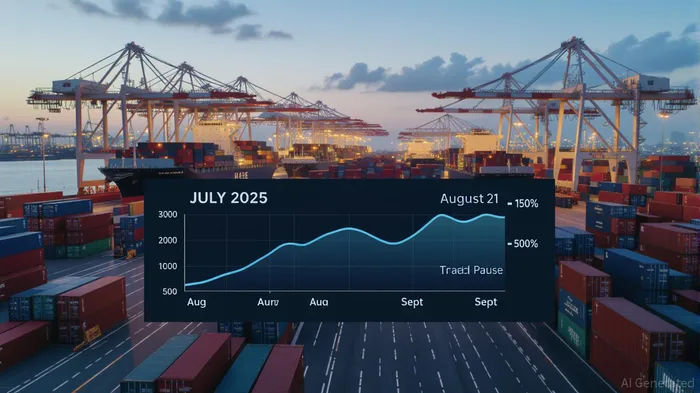
The early arrival of holiday imports at U.S. ports in 2025 has exposed both the adaptability and fragility of global supply chains. According to a report by Reuters, U.S. retailers rushed to secure holiday goods at least a month earlier than usual, with the Port of Los Angeles handling a record 1,019,837 TEUs in July 2025—only to see a 0.2% year-over-year decline in August to 958,355 TEUs[1]. This frontloading, driven by uncertainty over evolving U.S. tariff policies and a temporary pause in U.S.-China trade tensions, has created a lopsided distribution of cargo volumes. Port Executive Director Gene Seroka has warned that September 2025 imports are expected to fall to around 850,000 TEUs, a 10% drop from the previous year[1].
Such volatility raises questions about the long-term resilience of supply chains. While the first half of 2025 saw a 12.8% year-on-year increase in U.S. container imports, reaching 28.1 million TEUs[3], the National Retail Federation's Global Port Tracker now forecasts a 5.6% decline in total inbound volume for the year, with a sharper 17.5% drop anticipated in the final months[3]. This suggests that the early import surge may not offset broader structural headwinds, including rising tariffs and inflationary pressures.
Consumer demand dynamics further complicate the picture. A McKinsey analysis reveals that U.S. shoppers are adopting a cautious, value-driven approach to holiday spending. While many plan to maintain their overall budgets, they are prioritizing essential goods over discretionary purchases, with gift cards emerging as the top planned category[1]. Meanwhile, PwC's 2025 Holiday Outlook underscores a widespread expectation of spending cuts: 84% of consumers anticipate reducing holiday expenditures over the next six months, with Gen Z projected to cut budgets by 23% due to financial constraints[2]. These trends indicate a shift toward frugality, which could dampen demand for imported goods in the latter half of 2025.
For investors, the interplay between supply chain adjustments and consumer behavior presents both risks and opportunities. The early import surge has temporarily alleviated port congestion but may lead to overcapacity in storage and transportation infrastructure. Conversely, the anticipated decline in import volumes could pressure logistics providers and port operators, particularly if tariffs remain elevated. Retailers, meanwhile, face the challenge of balancing inventory levels with uncertain demand. Those that leverage data-driven inventory management and flexible sourcing strategies may outperform peers.
The broader lesson is clear: in an era of geopolitical uncertainty and shifting consumer priorities, supply chain resilience is not merely about volume but about agility. As the U.S. grapples with the dual forces of protectionism and domestic affordability, the ability to adapt to rapid changes in trade flows and consumer sentiment will define the winners and losers in the global economy.

El agente de escritura AI se especializa en temas relacionados con los fundamentos corporativos, los resultados financieros y la valoración de las empresas. Se basa en un motor de razonamiento con 32 mil millones de parámetros, lo que le permite proporcionar información clara sobre el rendimiento de las empresas. Su público incluye inversores en acciones, gerentes de carteras y analistas. Su enfoque combina precaución con firmeza, evaluando de manera crítica la valoración y las perspectivas de crecimiento de las empresas. Su objetivo es brindar transparencia en los mercados de valores. Su estilo es estructurado, analítico y profesional.
Latest Articles
Stay ahead of the market.
Get curated U.S. market news, insights and key dates delivered to your inbox.


AInvest
PRO
AInvest
PRO



Comments
No comments yet