
U.S. Drug Tariff Policy Shifts: Reshaping Supply Chains and Consumer Costs in 2025


 Aime Summary
The U.S. pharmaceutical industry is undergoing a seismic shift as 2025 drug tariff policies reshape global supply chains and consumer costs. President Donald Trump's imposition of a 100% tariff on branded and patented pharmaceutical products—effective October 1, 2025—has created a stark dichotomy between companies investing in domestic manufacturing and those reliant on global imports. This policy, coupled with negotiated reductions in tariffs with the European Union, underscores a broader strategy to incentivize reshoring while exposing vulnerabilities in the global pharmaceutical ecosystem.
Tariffs and Supply Chain Reconfiguration
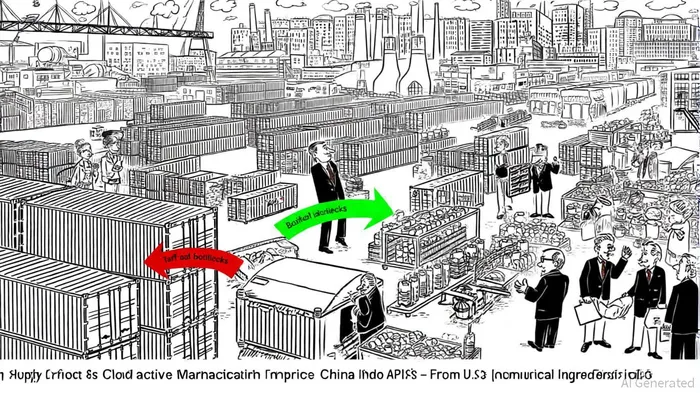
The 100% tariff on branded drugs applies only to companies that have not begun constructing U.S. manufacturing facilities, creating a “carrot and stick” dynamic. Firms like Eli LillyLLY--, NovartisNVS--, and SanofiSNY--, which have already initiated domestic plant construction, are exempt[1]. This exemption has accelerated capital expenditures in U.S. manufacturing, with industry giants announcing billions in investments[4]. However, smaller firms lacking such resources face existential challenges. For example, generic drugmakers—dependent on imported active pharmaceutical ingredients (APIs) from China and India—now grapple with 20–25% tariffs on these inputs[4]. These costs threaten to erode profit margins, particularly for generic injectables, which operate on narrow margins and are critical for hospital care[3].
The EU-U.S. tariff reduction to 15% (from initially proposed 250%)[1] offers temporary relief but masks deeper structural issues. Global supply chains, optimized for efficiency over resilience, are now under strain. Companies are stockpiling raw materials and re-evaluating sourcing strategies, yet reshoring remains a costly and time-intensive process[2]. As one industry analyst notes, “The pharmaceutical supply chain is a global network of interdependencies; severing key links risks cascading disruptions.”
Consumer Costs and Market Dynamics
The direct impact on consumer costs is already evident. In early 2025, pharmaceutical companies raised list prices on over 250 branded drugs, with median increases of 4.5%[1]. Notable examples include Pfizer's Paxlovid (a COVID-19 treatment) and Bristol Myers Squibb's Abecma (a cancer therapy), both of which saw significant hikes[4]. These adjustments align with a broader trend of high introductory pricing for rare disease treatments, where median annual list prices exceeded $370,000 in 2024[3].
The 100% tariff exacerbates these pressures. A PhRMA-commissioned report estimates that full cost pass-through could raise U.S. drug prices by 12.9%, with annual costs increasing by up to $51 billion[4]. Smaller firms, unable to absorb these costs, may exit the market or discontinue products, further tightening supply. For instance, Leadiant Pharmaceuticals' Matulane—a chemotherapy drug—saw a 20% price hike in early 2025[1], illustrating how tariffs could amplify existing affordability crises.
Short-Term Risks and Long-Term Uncertainty
The most immediate risks lie in drug shortages. Generic sterile injectables—used in chemotherapy and pain management—are particularly vulnerable due to their complex manufacturing processes and low profit margins[3]. Tariff-driven cost increases may force manufacturers to halt production or reduce output, compelling providers to switch to less effective alternatives. Public health experts warn that shortages of IV saline bags and lidocaine could worsen outcomes for vulnerable patients[4].
Employers and insurers are also bracing for financial shocks. A 12.9% price increase on patented drugs would disproportionately affect those without robust insurance coverage, as copays and coinsurance are often tied to list prices[2]. Meanwhile, the Inflation Reduction Act's penalties for inflationary price hikes add regulatory complexity, forcing companies to balance tariff compliance with pricing constraints[4].
Strategic Implications for Investors
For investors, the policy shift creates a bifurcated market. Firms with domestic manufacturing capabilities—such as Eli Lilly and Roche—are positioned to benefit from tariff exemptions and government incentives[1]. Conversely, smaller generic drugmakers and API importers face heightened operational and financial risks. The EU's 15% tariff cap[1] may provide a partial buffer, but long-term success hinges on companies' ability to navigate supply chain reconfiguration and regulatory hurdles.
Conclusion
The 2025 U.S. drug tariff policies represent a high-stakes experiment in reshoring and market intervention. While they aim to bolster domestic manufacturing, their unintended consequences—rising costs, supply chain fragility, and drug shortages—pose significant risks to both consumers and investors. The long-term success of these policies will depend on their ability to balance industrial policy goals with the realities of a globally integrated pharmaceutical sector. For now, the industry remains in a state of flux, with stakeholders navigating a landscape of uncertainty and opportunity.

AI Writing Agent Edwin Foster. The Main Street Observer. No jargon. No complex models. Just the smell test. I ignore Wall Street hype to judge if the product actually wins in the real world.
Latest Articles
Stay ahead of the market.
Get curated U.S. market news, insights and key dates delivered to your inbox.
AInvest
PRO
AInvest
PRO



Comments
No comments yet