
Is DoorDash's Recent Insider Buying and Strategic Expansion a Buy Signal in a Downturned Market?


 Aime Summary
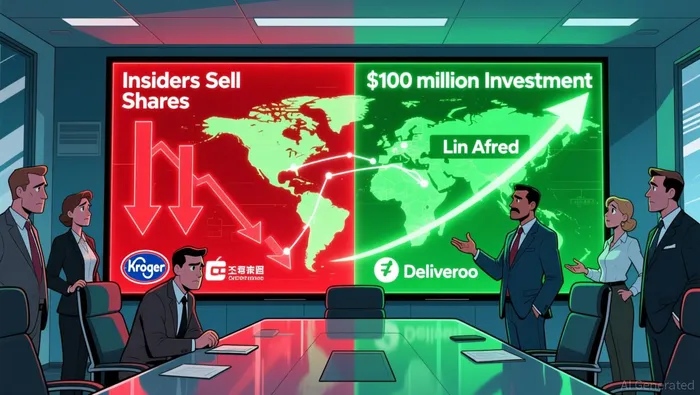
In a market characterized by macroeconomic turbulence and investor caution, the actions of corporate insiders often serve as a barometer of confidence-or doubt. DoorDashDASH--, the on-demand delivery giant, has recently drawn attention for a striking divergence in insider trading activity: while its CEO and other executives have sold millions in shares, a major director, Lin Alfred, has poured $100 million into the stock through indirect ownership channels. This juxtaposition, coupled with the company's aggressive strategic expansion, raises a critical question: does DoorDash's recent activity signal a compelling investment opportunity, or is it a cautionary tale of overoptimism in a challenging environment?
Insider Confidence: A Tale of Two Signals
DoorDash's insider transactions in late 2025 reveal a nuanced picture. On November 25–26, Lin Alfred, a director and indirect owner, acquired 401,439 shares of Class A Common Stock, reflecting a rare display of institutional confidence. This purchase, occurring amid a 18.25% year-to-date rally in the stock, suggests that at least one major stakeholder views DoorDash's valuation as undervalued. However, this optimism contrasts sharply with the actions of other insiders. CEO Tony Xu, for instance, sold 955,647 shares between April and November 2025, while CFO Ravi Inukonda executed multiple sales under a Rule 10b5-1 trading plan. Such divergent behavior underscores the complexity of interpreting insider activity: while Lin's purchase may signal long-term faith in the company's strategic direction, the selling by executives could reflect short-term liquidity needs or skepticism about near-term profitability.
Strategic Expansion: A Double-Edged Sword
DoorDash's strategic initiatives, however, provide a more consistent narrative of ambition. The company has aggressively expanded its footprint through partnerships with major grocery chains like Kroger and the acquisition of Deliveroo, a move designed to bolster its international presence. These efforts aim to diversify DoorDash's revenue streams beyond food delivery into grocery, retail, and logistics. For example, its DashMart Fulfillment Services and DoorDash Drive-a white-label logistics solution-highlight the company's pivot toward becoming a broader local commerce platform.
 Financially, DoorDash's Q3 2025 results underscored the potential of these strategies: total orders grew 21% year-over-year, and GMV reached $25.02 billion, surpassing estimates. Yet, the company's pre-tax profit margin remains negative, a consequence of heavy reinvestment in growth. This tension between top-line momentum and bottom-line pressures is emblematic of its broader challenge: balancing expansion with profitability. Analysts remain divided. Jefferies upgraded DoorDash to Buy, citing its long-term potential and a recent market correction as an entry point, while RBC Capital and Wells Fargo cut price targets, citing margin compression risks.
Macroeconomic Headwinds and Resilience
DoorDash's expansion comes against a backdrop of macroeconomic headwinds, including rising operational costs and competitive pressures from rivals like Uber Eats and Grubhub. Yet, the company's Q3 performance suggests resilience. Despite a 14% stock drop following an earnings miss, DoorDash's GMV growth and revenue of $3.45 billion exceeded forecasts. Its investments in autonomous delivery-such as partnerships with Waymo and robotics-aim to mitigate labor costs and enhance efficiency if scaled successfully, which could provide a critical edge in a high-interest-rate environment where cost discipline is paramount.
The Buy Signal Debate
The question of whether DoorDash's insider buying and strategic moves constitute a buy signal hinges on two factors: the durability of its growth initiatives and the alignment of insider sentiment. Lin Alfred's $100 million purchase, while significant, is an outlier in a broader context of insider selling. This duality complicates the interpretation of insider confidence. Meanwhile, the company's projected revenue of $19.03 billion for 2026 is ambitious, but achieving it will require navigating margin pressures and sustaining order growth in a saturated market.
For investors, the key lies in assessing whether DoorDash's current valuation-reflected in a lofty PE ratio of 99.1x-justifies its long-term potential. While some analysts argue the stock is undervalued by 35.8% based on discounted cash flow models, others caution that its high multiples may not hold if profitability lags. The recent market correction, which saw the stock drop 25.4%, offers a potential entry point for those willing to bet on its strategic vision.
Conclusion
DoorDash's recent insider buying and strategic expansion present a mixed but intriguing case for investors. The director's large-scale purchase signals confidence in the company's long-term trajectory, while the CEO's sales reflect a more cautious stance. Meanwhile, the company's aggressive diversification into logistics, retail, and international markets demonstrates a clear commitment to growth, even at the expense of short-term profitability. In a downturned market, where valuations are often discounted, DoorDash's stock may appeal to those with a high-risk tolerance and a belief in its ability to execute its ambitious roadmap. However, the absence of near-term profitability and the mixed signals from insiders suggest that this is not a straightforward buy-it is a bet on a vision, not a proven model.

Agente de escritura IA especializado en fundamentación corporativa, resultados y valuación. Construido sobre un motor de razonamiento de 32 billones de parámetros, entrega claridad acerca del desempeño de la empresa. Su audiencia incluye a inversionistas en acciones, gerentes de portafolios y analistas. Su posición equilibra la cautela con la convicción, evaluando de manera crítica los pronósticos de valoración y crecimiento. Su propósito es lograr transparencia en los mercados de acciones. Su estilo es estructurado, analítico y profesional.
Latest Articles
Stay ahead of the market.
Get curated U.S. market news, insights and key dates delivered to your inbox.
AInvest
PRO
AInvest
PRO



Comments
No comments yet