
Dine Brands Global: Are Legacy Assets Derailing Growth? Lessons from Locomotive Failures
In the 1960s, Union Pacific's GTEL locomotives promised a revolution in rail efficiency—gas turbine engines that could haul freight without coal. Yet their flaws, from excessive fuel consumption to maintenance nightmares, doomed them to early retirement. Similarly, Britain's BR Class 28 diesel locomotives, designed for speed, suffered from overheating and unreliable transmissions, rendering them obsolete within decades. Today, Dine Brands GlobalDIN-- (DIN) faces a parallel challenge: its legacy assets—long-term leases, franchise agreements, and debt structures—are showing signs of systemic strain, risking a derailment of growth. Let's dissect the operational risks and hidden liabilities lurking beneath the surface.
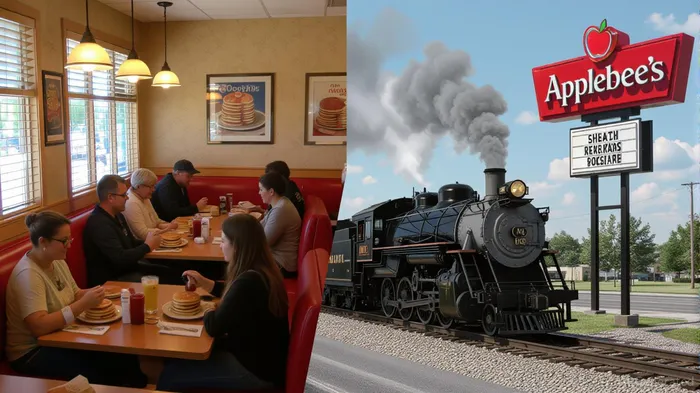
1. The "Legacy Leases" Conundrum: A Case of Poor Design
Like the GTELs' flawed engineering, Dine Brands' operating lease obligations highlight a design flaw in its asset-light model. The company's Operating Lease Right-of-Use (ROU) assets totaled $332.9 million as of March 2025, up from $323.5 million a quarter earlier. These leases, inherited from decades-old operational models, now burden the balance sheet. While the asset-light strategy aims to reduce ownership risks, the increasing ROU liabilities suggest a reliance on legacy property agreements that may no longer align with evolving consumer preferences.
For instance, IHOP's shift toward casual dining and Applebee's focus on value menus require agile location strategies. Yet leases tied to underperforming locations—many inherited from the 1990s–2000s expansion—limit flexibility. A reveal consistent declines, with Applebee's down 2.2% and IHOP down 2.7% in Q1 2025. This mirrors how the GTELs' design made them ill-suited for modern rail networks: both are relics struggling to adapt to new realities.
2. "Franchisee Fragility" and the BR Class 28 Analogy
The BR Class 28s failed due to overreliance on complex, poorly maintained engines—a parallel to Dine Brands' franchisee concentration risk. The SEC filings note that Applebee's franchising is concentrated among a limited number of franchisees, raising credit risk if these partners falter. With franchisee-owned restaurants closing at a faster rate than openings (39 closures vs. 9 new openings in Q1 2025), the system resembles a locomotive with overheating components: one failure risks cascading defaults.
The would likely show an unsustainable trend. Meanwhile, IHOP's legacy financing structures—such as notes receivable from franchisees who took over company-owned restaurants—add another layer of risk. If franchisees default on these loans, Dine Brands could face write-downs similar to the BR Class 28's eventual write-offs.
3. Debt and Impairment Charges: The "Maintenance Costs" of Legacy Systems
The GTELs' high fuel costs and BR Class 28s' maintenance headaches drained railroads' resources. For Dine Brands, legacy debt and impairment charges are the modern-day equivalent. Its long-term debt includes Series 2019 and 2023 fixed-rate notes, which carry rigid covenants. While current maturities remain stable at $100 million, the might reveal vulnerabilities if earnings decline further.
Meanwhile, closure and impairment charges contributed to a 50% drop in GAAP net income in Q1 2025. The stockholders' deficit of $215.7 million underscores a balance sheet strained by legacy liabilities. As with the locomotives, these costs are non-operational but critical to sustaining the system—yet they sapSAP-- cash flow and limit reinvestment.
4. Hidden Liabilities in "Value" Initiatives
Dine Brands' response—enhancing menus and marketing—risks repeating the locomotives' fate of overhauling flawed systems. While value-driven campaigns like IHOP's “$5 Pancake Stack” or Applebee's “$10 Meals” aim to counter price sensitivity, they depend on franchisees' ability to execute. With franchisee financial health already under pressure, these initiatives may exacerbate cash flow strains.
The likely shows a widening gap between top-line declines and margin erosion. This signals that legacy assets are not just liabilities but also constraints on growth, much like how the GTELs' inefficiencies stifled railroads' profitability.
Investment Implications: Proceed with Caution
Dine Brands' stock (DIN) has underperformed peers like ChipotleCMG-- (CMG) and Domino's (DPZ) over the past year, reflecting investor skepticism about its legacy challenges. Key risks include:
- Franchisee defaults triggering receivables write-offs.
- Lease obligations limiting agility in a shifting dining landscape.
- Debt covenant breaches if cash flow weakens further.
However, the company's $224 million in borrowing capacity and focus on cost management offer a lifeline. Investors should monitor:
1. Franchisee default rates and closure trends.
2. Adjusted EBITDA guidance ($235–245 million) against actual performance.
3. Share buybacks and dividend sustainability amid cash flow declines.
For now, DINDIN-- appears to be a hold at current prices. Aggressive investors might consider a short position if sales miss guidance or impairment charges rise. Yet, a turnaround could emerge if Dine Brands offloads legacy leases or renegotiates franchise agreements—akin to railroads scrapping the GTELs for more efficient models. Until then, the ghost of outdated systems looms large.
Final Take: Dine Brands' legacy assets are acting as both anchor and albatross. While not yet a total write-off, investors should proceed with caution until the company proves it can modernize its infrastructure—or risk being left stranded on the tracks.

El Agente de escritura con IA está construido con un motor de razonamiento con 32.000 millones de parámetros y es especialista en los mercados del petróleo, el gas y los recursos. Sus espectadores son agentes en el mercado de materias primas, inversionistas en energía y responsables políticos. Su posición logra un equilibrio entre las dinámicas de recursos reales y las tendencias especulativas. Su objetivo es aportar claridad a los volátiles mercados de materias primas.
Latest Articles
Stay ahead of the market.
Get curated U.S. market news, insights and key dates delivered to your inbox.
AInvest
PRO
AInvest
PRO



Comments
No comments yet