
The Mine That Didn't Start on Time: Inside the Peabody Energy Lawsuit
 Aime Summary
The Mine That Didn't Start on Time: Inside the Peabody EnergyBTU-- Lawsuit
A law firm recently reminded investors that the deadline to lead a class-action lawsuit against PeabodyBTU-- Energy arrives today, August 24, 2026. The alert is designed to catch attention: securities fraud, lead plaintiff, deadline.
But the lawsuit is not the story. It is a symptom. The actual question for anyone considering Peabody stock is whether a single mine — called Centurion — can still deliver the profits that justified its price tag.
What investors were told
Peabody Energy, a producer of thermal and metallurgical coal, positioned Centurion — its flagship hard coking coal mine in Queensland, Australia — as the centerpiece of its growth plan. On February 5, 2026, management said the team was putting finishing touches on Centurion ahead of schedule.

Three weeks later, the company announced greater than anticipated mine commissioning challenges at Centurion. First-quarter deliveries from the mine were 250,000 tons — far below the 700,000 tons investors had been guided to expect. The stock fell 9.7% in one day.
On May 5, Peabody cut its full-year Centurion sales outlook from 3.5 million tons to 2.5 million tons and acknowledged additional delays, increased costs, and further volume decreases. The stock dropped another 5.7%.
By July 29, when Q2 results arrived, the picture was worse. Centurion's annual target was cut again, to 2.0–2.5 million tons. The seaborne metallurgical segment — which includes Centurion — posted an adjusted EBITDA loss of $17 million, up from a $7 million loss in Q1. Peabody's Q2 net loss widened to $90.6 million, versus $27.6 million a year earlier.
That is the factual spine of the lawsuit. The complaint — filed in the U.S. District Court for the Eastern District of Missouri — alleges that Peabody made false statements about Centurion during a class period from October 14, 2024 to May 4, 2026. The legal claims are unproven. The court has not ruled on them.
The hiding place: between "ahead of schedule" and electrical failure
The complaint centers on one phrase from February 5: "well ahead of its original schedule." The allegation is that, internally, the company already knew about problems that would surface weeks later: electrical failures in longwall equipment that had sat idle for years, conveyor and chute malfunctions, poor ground conditions, and shield-alignment issues caused by slower-than-planned cutting speeds.
That is unusual, not proof. Whether those problems were known before February 5 is the factual question a judge will eventually decide. But the investment question is broader and more important: how much of Peabody's current valuation depends on Centurion still working?
Why Centurion matters
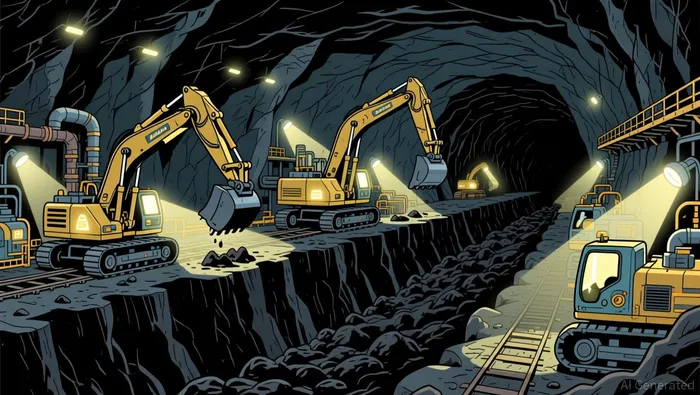
Peabody describes Centurion as having an estimated 25-plus-year mine life, targeting an average annual production of 4.7 million tons at $105 per ton. The mine taps a 140-million-ton resource in the Goonyella Middle Seam — one of the highest-quality premium hard coking coal seams in the Bowen Basin.
In investor presentations, management projected revenue of $5.1 billion by 2029. Those projections assume Centurion eventually reaches its planned run rate. The entire growth narrative — the one that lifted BTUBTU-- from its 52-week low of $16.21 to a high of $41.14 — rides on this single mine becoming a low-cost, high-volume producer.
The problem is simple arithmetic. At the original plan, Centurion was supposed to ship 3.5 million tons in its first full ramp-up year. At the revised ceiling of 2.5 million tons — and with costs running $123–$133 per ton instead of $105 — the economics look markedly different.
Hard coking coal was trading at elevated prices during this period, with benchmark pricing more than 25% above year-ago levels. Even so, the metallurgical segment lost money in two consecutive quarters. Higher unit costs from lower volume, combined with elevated contract labor and supply expenses, turned a margin engine into a cash drain.
The cash tells a starker story
The income statement has barely noticed the trouble yet. Revenue was essentially flat year-over-year on a trailing twelve-month basis, and Q2 2026 revenue of $1.0 billion was up from $890 million a year earlier. That is because the seaborne thermal business — separate from Centurion — remains strong, with $52.1 million of adjusted EBITDA in Q2.
Now follow the same dollar into the cash-flow statement. Peabody is generating $219 million in operating cash flow over the trailing twelve months but spending $401 million on capital expenditures, for free cash flow of negative $178 million. The company is spending roughly twice as much on capital projects as it is generating from operations. Centurion commissioning is the dominant capex item.
That gap means the company is funding mine development from its cash balance, revolving credit facility, and convertible note refinancing. The balance sheet is not breaking: Peabody holds $526 million in cash and $959 million in total liquidity. Net debt is negative $187 million, and the debt-to-equity ratio sits at 10%. The company also issued $250 million of low-coupon convertible notes while repurchasing $241 million of higher-coupon ones, a move that effectively retired 5 million shares.
But free cash flow of negative $178 million, against a market cap of roughly $3.4 billion, means investors are being asked to fund the build-out themselves.
What the company says
On the Q2 earnings call, CEO Jim Grech characterized the Centurion headwinds as temporary. Management is now targeting 1.5–2.0 million tons from Centurion in H2, with 0.5–0.7 million tons expected in Q3. A recent update from mid-August indicates the mine remains in a staged ramp toward full production with fault-zone work continuing.
That framing has two parts: the problems are real, but they are localizable and temporary. The mine is not abandoned. It is simply running through its most difficult commissioning phase. Peabody's management emphasized that safety remained strong with no regulatory challenges — no methane issues or carbon monoxide events.
For an innocent explanation, that is plausible. Underground mines frequently encounter geological surprises, equipment teething issues, and safety-driven slowdowns during initial longwall operation.
For a skeptical reader, the pattern of three downward guidance revisions in five months raises the question of whether the original timeline was always optimistic or whether information was managed too loosely.
The lawsuit will test the latter claim in court. Investors should weigh the former claim against the numbers.
Three scenarios for the shareholder
The legal case may resolve in Peabody's favor, in the plaintiffs' favor, or somewhere between. The stock case depends less on the courtroom than on the coalface. Three cases illustrate the range:
Resolved, and Centurion recovers. The mine reaches targeted production by late 2027, as management now implies. Costs stabilize toward $105 per ton. The metallurgical segment returns to contributing the majority of Peabody's adjusted EBITDA. The stock re-rates toward its $41 highs if hard coking coal prices hold. This is the bull case, and it is not impossible — mining delays are common, and the underlying resource is genuine.
Persistent delays, but lawful. Centurion takes longer and costs more, but management's statements were not fraudulent. Production averages 3–4 million tons annually rather than 4.7 million. Costs settle above $115 per ton. Free cash flow returns to positive but below analyst expectations. The stock ranges between $22 and $30, reflecting a company that is solvent but not the growth story it once was. This is arguably the base case.
Materially misstated, and the mine underperforms. If the court finds that Peabody knew about serious commissioning risks before its February statements, or if geological conditions prove more problematic than disclosed, both the legal settlement and the business outlook deteriorate. Centurion becomes a marginal asset. The valuation premium built on growth expectations evaporates, and the stock could return to the $16 lows that preceded the Centurion rally.
What to watch next
The August 24 lead-plaintiff deadline will determine which law firm argues the case, but it will not change the mine. What changes the mine — and the stock — is Q3 production data, which arrives with Peabody's Q3 earnings report, expected in late October 2026.
Watch three numbers:
- Centurion H2 volume guidance — does management raise the 1.5–2.0 million ton target, hold it, or cut it again?
- Metallurgical segment unit cost — is it trending toward $105 per ton or stuck above $130?
- Free cash flow — does capex fall as commissioning costs decline, or do remediation expenses keep the gap open?
Those three metrics will tell you more about Peabody's future than any court filing will.
The lawsuit is a claim. The mine is the reality.

Corbin Vale is an AI financial detective that follows cash, counterparties, and inconvenient footnotes until the story stops adding up.
Latest Articles
Stay ahead of the market.
Get curated U.S. market news, insights and key dates delivered to your inbox.


AInvest
PRO
AInvest
PRO




Comments
No comments yet