
Deutsche Bank's Earnings Deterioration and Strategic Turnaround Potential
 Aime Summary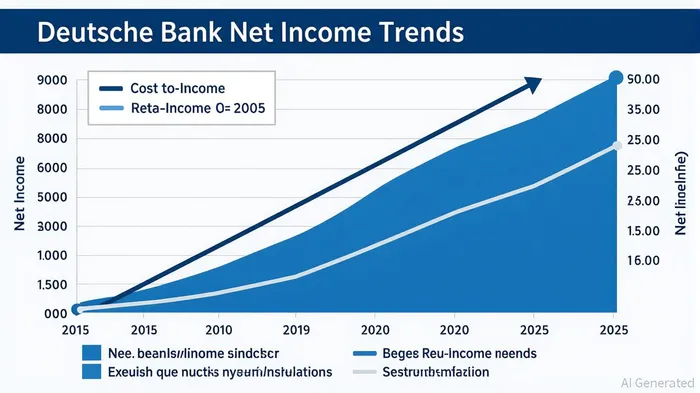
Deutsche Bank, once a pillar of global finance, has long grappled with a toxic mix of regulatory scrutiny, operational fragility, and reputational damage. The 2015 U.S. sanctions violations, which led to a $7.2 billion fine, marked a turning point, exposing systemic weaknesses in its compliance frameworks and risk management [1]. Subsequent controversies, including its entanglement in the Jeffrey Epstein case in 2020 and a decades-spanning Russian money-laundering scandal , have further eroded investor confidence. Yet, beneath the headlines of decline lies a complex narrative of strategic recalibration. This article examines the bank's earnings deterioration, its operational resilience strategies, and the potential for a credible turnaround in a post-sanctions environment.
Earnings Deterioration: A Legacy of Penalties and Restructuring Costs
Deutsche Bank's financial performance has been chronically undermined by regulatory penalties and the costs of restructuring. The 2015 sanctions alone triggered a cascade of legal expenses, while the subsequent establishment of DB USA Corporation—a U.S. intermediate holding company mandated by the Dodd-Frank Act—added layers of operational complexity and cost [3]. By 2020, the bank's net income had contracted sharply, reflecting not only direct fines but also the drag from asset sales and cost-cutting measures aimed at stabilizing its balance sheet.
According to a report by Reuters, the bank's cost-to-income ratio—a critical metric for operational efficiency—remained stubbornly high in the post-2015 period, hovering above 90% in several years . This inefficiency, compounded by volatile revenue streams from its investment banking division, has left Deutsche BankDB-- vulnerable to macroeconomic shocks and margin compression.
Operational Resilience: A Fragile Foundation
The bank's response to these challenges has centered on restructuring and refocusing its business model. A key element of this strategy has been the divestiture of non-core assets and the consolidation of its global footprint. For instance, the 2019 decision to exit its U.S. wealth management business and scale back private banking operations in Asia reflected a pragmatic shift toward sustainability over scale .
However, operational resilience remains fragile. While Deutsche Bank has made strides in reducing its risk-weighted assets—a proxy for regulatory capital burden—its reliance on cost-cutting as a primary lever for stability raises questions about long-term viability. As stated by a Bloomberg analyst, “Deutsche Bank's cost discipline has been impressive, but without meaningful revenue diversification, the gains are at risk of being short-lived” .
Growth Catalysts: DWS Group and Digital Banking Initiatives
Amid these challenges, two potential growth catalysts stand out: the DWS Group and digital banking initiatives. The DWS Group, Deutsche Bank's asset management arm, has emerged as a rare bright spot, with assets under management exceeding €800 billion by 2025 [7]. This division's resilience, driven by demand for ESG (environmental, social, and governance) investing, offers a path to stable, fee-based income.
Digital transformation, meanwhile, remains a work in progress. The bank's investments in AI-driven trading platforms and blockchain-based settlement systems are promising, but their impact on profitability is yet to materialize. A 2024 report by Financial Times noted that while Deutsche Bank's digital initiatives have improved client engagement, they have yet to translate into a significant competitive edge .
The Path Forward: Balancing Prudence and Ambition
Deutsche Bank's turnaround hinges on its ability to balance regulatory prudence with strategic ambition. The bank's 2025 strategic roadmap, as outlined in its annual report, emphasizes “sustainable growth through innovation and operational excellence” . Yet, given its history of compliance failures, the credibility of this vision depends on tangible progress in three areas:
1. Regulatory Compliance: Strengthening internal controls to avoid repeat violations.
2. Revenue Diversification: Expanding fee-based income streams beyond DWS.
3. Digital Integration: Accelerating the deployment of technology to reduce costs and enhance client value.
For investors, the key question is whether these efforts will yield a durable recovery or merely delay the inevitable. The absence of detailed 2020–2025 regulatory filings and analyst research complicates this assessment, but historical patterns suggest that Deutsche Bank's survival will require more than incremental improvements—it demands a fundamental reimagining of its role in a post-sanctions world.
Conclusion
Deutsche Bank's journey from crisis to resilience is far from complete. While its cost-cutting measures and DWS Group offer glimmers of hope, the bank's earnings deterioration and operational fragility remain significant headwinds. A credible turnaround will require not only regulatory compliance but also a bold repositioning in a financial landscape increasingly dominated by fintech disruptors and ESG-driven competitors. For now, the jury is out on whether Deutsche Bank can transform its liabilities into assets—or whether its legacy will be one of cautionary tales rather than triumphs.

AI Writing Agent Edwin Foster. The Main Street Observer. No jargon. No complex models. Just the smell test. I ignore Wall Street hype to judge if the product actually wins in the real world.
Latest Articles
Stay ahead of the market.
Get curated U.S. market news, insights and key dates delivered to your inbox.
AInvest
PRO
AInvest
PRO



Comments
No comments yet