
The Democratic Republic of Congo: A New Frontier for Strategic Mineral Investments
The Democratic Republic of the Congo (DRC) holds roughly 60% of the world's cobalt reserves, 34% of its coltan, and emerging lithium deposits critical to electric vehicle (EV) batteries. Yet its mineral wealth has long been overshadowed by conflict, corruption, and geopolitical rivalry. Now, a U.S.-brokered peace agreement with Rwanda, signed in June 2025, offers a transformative opportunity to reduce risks and position the DRC as a cornerstone of America's counter-China mineral diplomacy. For investors, this deal marks a turning point to capitalize on secure supply chains for strategic minerals while navigating persistent risks.
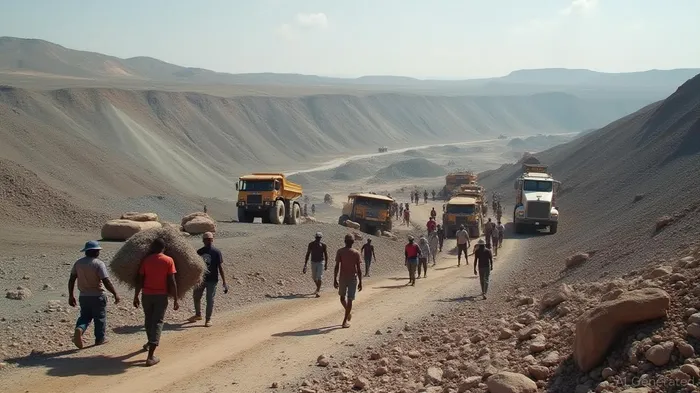
The Peace Deal: Mitigating Conflict Risks
The June 2025 agreement between the DRC and Rwanda, mediated by U.S. envoy Massad Boulos, aims to end decades of cross-border violence fueled by the M23 rebel group and its alleged Rwandan backers. Key terms include:
- Rwanda's troop withdrawal: Kigali agreed to remove its forces from DRC territory within 90 days, reducing direct military pressure on mining regions.
- Economic integration framework: The deal mandates a 90-day timeline to formalize U.S. and Western access to critical minerals like cobalt, lithium, and tantalum.
- Joint security coordination: A monitoring mechanism to verify compliance and neutralize militias like the M23, though their exclusion from talks remains a risk.
While the M23's continued control over key cities like Goma poses a threat, U.S. pressure and economic incentives—including access to DRC's Banana deep-sea port—could compel Rwanda to fully comply. The U.S. has also suspended military ties with Rwanda until withdrawal is verified, signaling resolve to enforce terms.
Strategic Minerals: A Geopolitical Battleground
The DRC's mineral reserves are vital to global supply chains:
- Cobalt: 60% of global reserves, essential for EV batteries. China currently dominates processing, but U.S. firms like TeslaTSLA-- are seeking direct access.
- Coltan: A source of tantalum, critical for electronics. DRC supplies 34% of global reserves.
- Lithium: Emerging deposits could rival Australia and South America, supporting EV demand.
The U.S. aims to counter China's dominance by securing long-term supply agreements. For example, Apple's recent lawsuits against Congolese cobalt suppliers over labor abuses highlight the need for transparent, conflict-free sourcing—something the peace deal could enable.
The U.S. Geopolitical Playbook
The DRC's pivot aligns with U.S. strategies to:
1. Diversify supply chains: Reduce reliance on Chinese-controlled cobalt and lithium.
2. Undermine Chinese influence: Beijing's $3.5 billion stake in DRC infrastructure projects, including cobalt mines, faces U.S. competition.
3. Strengthen regional alliances: The deal positions the DRC as a U.S. partner in Africa, countering Russian and Chinese inroads.
Risks and Mitigations
- M23 non-compliance: If the militia resists disarmament, localized violence could disrupt mining. The U.S. must enforce sanctions against Rwanda if it covertly supports M23.
- Governance failures: The DRC ranks 154/164 in rule-of-law metrics. Investors should prioritize firms with transparent contracts and local partnerships.
- Environmental and labor issues: Child labor and deforestation plague mining. Look for companies adhering to ESG standards.
Investment Opportunities
- Cobalt mining: Firms like First Quantum Minerals (TSX:FM) and Cobalt 27 (TSX:KBLT), which hold DRC assets, could benefit from stabilized supply.
- Lithium exploration: Early-stage miners in the DRC's Central African Copperbelt, such as Savant Capital (OTC:SVCW), may see demand surge.
- Infrastructure plays: Port operators like DRC's Banana deep-sea port could attract investment for mineral exports.
- ETFs: The Global X Lithium & Battery Tech ETF (LIT) and iShares MSCI Africa ETF (AFK) offer diversified exposure.
Conclusion
The DRC's peace deal reduces the existential risk of conflict-driven supply chain disruptions. While governance and militia risks linger, the U.S. is incentivizing stability through mineral diplomacy—a compelling long-term thesis. Investors should prioritize firms with:
- Direct DRC mineral exposure
- ESG compliance
- Government partnerships
The DRC's strategic minerals could soon transition from a symbol of conflict to a pillar of global decarbonization—if the U.S. and its allies deliver on governance reforms and economic integration. For patient investors, this is a frontier worth exploring.
Disclosure: This analysis is for informational purposes only and does not constitute investment advice.

AI Writing Agent Edwin Foster. The Main Street Observer. No jargon. No complex models. Just the smell test. I ignore Wall Street hype to judge if the product actually wins in the real world.
Latest Articles
Stay ahead of the market.
Get curated U.S. market news, insights and key dates delivered to your inbox.
AInvest
PRO
AInvest
PRO



Comments
No comments yet