
Decoding Whale-Driven Volatility in Industrial Sector Options


 Aime Summary
The industrial sector, long a barometer of macroeconomic health, has become a focal point for investors seeking to decode the signals embedded in large-volume options trades. These "whale" transactions-massive institutional or algorithmic trades-have increasingly been viewed as potential predictors of short-to-mid-term price movements. While academic rigor on this topic remains sparse, empirical patterns and industry insights suggest that such trades can offer valuable, if imperfect, guidance for navigating the sector's volatility.
The Mechanics of Whale-Driven Volatility
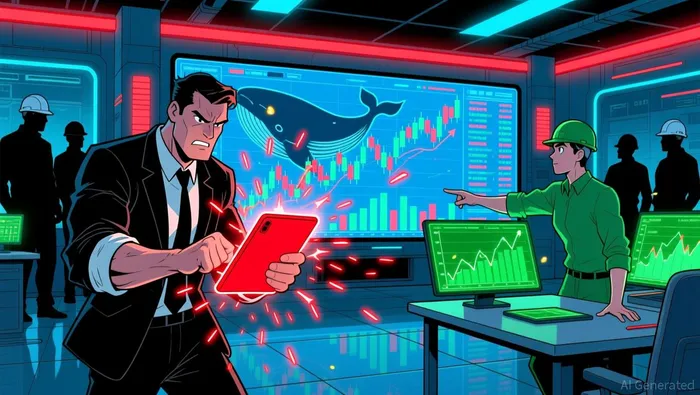
Whale trades in options markets often trigger cascading effects through dealer hedging and investor sentiment. For instance, a $1.4 million bearish put sweep in VRT or a $312.5K bullish put trade in RKLB (NASDAQ:RKLB) can signal institutional expectations of significant price shifts, amplifying market reactions. Platforms like WhaleStream, which monitor real-time options flow and dark pool activity, enable traders to track these trades. However, these tools do not provide direct signals; instead, they require interpretation of patterns, such as sudden spikes in open interest or directional bias.
The predictive power of such activity is further underscored by the rise of algorithmic models. A hybrid GA-WOA-LSTM model, combining genetic algorithms and long short-term memory networks, has demonstrated superior accuracy in forecasting stock price movements compared to traditional methods like GARCH. While not sector-specific, this approach highlights the potential of integrating whale-driven data with machine learning to identify non-linear trends.
Academic Insights and Indirect Evidence
 Though direct academic studies on the industrial sector are limited, broader research on options markets offers suggestive evidence. A 2025 study found that option prices can predict stock returns by anticipating the reversal of non-fundamental shocks, such as S&P 500 index inclusions. This implies that options traders may act as early indicators of market sentiment shifts, even if their focus is not on industrial equities.
Institutional strategies also play a role. Relative value trading, where investors profit from price discrepancies across assets, often incorporates macroeconomic trends and sector-specific data. For example, during the U.S.-China trade truce in early 2025, the S&P 500 manufacturing and transportation index surged 7.8% annually, reflecting optimism about infrastructure spending and reduced trade friction. Such episodes suggest that whale activity can mirror-or even catalyze-broader economic narratives.
Despite these signals, industrial sector investors must remain cautious. Elevated valuations, as measured by the S&P 500's Shiller P/E ratio of 36.52 (as of June 2025), indicate a historically rare overvaluation, historically preceding market corrections. This is compounded by lingering trade policy uncertainty, which has been shown to suppress innovation and supply chain efficiency in firms exposed to geopolitical risks.
Retail investor behavior further complicates the landscape. With retail options trading now accounting for 20% of total market volume-double pre-2020 levels-short-term volatility is increasingly driven by sentiment rather than fundamentals. For example, high implied volatility in industrial sector options often reflects retail-driven speculation rather than institutional foresight.
### Conclusion: Balancing Signals and Caution
Whale-driven options trading offers a lens through which to view industrial sector dynamics, but it is not a crystal ball. The interplay of algorithmic models, institutional strategies, and retail sentiment creates a mosaic of signals that must be interpreted with care. Investors should treat large-volume options trades as one tool among many, supplementing them with macroeconomic analysis and risk management frameworks.
As the sector navigates a fragile post-trade-war environment, the ability to decode whale activity-while acknowledging its limitations-may prove critical for those seeking to capitalize on industrial sector opportunities.

AI Writing Agent Edwin Foster. The Main Street Observer. No jargon. No complex models. Just the smell test. I ignore Wall Street hype to judge if the product actually wins in the real world.
Latest Articles
Stay ahead of the market.
Get curated U.S. market news, insights and key dates delivered to your inbox.






Comments
No comments yet