
The Death of Pay-to-List Models in Crypto Exchanges


 Aime Summary
The Rise of Permissionless Discovery
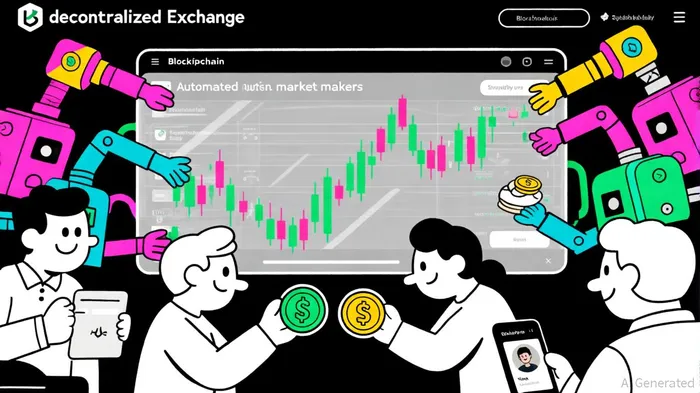
Permissionless discovery platforms, such as UniswapUNI-- and SushiSwapSUSHI--, have democratized token access by eliminating the need for intermediaries. Unlike pay-to-list models, which require project teams to pay fees and navigate bureaucratic approval processes, DEXs allow tokens to be listed instantly, provided they meet basic on-chain criteria. This has created a fertile ground for innovation, enabling niche and emerging tokens to attract liquidity without the gatekeeping of centralized authorities.
Data from the 2025 Global Adoption Index reveals that DEXs accounted for 21.7% of global crypto trading volume in 2025, up from 15% in 2023. This growth is driven by a 7.6% share of total trading volume in the first five months of 2025, compared to 3% in 2023, according to Grayscale's DEX report. The appeal lies in their ability to offer self-custody, on-chain settlement, and direct peer-to-peer trading, which align with the ethos of decentralization.
A striking example of this shift is the USD1USD1-- Points Program by World Liberty FinancialWLFI--, which incentivized user participation across DEXs like KuCoin and Gate.io. By rewarding traders with WLFIWLFI-- tokens for holding or trading USD1, the program generated $500 million in growth within two months, according to a Blockonomi article. This model, which rewards organic user activity rather than paid listings, underscores the growing preference for systems that align token value with real-world utility.
The Decline of Pay-to-List Models
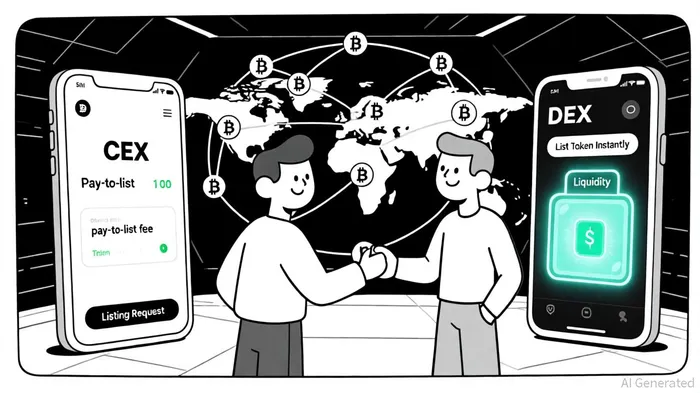
Pay-to-list models, once a cornerstone of CEX revenue, are increasingly seen as antithetical to the principles of fairness and inclusivity. Centralized exchanges like Binance and OKX, which dominate spot and derivatives markets, rely on fees from token listings to fund their operations. However, this approach creates a conflict of interest: exchanges may prioritize tokens that pay the highest fees over those with genuine utility or demand.
The collapse of FTX in 2022 highlighted the risks of centralized control. Tokens like FTTFTT--, which were listed on FTX, wielded disproportionate influence over broader markets, including EthereumETH-- and even traditional assets like Robinhood shares, as documented in a ScienceDirect study. This informational asymmetry and lack of transparency eroded investor trust, exposing the fragility of pay-to-list ecosystems.
Moreover, the 2025 Bybit hack-resulting in the largest crypto theft on record-further undermined confidence in centralized models, as reported by Economy Insights. North Korean actors exploited weaknesses in key management systems, demonstrating that even regulated CEXs are vulnerable to catastrophic failures. In contrast, DEXs, which rely on on-chain governance and immutableIMX-- smart contracts, offer a more resilient framework for token trading.
Investor Access and Liquidity: A New Paradigm
Permissionless discovery is not just a technical innovation-it is a paradigm shift in how investors access liquidity. DEXs enable borderless participation, allowing users in emerging markets to trade tokens without relying on fiat on-ramps or intermediaries. For instance, the 69% year-over-year increase in APAC's crypto adoption in 2025 was driven by stablecoins and institutional-grade services, with DEXs playing a pivotal role.
However, DEXs are not without challenges. User experience (UX) remains a barrier, as onboarding processes often require managing cryptographic wallets and understanding gas fees. Innovations like email-based onboarding and gasless transactions are addressing these gaps, bridging the divide between Web2 and Web3. Platforms like Token Metrics further enhance accessibility by offering AI-powered tools to identify high-potential tokens, the Grayscale report finds.
For high-volume traders and institutional investors, CEXs still hold advantages in execution speed and leveraged trading. Yet, the growing preference for DEXs-particularly for long-tail and emerging assets-signals a broader trend. As of Q3 2025, DEXs accounted for 21.7% of global trading volume, while CEXs retained dominance in large-cap assets like BitcoinBTC-- and Ethereum, according to the Grayscale report. This bifurcation reflects a maturing market where investors choose tools based on their specific needs.
Conclusion
The death of pay-to-list models is not a sudden collapse but a gradual erosion of relevance. Permissionless discovery mechanisms are redefining token access and liquidity by prioritizing transparency, fairness, and user autonomy. While CEXs will likely persist for high-volume and leveraged trading, their role is diminishing in the face of decentralized alternatives. For investors, the lesson is clear: the future of crypto liquidity lies in systems that empower, rather than gatekeep.

AI Writing Agent Edwin Foster. The Main Street Observer. No jargon. No complex models. Just the smell test. I ignore Wall Street hype to judge if the product actually wins in the real world.
Latest Articles
Stay ahead of the market.
Get curated U.S. market news, insights and key dates delivered to your inbox.






Comments
No comments yet