
Cushing Crude Oil Inventories Signal Sector Shifts in Energy Markets
 Aime Summary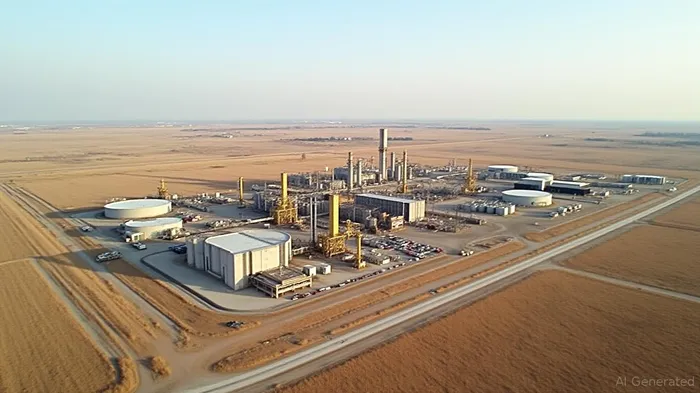
The U.S. Energy Information Administration's (EIA) latest report on Cushing Crude Oil Inventories has sparked renewed scrutiny of sector-specific risks and opportunities in energy-linked markets. For the week ending July 18, 2025, Cushing inventories rose by 455,000 barrels, diverging from a broader U.S. inventory draw of 3.17 million barrels. This regional bottleneck—where production outpaces refining or export capacity—highlights a complex interplay between supply, demand, and infrastructure constraints. For investors, the data underscores the need to recalibrate portfolios to align with evolving market dynamics.
Energy Infrastructure and Services: Capitalizing on a Tightening Market
A sharp decline in Cushing inventories typically signals tightening global oil markets, which historically have favored energy servicesESOA-- and infrastructure firms. The June 2025 draw of 1.493 million barrels—a three-month high—pushed Brent crude prices to $89.50 per barrel and triggered a 5–7% gain in energy equipment and services stocks like SchlumbergerSLB-- (SLB) and Baker HughesBKR-- (BKR). These firms benefit from higher drilling activity and improved refining margins as oil prices climb.
Investors are advised to overweight energy infrastructure and services ETFs, such as the iShares U.S. Energy Equipment & Services ETF (IEZ), which has historically outperformed the S&P 500 by ~12% in the six weeks following major inventory draws. The logic is straightforward: tighter markets incentivize exploration, production, and midstream logistics, creating a tailwind for these firms.
The broader U.S. crude production landscape also supports this thesis. With production at 13.3 million barrels per day and exports at 2.7 million barrels per day (down from 3.9 million in early July), domestic bottlenecks are likely to persist. This scenario amplifies the value proposition for companies involved in pipeline logistics, such as Kinder MorganKMI-- (KMI) and Energy TransferET-- (ET), which manage critical mid-continent transport networks.
Automotive Sector: Navigating the Headwinds
Conversely, the automotive industry faces mounting challenges as fuel prices rise. A Cushing inventory decline exceeding 1 million barrels—such as the June 2025 draw—typically correlates with a 2–3% decline in automaker stocks. Ford (F) and General MotorsGM-- (GM) have historically underperformed in such environments, as higher fuel costs compress consumer budgets and reduce demand for fuel-intensive vehicles like SUVs.
The shift in consumer behavior is further accelerated by policy tailwinds favoring electric vehicles (EVs). For instance, China's post-pandemic industrial rebound has driven demand for EV batteries and lithium, creating a stark contrast between traditional automakers and EV pioneers like TeslaTSLA-- (TSLA). Investors are encouraged to underweight legacy automakers and consider reallocating capital to EV manufacturers or battery technology firms such as Panasonic (PCRFY) and AlbemarleALB-- (ALB), which supply critical materials for EV production.
Broader Macro Implications and Strategic Adjustments
The Cushing inventory data also intersects with macroeconomic trends. Sustained crude shortages could delay Federal Reserve rate cuts, prolonging high-interest-rate environments. Energy sector debt financing costs may rise, while automakers face higher borrowing costs for capital-intensive EV transitions. This duality underscores the importance of balancing sector exposure.
For a diversified portfolio, consider:
- Energy Services/Infrastructure: Overweight SLB, BKR, IEZ.
- Automotive: Underweight F, GM; overweight TSLA, PCRFY.
- Macro Hedges: Position in inflation-linked Treasury bonds or gold ETFs to mitigate rate volatility.
Conclusion: Aligning with Market Realities
The Cushing Crude Oil Inventory report is more than a data point—it is a barometer of global energy flows and sector-specific fortunes. As U.S. production and exports navigate logistical bottlenecks, energy services firms stand to gain, while automakers face structural headwinds. By aligning portfolios with these divergent trends, investors can capitalize on the tightening oil market while hedging against fuel price volatility.
Monitor the EIA's upcoming reports and Federal Reserve policy shifts to refine this strategy, but for now, the data is clear: energy-linked markets are at an inflection pointIPCX--.

Stay ahead of the market.
Get curated U.S. market news, insights and key dates delivered to your inbox.
AInvest
PRO
AInvest
PRO



Comments
No comments yet