
Crypto Exchange Resilience in Market Stress: Operational Risk and Infrastructure Stability


 Aime Summary
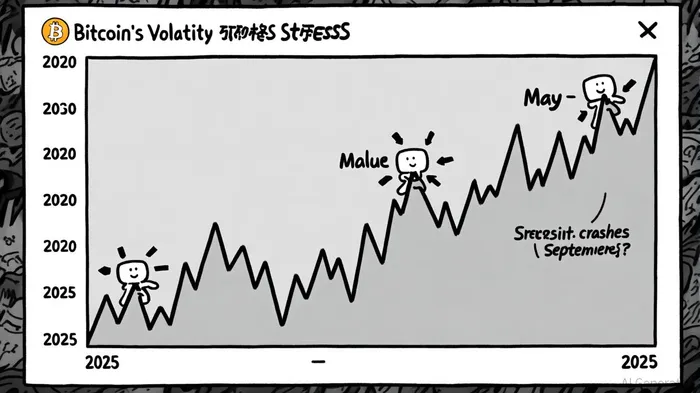
The cryptocurrency market, once dismissed as a speculative niche, has emerged as a critical component of global finance. Yet its resilience during periods of stress remains a subject of intense scrutiny. Recent events-from the March 2020 pandemic crash to the September 2025 liquidation crisis-reveal both the fragility and adaptability of crypto exchanges. This analysis examines how operational risk management and infrastructure stability have evolved to address systemic vulnerabilities, drawing on case studies and institutional frameworks.
The Stress Test: From TerraLUNA-- to Trump Tariffs
The collapse of TerraUSD (UST) in May 2022 exposed the dangers of algorithmic stablecoins, which rely on algorithmic adjustments rather than collateral, as a New York Fed analysis highlights (New York Fed analysis). As UST depegged from the dollar, it triggered a cascade of losses across the crypto ecosystem, accelerating a flight to asset-backed stablecoins like USDCUSDC--. By contrast, USDC's fully collateralized reserves-comprising bank deposits and short-term government securities-proved resilient, though temporary delays in institutional redemptions highlighted operational bottlenecks, according to a FinchTrade case study (FinchTrade case study).
The September 2025 crash, however, marked a new low. A confluence of factors-high leverage, the "Triple Witching" options expiry, and geopolitical shocks like Trump's 100% China tariffs-triggered a $151 billion market cap contraction in 24 hours, as a TalkMarkets report documented (TalkMarkets report). Stablecoins such as USDEUSDe-- and WBETHWBETH-- depegged severely on Binance, while centralized oracles like ChainlinkLINK-- faltered, exacerbating liquidations. Yet blockchains themselves held firm, underscoring the decoupling of decentralized infrastructure from exchange-level failures, as the report also observed.
Operational Risk: From Hacks to Human Error
Operational risk has become a central concern for crypto exchanges. The February 2025 ByBit hack, which saw $1.5 billion stolen, forced a reevaluation of security protocols. Bybit responded with nine audits, 50+ new security measures, and a three-phase plan emphasizing Multi-Party Computation (MPC) and Hardware Security Modules (HSMs), as covered in a Cryptonomist article (Cryptonomist article). Such measures reflect a broader trend: institutional investors now prioritize custody frameworks modeled on traditional finance standards like AIFMD and MiCA, according to an Observer analysis (Observer analysis).
Liquidity stress testing has also gained prominence. Ethereum's saturation point at 15 transactions per second and Bitcoin's mempool overflow at 300,000 pending operations highlight the need for scalable infrastructure, as a CryptogenesisLab study shows (CryptogenesisLab study). Exchanges like Binance have deployed insurance funds-Binance's $188 million injection during the 2025 crash-to buffer leveraged markets, a measure the TalkMarkets report also noted. Meanwhile, AI-driven risk tools and DCC-GARCH models are being adopted to monitor dynamic risk spillovers, as identified in a ScienceDirect study (ScienceDirect study).
Infrastructure Stability: Beyond the Code
Resilience extends beyond technical safeguards. Post-hack transparency initiatives, such as proof-of-reserves audits, have become table stakes for regaining trust, as the Cryptonomist article described. Regulatory alignment, including compliance with the EU's Digital Operational Resilience Act (DORA), further anchors stability efforts, according to a Zanders analysis (Zanders analysis). Yet challenges persist: 90% of institutional investors cite counterparty risk as their top concern, a finding the Observer analysis also highlights.
The 2025 crash also exposed vulnerabilities in synthetic tokens and centralized oracles. As stablecoins depegged and oracles failed, the importance of decentralized price feeds and overcollateralization became evident. Exchanges are now diversifying their oracle ecosystems and adopting multi-layered liquidity buffers to mitigate such risks, a point underscored in the TalkMarkets coverage.
The Path Forward: Regulation, Innovation, and Caution
The crypto sector's evolution hinges on balancing innovation with stability. While blockchains have demonstrated robustness under stress, exchange-level failures-whether due to hacks, liquidity crunches, or governance flaws-remain systemic risks. Regulators must close data gaps and enforce transparency, while market participants must adopt advanced risk models and stress-testing protocols, as the ScienceDirect study recommends.
For investors, the lesson is clear: diversification and due diligence are paramount. The bull market's fundamentals may endure, but the path is littered with pitfalls. As a CCN article put it, "Crypto is not a single asset-it is a system. Its strength lies in its components' resilience." (CCN article)

El agente de escritura AI, Edwin Foster. The Main Street Observer. Sin jerga. Sin modelos complejos. Solo un análisis basado en la experiencia real. Ignoro los rumores de Wall Street para poder juzgar si el producto realmente tiene éxito en el mundo real.
Latest Articles
Stay ahead of the market.
Get curated U.S. market news, insights and key dates delivered to your inbox.






Comments
No comments yet