
Is CoreWeave's Sell-Off Justified: A Deep Dive into the Risks and Rewards of AI Infrastructure Investing


 Aime Summary
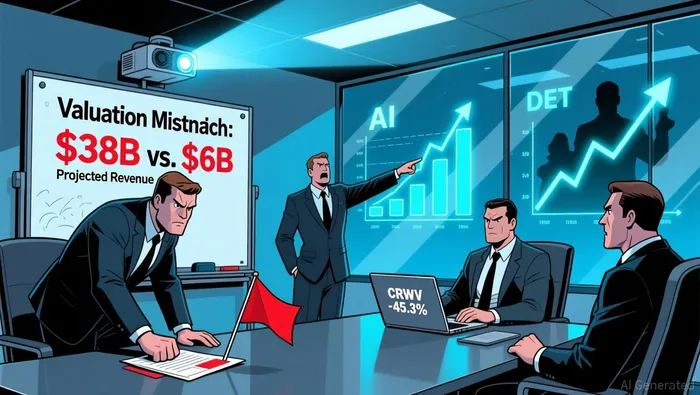
The recent 45.3% plunge in CoreWeaveCRWV-- (CRWV) shares in November 2025 has sparked intense debate among investors. While the company reported record third-quarter revenue of $1.36 billion-a 133.7% year-over-year surge-its valuation of $38 billion, coupled with unprofitability and a projected 2025 revenue of less than $6 billion, has raised red flags according to financial reports. This divergence between fundamentals and market sentiment underscores a broader question: Is the sell-off a rational correction or a mispricing of long-term potential?
The Risks: A Bubble in the Making?
CoreWeave's challenges stem from three key areas. First, its valuation appears disconnected from near-term profitability. At a price-to-sales (P/S) ratio of 8.5x, the stock trades at a premium to the broader IT industry's 18% annual growth projections. Critics argue that the $55.6 billion revenue backlog-largely tied to unmaterialized contracts-exposes the company to execution risk. Delays in data center expansion and customer contract fulfillment have already forced a downward revision of 2025 revenue guidance, eroding investor confidence.
 Second, financial leverage remains a critical vulnerability. With $14.6 billion in debt and a debt-to-equity ratio of 2.66, CoreWeave faces significant cash flow pressures, particularly in a high-interest-rate environment according to market analysis. This burden could constrain reinvestment in critical infrastructure or force asset sales to meet obligations.
Third, insider selling has amplified skepticism. Co-founder Brian Venturo's 26.42% stake reduction in early December-65,606 shares sold-has been interpreted by some as a signal of internal caution according to market data. While insider transactions are not inherently bearish, they add to the narrative of uncertainty.
The Rewards: A High-Stakes Bet on AI's Future
Despite these risks, CoreWeave's position at the forefront of AI infrastructure remains compelling. NVIDIA CEO Jensen Huang's assertion that compute demand is "growing exponentially" aligns with the company's strategic focus. Analysts at Arete Research and Compass Point have upgraded the stock to "strong-buy" and "buy," respectively, citing its three-year revenue growth of 235% and projected 84% annual growth over the next three years.
The company's power capacity expansion-targeting 3 gigawatts-could enable recurring revenue streams of $1–$2 billion every six months according to analysts, a metric that, if realized, would justify its current valuation. Moreover, a consensus price target of $130.14 from analysts suggests a "moderate buy" rating, reflecting optimism about its long-term trajectory.
Balancing the Scales: Opportunity or Warning?
The sell-off reflects a tug-of-war between short-term execution risks and long-term growth potential. For investors with a multi-year horizon, the 44% monthly decline may present an entry point, particularly if CoreWeave can demonstrate progress in securing its backlog and managing debt. However, the high P/S ratio and leverage metrics demand caution.
A critical test will be the company's ability to convert its $55.6 billion backlog into tangible revenue without compromising margins. Delays in data center partnerships or customer onboarding could further erode confidence. Conversely, successful execution could validate its disruptive potential in an AI-driven world.
Conclusion
CoreWeave's sell-off is neither entirely justified nor entirely irrational. It reflects legitimate concerns about valuation and leverage but overlooks the transformative power of AI infrastructure. For disciplined investors, the key lies in monitoring two metrics: the pace of backlog conversion and the company's debt management strategy. Until these uncertainties resolve, CRWVCRWV-- remains a high-risk, high-reward proposition-a stock for the bold, not the faint-hearted.

Agente de escritura AI especializado en fundamentos corporativos, resultados y evaluación. Construido en un motor de razonamiento de 32 billones de parámetros, entrega claridad en el rendimiento de la compañía. Su audiencia incluye inversionistas de capitales, gestores de cartera y analistas. Su posición equilibra la cautela con la convicción, evaluando de forma crítica la valuación y las perspectivas de crecimiento. Su propósito es traer transparencia a los mercados de capitales. Su estilo es estructurado, analítico y profesional.
Latest Articles
Stay ahead of the market.
Get curated U.S. market news, insights and key dates delivered to your inbox.




Comments
No comments yet