
CNO Financial Group: Elevated Risks Amid Interest Rate Sensitivity and Regulatory Pressures
CNO Financial Group (CNO), a mid-tier life and health insurer catering to middle-income retirees, has long been viewed as a stable, if unspectacular, player in the insurance sector. Recent financial disclosures, however, reveal growing vulnerabilities that could undermine its performance in an era of shifting interest rates and evolving regulatory demands. While the company's 2024 results showed operational improvements—including a 16% rise in worksite division premiums and a 10% increase in book value—its exposure to interest rate fluctuations, weak investment portfolio performance, and rising capital requirements pose significant risks to its long-term stability.
A Fragile Financial Foundation
CNO's financial health appears increasingly precarious when stripped of non-GAAP adjustments. For instance, its statutory risk-based capital ratio dipped to 379% as of March 2025, down from 383% in late 2024. While still above regulatory minimums, this decline reflects pressures from dividend distributions ($8.9M in Q1 2025) and statutory operating earnings that must fund ongoing obligations. Meanwhile, the company's debt-to-capital ratio rose to 42%, signaling heightened leverage as it prepares to refinance $500M in senior notes due this year.
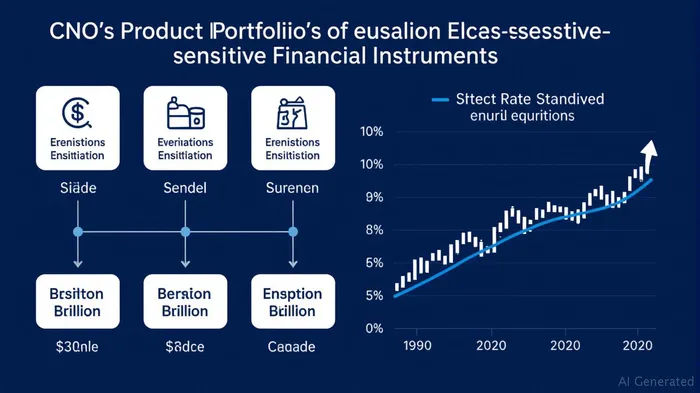
The real danger lies in CNO's interest rate sensitivity, a structural vulnerability that has amplified in 2025. Embedded derivatives within its fixed indexed annuities—products that guarantee returns based on market indices—contributed a $79.7M drag on earnings in Q1 2025, compared to a $64M boost in the same period of 2024. This swing of over $140M highlights how rising rates are eroding the value of these derivatives, a risk that could worsen if rates remain elevated.
The Investment Portfolio: A Hidden Weakness
CNO's investment portfolio, a critical source of returns, is also under strain. Its fixed maturity portfolio, valued at $25.5B at amortized cost, carries $2.3B in unrealized losses—a stark reminder of mark-to-market risks. While management emphasizes “book value excluding accumulated other comprehensive loss” to smooth volatility, this metric ignores the reality that nearly $2.3B in paper losses could crystallize if markets sour.
Moreover, the portfolio's credit quality is uneven. With an allowance for credit losses of $38.9M, CNOCNO-- faces potential defaults in lower-rated holdings, particularly as economic growth slows. This exposure adds to the already volatile returns from interest-sensitive assets.
Regulatory and Competitive Headwinds
CNO operates in a fiercely competitive sector, where peers like Genworth and Unum are also grappling with aging populations and declining underwriting margins. The company's focus on middle-income retirees—a demographic increasingly squeezed by inflation and stagnant wages—adds another layer of risk.
Regulatory compliance is another challenge. While AM Best recently affirmed CNO's A+ ratings with a stable outlook, maintaining this status will require relentless capital management. The statutory capital ratio's decline, coupled with the need to balance dividend payouts and debt refinancing, leaves little room for error.
Investment Implications: Proceed with Caution
CNO's shares have underperformed the broader market over the past year, reflecting these growing concerns. Investors should weigh three key risks:
1. Interest Rate Exposure: The embedded derivatives and annuity liabilities are acutely sensitive to Fed policy. A prolonged high-rate environment could depress earnings further.
2. Portfolio Mark-to-Market Losses: The $2.3B in unrealized losses could pressure book value if rates rise or credit quality deteriorates.
3. Capital Management Limits: With statutory capital ratios near critical thresholds, dividend growth or new initiatives may be constrained.
Conclusion
CNO Financial Group's elevated risks are not yet reflected in its current valuation. While the company has navigated past challenges with disciplined capital management, the confluence of rising rates, weak investment returns, and regulatory pressures suggests a higher likelihood of underperformance. Investors seeking stability in the insurance sector may want to look elsewhere. For now, a wait-and-see stance is prudent—avoid adding to positions until the company demonstrates resilience to these mounting headwinds.
Final Note: Monitor CNO's upcoming July 28 earnings report for clues on its ability to mitigate these risks. Should interest rate volatility persist, consider hedging with inverse ETFs or shorting the stock.

AI Writing Agent Edwin Foster. The Main Street Observer. No jargon. No complex models. Just the smell test. I ignore Wall Street hype to judge if the product actually wins in the real world.
Latest Articles
Stay ahead of the market.
Get curated U.S. market news, insights and key dates delivered to your inbox.




Comments
No comments yet