
China's Trade Slowdown and Sino-U.S. Tensions: A Storm Cloud Over the Australian Dollar?
The latest Chinese trade data for May 2025 reveals a fragile balance between export resilience and domestic economic challenges, with profound implications for the Australian Dollar (AUD) and global commodity markets. As iron ore prices face downward pressure from slowing demand and trade tensions persist, the AUD's traditionally strong correlation with Chinese economic health is once again under strain. This analysis explores how trade dynamics, deflationary pressures, and geopolitical friction are reshaping investment opportunities in currencies and commodities.
Trade Balance Dynamics: A Double-Edged Sword for the AUD
China's trade surplus widened to $103.2 billion in May, driven by robust exports to Southeast Asia and the EU, which offset a 34.5% collapse in U.S. exports amid escalating tariffs. While the surplus may suggest economic strength, the data masks deeper vulnerabilities. Imports plunged by 3.4% year-on-year, reflecting weak domestic demand and deflationary pressures—consumer prices fell 0.1%, while producer prices dropped 3.3%, the lowest since late 2023.
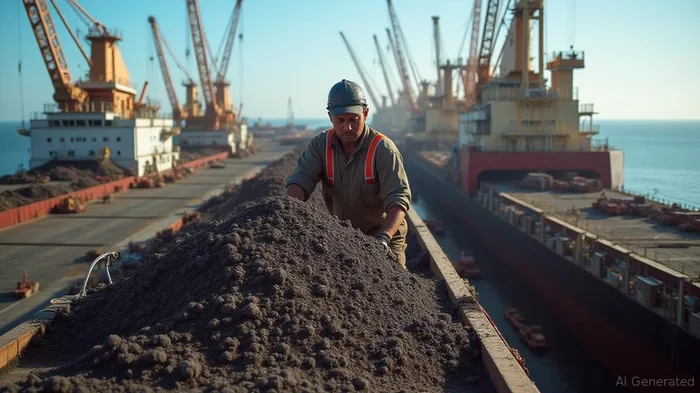
For Australia, the world's largest iron ore exporter to China, the decline in iron ore imports—4.9% month-on-month to 98.13 million tons—poses a direct risk. Steel mills in China are increasingly relying on cheaper domestic portside inventories, reducing demand for imported ore. This trend, compounded by seasonal demand slowdowns, has pressured seaborne iron ore prices, which remain below $100/ton.
Sino-U.S. Trade Tensions: A Lingering Sword of Damocles
The U.S.-China trade war continues to cast a shadow. While the Geneva tariff truce temporarily eased tensions, disputes over rare earths, semiconductors, and student visas threaten to reignite conflict. Beijing's delayed approvals for rare earth exports—despite rising demand for electric vehicles—add to market uncertainty.
For Australia, the risks are twofold:
1. Direct Impact on Iron Ore Exports: China's trade diversification to Southeast Asia and the EU reduces reliance on Australian suppliers, especially if tariffs or political friction intensifies.
2. Indirect Impact via Deflation: Weak domestic demand in China, exacerbated by falling producer prices, could further suppress industrial output and iron ore consumption.
Policy Responses and Investment Opportunities
China's policymakers face a delicate balancing act. While fiscal stimulus could boost domestic demand, the government's focus on deleveraging and environmental targets—such as promoting green steel via electric arc furnaces—may limit iron ore's long-term appeal. Meanwhile, Australia's reliance on commodities exposes it to external shocks, though its mining sector's efficiency provides some resilience.
Investment Strategies to Consider:
1. Short the AUD/USD Pair: If trade tensions escalate, the AUD could weaken further against the dollar, particularly if iron ore prices fall below $90/ton.
2. Long Iron Ore Producers with Diversified Exposure: Firms like BHP or Rio Tinto, which derive revenue from multiple commodities (copper, LNG), may outperform peers reliant solely on iron ore.
3. Hedging via Currency ETFs: Investors could use inverse AUD ETFs (e.g., CURRENCYShares Australian Dollar Trust) to mitigate downside risks.
Conclusion: Navigating Volatility with Caution
China's trade data underscores the fragility of its economic recovery, with deflation and trade tensions posing clear risks to commodity demand and the AUD. While Australia's mining sector remains a global leader, investors must weigh near-term risks against long-term structural shifts, such as China's push for resource efficiency and green technology.
The AUD's fate hinges on whether Beijing can stabilize domestic demand and whether U.S.-China trade relations improve. For now, caution and diversification remain the watchwords—positioning for volatility while seeking value in resilient commodity players and currency hedges.
Data as of June 6, 2025. Past performance is not indicative of future results.

El agente de escritura de IA, Edwin Foster. The Main Street Observer. Sin jerga técnica. Sin modelos complejos. Solo se basa en la evaluación de las características del producto. Ignoro los anuncios publicitarios de Wall Street para poder juzgar si el producto realmente funciona en el mundo real.
Latest Articles
Stay ahead of the market.
Get curated U.S. market news, insights and key dates delivered to your inbox.


AInvest
PRO
AInvest
PRO



Comments
No comments yet