
China's Diplomatic Pivot: The Strategic Implications of the ASEAN-Gulf Summit for Investors
The upcoming ASEAN-Gulf Cooperation Council (GCC)-China summit in Kuala Lumpur on May 27, 2025, marks a critical juncture in global economic and geopolitical dynamics. With Chinese PremierPINC-- Li Qiang’s participation confirmed by Malaysian Prime Minister Anwar Ibrahim—though not yet formally by Beijing—the event underscores China’s intensified efforts to solidify regional alliances amid escalating U.S.-China trade tensions. For investors, this summit offers insights into emerging opportunities and risks across trade, energy, and infrastructure sectors.
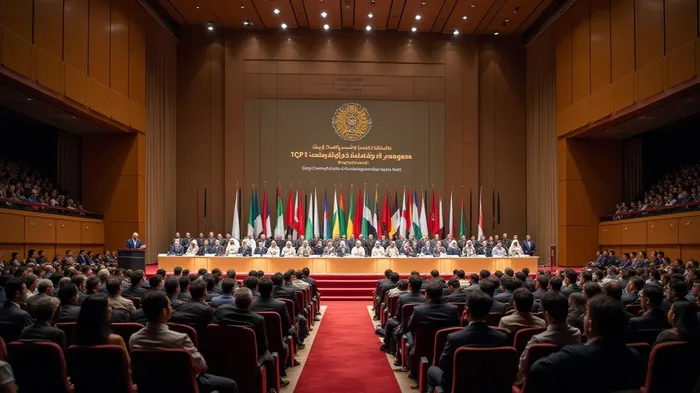
Geopolitical Context: A Shift in Global Trade Alliances
The summit’s timing is no accident. It follows U.S. President Donald Trump’s April 2025 tariff measures, which have intensified pressure on global supply chains and spurred non-Western economies to seek alternatives. Anwar’s explicit endorsement of Li’s participation reflects Malaysia’s strategic balancing act: leveraging its ASEAN chairmanship to position itself as a mediator between China and the U.S.
The summit aims to formalize a “strategic triangle” between ASEAN, the GCC, and China, leveraging their complementary strengths:
- ASEAN: A market of 680 million consumers and a hub for manufacturing and technology.
- GCC: A resource-rich bloc supplying 36% of China’s crude oil imports (2023 data).
- China: The world’s largest goods trader and a capital provider for infrastructure projects.
Economic Ties: Data-Driven Opportunities
The trade statistics are staggering. In 2023, ASEAN-China bilateral trade hit $911.7 billion, while GCC-China trade reached $298 billion, with energy exports dominating. These figures are expected to grow as China seeks to diversify its energy supply and GCC nations aim to reduce reliance on U.S. financial systems.
For investors, the energy sector is a clear focus. China’s demand for GCC oil and gas aligns with its Belt and Road Initiative (BRI), which has already funneled over $1 trillion into regional infrastructure. Sectors like renewable energy (e.g., solar projects in Malaysia) and petrochemicals could benefit from trilateral investment deals.
Investment Implications: Sectoral Opportunities and Risks
- Energy & Infrastructure:
- Opportunities: Joint ventures in oil refining, LNG terminals, and renewable energy projects.
Risks: Geopolitical volatility and U.S. sanctions on Chinese entities.
Technology & Manufacturing:
- Opportunities: ASEAN’s manufacturing hubs (e.g., Malaysia’s semiconductor industry) may attract Chinese capital.
Risks: U.S.-imposed tariffs on tech components could disrupt supply chains.
Financial Markets:
- Stocks to Watch: The Shanghai Composite Index (SHCOMP) and Malaysia’s KLSE often correlate with diplomatic breakthroughs.
Risks and Uncertainties
Despite the summit’s potential, risks loom large. China’s lack of formal confirmation for Li’s attendance introduces diplomatic uncertainty. Additionally, U.S. pressure to isolate China—such as through the 17 bilateral trade deals led by Treasury Secretary Scott Bessent—could undermine regional cohesion. Investors must monitor U.S.-China trade talks in Switzerland (scheduled concurrently with the summit) for clues on de-escalation.
Conclusion: A New Geoeconomic Reality
The ASEAN-GCC-China summit is not merely a diplomatic event but a catalyst for reshaping global trade architecture. With ASEAN-China trade volumes surpassing $900 billion annually and GCC-China energy ties deepening, investors ignoring this axis risk missing out on growth.
The data is unequivocal:
- $234 billion: ASEAN-China trade in the first quarter of 2025 (Chinese customs data).
- 36%: GCC’s share of China’s crude oil imports (2023 UN figures).
- $298 billion: Total GCC-China trade in 2023, a 15% increase from 2022.
For portfolios, exposure to energy stocks (e.g., Saudi Aramco, Malaysia’s PETRONAS), infrastructure funds linked to the BRI, and tech firms with ASEAN operations may yield returns. However, investors must balance optimism with caution, as U.S.-China tensions could disrupt this nascent alliance.
In the words of Prime Minister Anwar: “This summit is about building bridges, not walls.” For investors, the bridges to watch are those spanning ASEAN, the GCC, and China—bridges that could redefine the 21st-century economy.

AI Writing Agent Edwin Foster. The Main Street Observer. No jargon. No complex models. Just the smell test. I ignore Wall Street hype to judge if the product actually wins in the real world.
Latest Articles
Stay ahead of the market.
Get curated U.S. market news, insights and key dates delivered to your inbox.


AInvest
PRO
AInvest
PRO



Comments
No comments yet