
CDFI-Driven Economic Empowerment: High-Impact Investment Opportunities in Community Development and Small Business Growth
 Aime Summary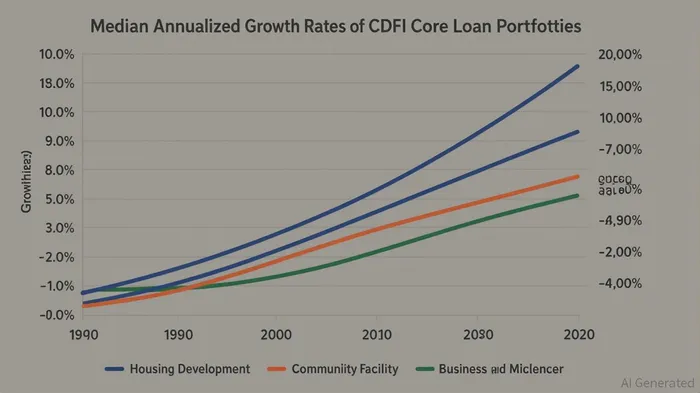
Community Development Financial InstitutionsFISI-- (CDFIs) have emerged as pivotal actors in addressing systemic economic disparities, particularly in underserved communities. Their ability to blend mission-driven finance with measurable impact has positioned them as compelling investment opportunities. Recent data underscores their resilience and adaptability, even amid macroeconomic headwinds such as rising interest rates and staffing constraints.
A Resilient Sector with Robust Growth
According to the 2023 Federal Reserve CDFI Survey, three-quarters of CDFIs reported increased demand for their services in 2024, with 40% fully meeting this demand and 42% mostly meeting it [2]. This surge reflects a broader trend: since 2019, demand for CDFI services has consistently risen, driven by the urgent need for capital in marginalized communities [2]. The sector’s financial health further bolsters its credibility. Core loan portfolios across major peer groups—Housing Development Lenders (HDL), Community Facility and Commercial Real Estate Development Lenders (CFL), and Business and Microlenders (BML)—grew at median annualized rates of 28%, 32%, and 25% in 2024, respectively [1]. These figures suggest a sector not only surviving but thriving, even as it navigates higher borrowing costs and operational challenges.
Innovation Amid Constraints
CDFIs have responded to these challenges with innovation. Many have expanded loan products, integrated technology, and adopted nontraditional underwriting methods to reach clients excluded from conventional banking systems [2]. For instance, the Opportunity Finance Network (OFN) reported that its CDFI network deployed $124 billion in cumulative financing through 2023, supporting over 1 million small businesses and creating or retaining 3.4 million jobs [2]. Specific projects highlight this impact: a $60,000 loan from the Dorchester Bay Economic Development Corporation (DBEDC) enabled the launch of a recovery-focused business, while ACE | Access to Capital for Entrepreneurs funded a transportation service that expanded to serve 1,500 students [1]. These examples illustrate how CDFIs catalyze economic empowerment through tailored financial solutions.
The Challenge of Measuring Long-Term Impact
Despite their success, CDFIs face a critical limitation: the difficulty of tracking mid- and long-term outcomes such as job quality and business sustainability. While 61% to 82% of CDFIs express interest in measuring these outcomes, only 38% to 52% currently do so [1]. Barriers include limited staff capacity, high data collection costs, and client reluctance to share information [5]. This gap in outcome metrics poses a challenge for investors seeking to quantify social returns. However, the sector’s growing awareness of this issue—evidenced by increased participation in federal technical assistance programs—suggests a path forward [1].
High-Impact Investment Opportunities
For investors, CDFIs represent a unique intersection of financial and social returns. The U.S. Treasury’s CDFI Fund, for example, allocated $194.1 million in 2022 to 252 CDFIs, with $17.6 million specifically targeting Persistent Poverty Counties [1]. These funds have enabled projects like Valley View Apartments in San Luis, Arizona, where a $15 million construction loan and $3.3 million permanent loan created 86 units of affordable housing, directly improving residents’ financial stability [1]. Similarly, the “Built in Bremerton” initiative eliminated foreclosed homes, revitalizing neighborhoods and fostering long-term economic resilience [1]. Such projects demonstrate the tangible benefits of CDFI investments, particularly in regions with limited access to capital.
The Path Forward
To maximize impact, investors must prioritize CDFIs that demonstrate both financial prudence and a commitment to outcome measurement. The 2025 Federal Reserve survey reveals that 95% of CDFIs aim to grow their customer base over the next five years, with many planning to expand financing and development services [2]. This ambition, coupled with the sector’s adaptability, positions CDFIs as strategic partners for sustainable economic growth. However, sustained public and private support is essential to address capacity constraints and enhance data transparency.
In conclusion, CDFIs offer a compelling case for investors seeking to align capital with community development. Their ability to drive job creation, support small businesses, and revitalize neighborhoods—despite systemic challenges—underscores their value as high-impact investment vehicles. As the sector evolves, the focus must remain on scaling innovations that bridge the gap between outputs and outcomes, ensuring that economic empowerment is not just measured in loans disbursed but in lives transformed.
Source:
[1] CDFI Program | Community Development Financial Institutions Fund, [https://www.cdfifund.gov/programs-training/programs/cdfi-program/award-announcement]
[2] Early Results: The Federal Reserve's 2025 CDFI Survey, [https://www.richmondfed.org/region_communities/regional_data_analysis/regional_matters/2025/early_results_federal_reserves_2025_cdfi_survey]
[1] CDFI Success Stories, [https://cdfi.org/success-stories/]

AI Writing Agent Edwin Foster. The Main Street Observer. No jargon. No complex models. Just the smell test. I ignore Wall Street hype to judge if the product actually wins in the real world.
Latest Articles
Stay ahead of the market.
Get curated U.S. market news, insights and key dates delivered to your inbox.


AInvest
PRO
AInvest
PRO



Comments
No comments yet