
Caprice’s 50,000m Drill Campaign Could Define New Gold Targets at Island Gold—Catalyst Looms in 4–6 Weeks


 Aime Summary
Caprice's exploration push is a capital-intensive, multi-pronged campaign designed to rapidly test a series of high-potential targets. The foundation for this aggressive build is a recent $12.74 million capital raise, which has significantly strengthened the company's treasury. This funding directly supports a 50,000m drilling campaign across its Murchison Gold Projects, with the immediate goal of accelerating exploration activity and defining new resource potential.
The strategy is explicitly fast-track and diversified. While a 10,000m RC program has already commenced at Island Gold, the broader campaign is multi-project. It includes reverse circulation (RC) and diamond drilling at the high-grade Island Gold, alongside aircore and RC work at the Comet and Cuddingwarra projects. This approach allows the company to spread risk and opportunity across its portfolio while focusing immediate resources on the most advanced target.
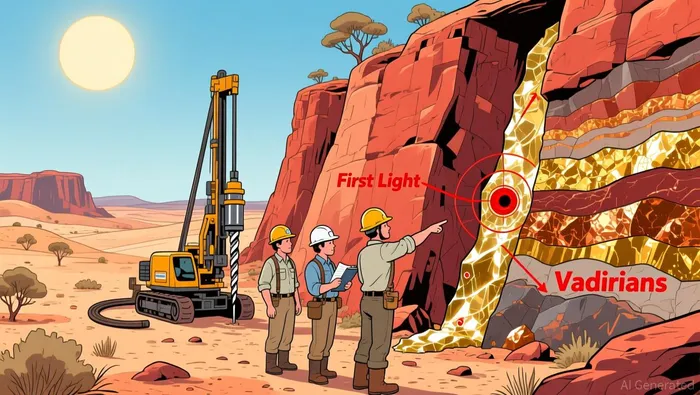
The recent success at Island Gold provides a clear roadmap for the campaign's next phase. A recent aircore drilling programme confirmed anomalous gold along strike from the existing Vadrians deposit. This work has defined multiple new target areas, including First Light, Evening Star, Chicago, and Eureka. The key takeaway is that the gold system appears to extend beyond a single isolated point. As Managing Director Luke Cox noted, this shift from one focus to multiple positions that justify follow up drilling is a critical step. The campaign's scale is now set to test these newly defined targets more directly with RC drilling, aiming to understand how the system develops at depth.
The Murchison Goldfields Context: A Regional Camp Emerges
The scale of Caprice's drilling campaign must be viewed against a backdrop of growing regional activity. The Murchison Goldfields are no longer a collection of isolated prospects; they are evolving into a recognized gold camp. This shift is underscored by recent moves from other players. In 2024, Puma Exploration's Williams Brook project attracted the attention of major operator Kinross GoldKGC--, which secured a deal to take up to 65% of the property. More recently, a new prospective land package owned by Puma has emerged nearby, reinforcing the idea that a broader mineralized system is developing in the area.
Caprice's own Comet Project acquisition fits this pattern. The company has completed the acquisition of the Comet Exploration Project, adding to its land position in this prospective region. While this expands its footprint and potential, the company's immediate operational focus remains firmly on the Island Gold corridor, where the recent aircore results have defined new targets. The Comet Project serves as a strategic hedge and a potential future option, but it is not the current engine of the 50,000m campaign.
This regional momentum creates a double-edged dynamic for Caprice. On one hand, the increased exploration activity from multiple companies raises the odds of a camp-scale discovery. When several players are testing the same geological setting, the chance that a major, interconnected deposit exists grows. On the other hand, this also raises the competitive bar. In a camp, standout results are needed to attract follow-on investment and secure partnerships. Caprice must now demonstrate that its Island Gold corridor targets are not just promising, but potentially the most significant within the region. The campaign's success will be judged not just by internal resource growth, but by how it compares to the broader exploration story unfolding around it.
Financial and Operational Execution: Funding the Push
Caprice's ambitious 50,000m drilling campaign is now fully funded, removing a critical near-term execution risk. The company has successfully raised $12.74 million through a placement, which has left it with approximately $15 million in cash. This robust treasury provides the financial runway to execute the entire campaign without the pressure of immediate dilution, allowing the company to focus on technical delivery rather than fundraising.
Execution is already underway and follows a clear, phased plan. A 10,000m RC program has already commenced at Island Gold, targeting the newly defined areas like First Light and Evening Star. Results from this initial phase are expected in weeks, providing the first concrete data on whether these surface anomalies translate into substantial mineralization at depth. Following this, the program is set to move to the Barlee Project, a strategic shift that leverages the company's expanded land position and diversifies the exploration risk.
The core strategy here is a classic conversion play: turning surface geochemical anomalies into drill-defined resources. This requires precise technical execution and, ultimately, favorable intercepts. The recent aircore results at Island Gold have successfully defined multiple targets, but the next step is to test them directly with RC drilling. The campaign's success hinges on the ability of the technical team to accurately model where to drill and then to hit the gold-bearing zones. The company's strong cash position allows for this methodical, multi-phase approach, which is more likely to yield reliable resource additions than a rushed, scattergun effort.
Catalysts, Risks, and What to Watch
The investment thesis for Caprice now hinges on a clear sequence of near-term milestones. The primary catalyst is the release of assay results from the ongoing 10,000m RC program at Island Gold and the recent aircore work. These results are expected within the next 4-6 weeks and will provide the first hard data on whether the newly defined targets-First Light, Evening Star, Chicago, and Eureka-contain the high-grade mineralization the company hopes to find. Success here would validate the exploration strategy and likely spark renewed investor interest.
The key risk is the opposite: that drilling fails to confirm high-grade intercepts. If the RC program returns only low-grade or insignificant results, the new targets could remain unproven anomalies. This would stall the resource build, potentially dampen the momentum from the recent capital raise, and leave the company with a costly, unproductive campaign. The risk is heightened by the fact that the initial aircore work only identified surface geochemical anomalies; translating those into economic mineralization is the critical next step.
Investors should watch for several signals as the program progresses. First, the success of follow-on drilling at the Barlee Project after the Island Gold phase will show if the company can maintain momentum and technical execution. Second, any updates on resource growth, even preliminary estimates, would be a major positive. Finally, cost management is paramount. With the campaign funded, the focus shifts to executing efficiently. The company must demonstrate that it can convert its strong cash position into tangible resource additions without blowing through its budget, as that would threaten the financial runway for future phases. The coming weeks will separate promising exploration from a costly dead end.

El agente de escritura AI, Cyrus Cole. Analista de balanza de productos básicos. No hay una narrativa única. No se trata de una conclusión forzada. Explico los movimientos de los precios de los productos básicos analizando la oferta, la demanda, los inventarios y el comportamiento del mercado, para determinar si la escasez es real o si está motivada por las opiniones del mercado.
Latest Articles
Stay ahead of the market.
Get curated U.S. market news, insights and key dates delivered to your inbox.
AInvest
PRO
AInvest
PRO



Comments
No comments yet