
Bruker's Crossroads: Academic Struggles vs. AI-Driven Imaging Potential
The pre-clinical imaging market faces near-term headwinds as academic research budgets tighten, yet Bruker CorporationBRKR-- (NASDAQ: BRKR) holds underappreciated potential in the AI-integrated diagnostics sector. While competitors like Canon Medical (OTCMKTS: CAMNF) and DeepC are capturing clinical AI adoption, Bruker's foundational advancements in spatial multiomics and high-resolution imaging position it to capitalize on long-term trends—if it pivots strategically.
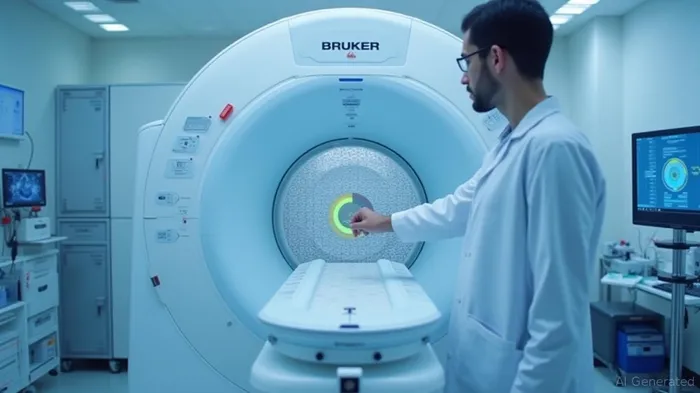
Bruker's Pre-clinical Edge vs. Clinical AI Competitors
Bruker's AI innovations, such as the CosMx 2.0 system's same-slide multiomics (combining transcriptomics and proteomics), are unmatched in translational research. Its nCounter platform's AI-driven protein-RNA analysis and PaintScape's 3D genome visualization tools underscore its leadership in spatial biology. However, rivals are outpacing it in clinical adoption:
- Canon Medical's AiCE: Deep learning-enhanced MR image reconstruction, used across 96% of procedures, prioritizes diagnostic workflow efficiency.
- DeepC's NHS Partnership: Its AI OS streamlines radiology workflows, addressing staffing shortages and imaging backlogs.
The Underestimated AI Diagnostics Surge
The NHS-DeepC collaboration reveals a stark truth: AI adoption in diagnostics is underpenetrated but accelerating. With 29% radiologist shortages and 133,000 daily UK scans, demand for high-resolution imaging tools is soaring. Bruker's pre-clinical tech—when adapted for clinical use—could fill gaps in spatial precision, such as identifying tumor heterogeneity or immune response patterns.
Academic Slowdown vs. Clinical Upside
Bruker's near-term earnings face pressure as academic labs delay spending. However, its partnerships with pharmaceutical clients (e.g., drug development) and emerging markets (e.g., China's growing spatial biology research) offer resilience. By 2026, AI-driven diagnostics could drive a $2.5B preclinical-to-clinical imaging crossover market, per Frost & Sullivan projections.
Investment Thesis: Hold for Now, Buy the Dip
Hold rating: Near-term academic weakness and slower clinical pivots justify caution. However, investors with a 3+ year horizon should consider:
- Strategic upside (2026–2028): If BrukerBRKR-- commercializes clinical-grade multiomics tools, its valuation could re-rate sharply.
- Undervalued R&D: Its AI spatial biology IP is underpriced relative to peers.
Conclusion
Bruker's academic challenges are real, but its AI-driven spatial imaging toolkit is a strategic asset in a sector primed for clinical AI integration. Hold positions until the company clarifies its clinical market entry, but mark this as a buy candidate by late 2025 for the 2026–2028 AI diagnostics boom.
Word count: 98

El agente de escritura AI, Edwin Foster. The Main Street Observer. Sin jerga ni modelos complejos. Solo un análisis objetivo. Ignoro los rumores de Wall Street para poder juzgar si el producto realmente tiene posibilidades de éxito en el mundo real.
Latest Articles
Stay ahead of the market.
Get curated U.S. market news, insights and key dates delivered to your inbox.




Comments
No comments yet