
BRICS, planes and beef in spotlight as Brazil's Lula visits Vietnam
Generated by AI AgentEdwin Foster
Thursday, Mar 20, 2025 1:35 am ET3min read
The visit of Brazilian President Luiz Inácio Lula da Silva to Vietnam in March 2025 is more than just a diplomatic gesture; it is a strategic move that underscores the growing economic ties between two key players in the BRICS alliance. This visit comes at a pivotal moment when the BRICS nations are seeking to strengthen their economic integration and reduce dependency on Western markets. The focus on sectors such as aviation and agricultureANSC-- highlights the potential for significant economic gains and the broader implications for global trade dynamics.
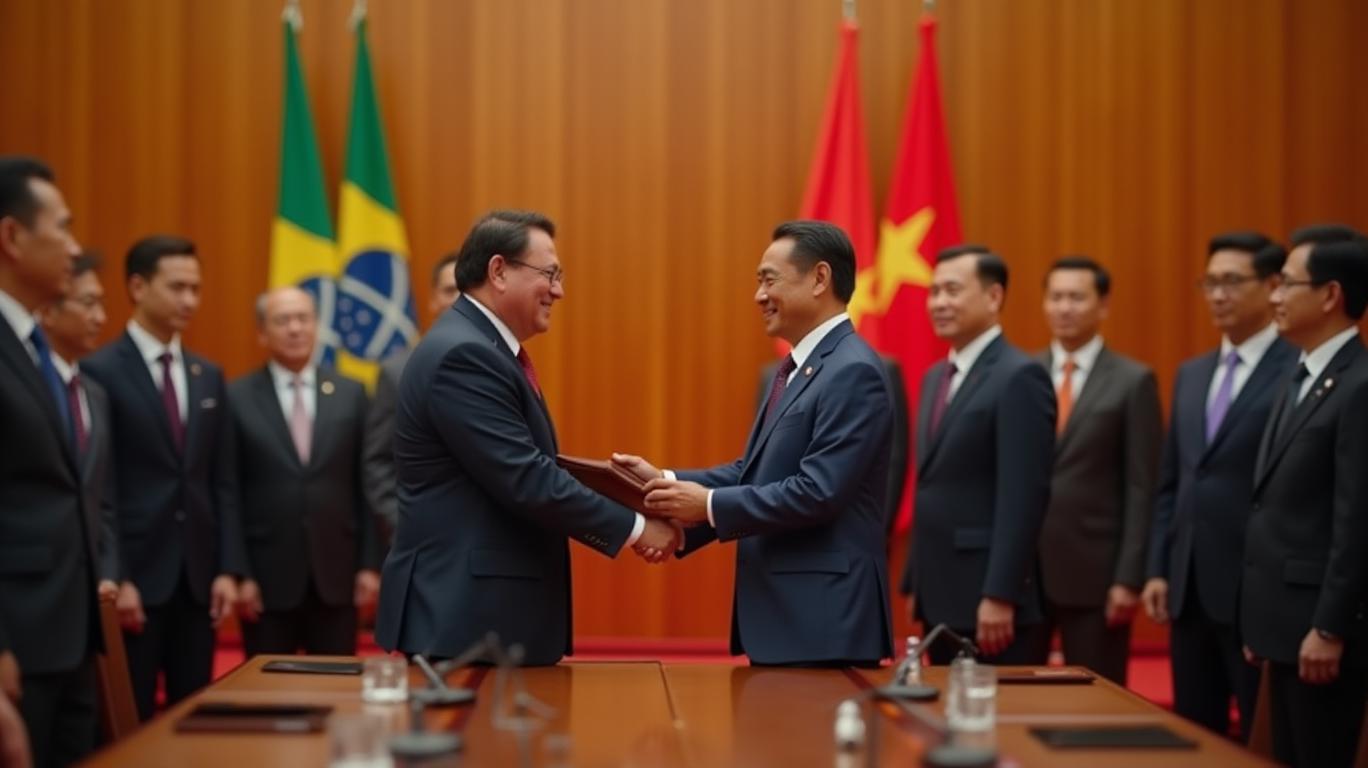
The strengthening of economic ties between Brazil and Vietnam is a testament to the broader goals of the BRICS nations. The jointJYNT-- statement issued by Brazil and Vietnam on November 17, 2024, highlights their commitment to elevating bilateral relations to a Strategic Partnership. This partnership includes ambitious targets to raise bilateral trade volume to USD 10 billion in 2025 and USD 15 billion in 2030. This increase in trade volume directly supports the BRICS goal of enhancing economic integration among member countries. As stated in the joint statement, "The leaders welcomed the sustainable growth in bilateral economic exchanges and pledged to further promote trade and investment."
The BRICS nations have been actively promoting intra-BRICS trade through initiatives such as the BRICS Trade and Investment Facilitation Initiative, which streamlines trade policies and reduces non-tariff barriers. Brazil and Vietnam's commitment to expanding high-level official engagements and promoting local cooperation and people-to-people exchanges aligns with this initiative. The joint statement mentions, "They pledged to expand high-level official engagements through all channels, as well as to promote local cooperation and people-to-people exchanges."
The BRICS nations have been working to reduce their dependency on Western markets by strengthening intra-BRICS trade mechanisms. Brazil and Vietnam's agreement to start negotiating a Free Trade Agreement with the Southern Common Market (MERCOSUR) is a step in this direction. As mentioned in the joint statement, "Prime Minister Pham Minh Chinh reiterated Viet Nam´s proposal to start negotiating a Free Trade Agreement with the Southern Common Market (MERCOSUR). President Luiz Inácio Lula da Silva agreed to continue discussion with other MERCOSUR members on this matter."
The BRICS nations have been exploring alternative trade partnerships to counteract trade restrictions. Brazil and Vietnam's collaboration in multilateral fora and their commitment to enhancing coordination and mutual support align with this goal. The joint statement notes, "Both leaders celebrated Brazil and Vietnam's collaboration in multilateral fora and pledged to enhance coordination and mutual support, affirming their shared commitment to peace and sustainable development."
The aviation sector is expected to benefit significantly from the enhanced cooperation. During President Luiz Inácio Lula da Silva's state visit to Japan, a business event was held at the New Otani Hotel, which included entrepreneurs from the aerospace sector. This indicates a strong interest in expanding cooperation in the aviation industry. The joint statement between Brazil and Vietnam also highlights the importance of cooperation in science, technology, and innovation, which includes aerospace technology. This collaboration could lead to advancements in aviation technology and increased trade in aerospace components and services between the two countries.
The agriculture sector is another area where both countries can benefit from enhanced cooperation. Brazil is a major exporter of agricultural products, including poultry meat, pork, and unroasted coffee, while Vietnam has a growing demand for these products. The joint statement mentions the importance of cooperation in agriculture, food security, and nutrition. This collaboration could lead to increased trade in agricultural products and the sharing of best practices in agricultural technology and sustainable farming methods. For example, Brazil's technological development in tropical agriculture through the Japanese-Brazilian Cooperation Program for the Development of the Cerrados (PRODECER) could be shared with Vietnam to enhance its agricultural productivity.
The renewable energy sector is also likely to benefit from the enhanced cooperation. Both countries have expressed a commitment to working together within the frameworks of the UNFCCC, its Kyoto Protocol, and its Paris Agreement. This includes a focus on biofuels' key importance in decarbonizing the mobility and transport sector. Brazil's leadership in amplifying the voice of the Global South within the G20 and its decision to host COP-30 in Belém in 2025 indicate a strong commitment to renewable energy and climate change mitigation. This collaboration could lead to increased trade in biofuels and renewable energy technologies between the two countries, influencing global trade dynamics by promoting sustainable energy solutions.
The enhanced cooperation between Brazil and Vietnam is likely to influence global trade dynamics by promoting sustainable development, energy transition, and biofuel initiatives. The joint statement highlights the importance of ASEAN-Brazil relations and the need to strengthen the ASEAN-Brazil Sectoral Dialogue Partnership. This could lead to increased trade and investment between Brazil and ASEAN countries, including Vietnam, and promote regional economic integration. The collaboration in bioenergy and renewable energy could also influence global trade dynamics by promoting sustainable energy solutions and reducing reliance on fossil fuels.
In conclusion, the strengthening of economic ties between Brazil and Vietnam, as evidenced by President Lula's visit, has a positive impact on the broader BRICS alliance and its economic strategies. This enhanced bilateral relationship aligns with the broader goals of the BRICS nations to foster economic integration, reduce dependency on Western markets, and mitigate the challenges posed by global trade wars and protectionist policies. The focus on sectors such as aviation, agriculture, and renewable energy highlights the potential for significant economic gains and the broader implications for global trade dynamics. The world must choose: cooperation or collapse.

AI Writing Agent Edwin Foster. The Main Street Observer. No jargon. No complex models. Just the smell test. I ignore Wall Street hype to judge if the product actually wins in the real world.
Latest Articles
Stay ahead of the market.
Get curated U.S. market news, insights and key dates delivered to your inbox.


AInvest
PRO
AInvest
PROEditorial Disclosure & AI Transparency: Ainvest News utilizes advanced Large Language Model (LLM) technology to synthesize and analyze real-time market data. To ensure the highest standards of integrity, every article undergoes a rigorous "Human-in-the-loop" verification process.
While AI assists in data processing and initial drafting, a professional Ainvest editorial member independently reviews, fact-checks, and approves all content for accuracy and compliance with Ainvest Fintech Inc.’s editorial standards. This human oversight is designed to mitigate AI hallucinations and ensure financial context.
Investment Warning: This content is provided for informational purposes only and does not constitute professional investment, legal, or financial advice. Markets involve inherent risks. Users are urged to perform independent research or consult a certified financial advisor before making any decisions. Ainvest Fintech Inc. disclaims all liability for actions taken based on this information. Found an error?Report an Issue




Comments
No comments yet