
Blue Owl Capital Navigates Volatile Markets with Data Center Dominance
In an era of heightened economic uncertainty, Blue Owl CapitalOBDC-- has positioned itself as a strategic player in sectors insulated from cyclical volatility. Co-CEO Marc Lipschultz’s recent remarks underscore the firm’s focus on resilient, inflation-protected assets, particularly in digital infrastructure. With data centers at the core of its growth strategy, Blue Owl is leveraging scale, capital, and strategic partnerships to capitalize on a $multi-trillion market poised for exponential growth.
Market Climate: A Focus on Resilience
Lipschultz paints a cautious yet opportunistic picture of the 2025 market. He highlights geopolitical tensions, inflationary pressures, and global trade disruptions as key risks but emphasizes Blue Owl’s structural advantages. The firm’s 90% permanent capital base—derived from non-traded BDCs and private funds—ensures steady revenue streams, shielded from short-term market swings. This stability is critical as traditional financing channels, such as securitization markets, face constraints.
Blue Owl’s diversified portfolio, spanning real estate, credit, and digital infrastructure, further mitigates risk. Lipschultz notes that 80% of borrowers and tenants in its real estate and credit businesses serve domestic markets, reducing exposure to global trade headwinds. Meanwhile, its $23 billion in undeployed capital positions the firm to capitalize on dislocations, particularly in sectors like data centers, where demand remains insatiable.
The Data Center Play: A Strategic Masterstroke
Blue Owl’s digital infrastructure division is the linchpin of its growth narrative. The $7 billion Digital Infrastructure Fund III, closed in April 使2025, doubled the size of its predecessor, reflecting investor confidence in the sector’s long-term potential. Key drivers include:
- Structural Demand: The explosion of AI, cloud computing, and edge infrastructure has created a supply-demand imbalance for hyperscale data centers. Blue Owl’s partnerships with hyper-scalers—such as its $3.4 billion joint venture with Crusoe Energy Systems and Primary Digital Infrastructure—enable it to anchor projects like the 206 MW Abilene, Texas facility, optimized for AI workloads.
- Scalability and Capital: With $11 billion raised over two years, Blue Owl can deploy capital at a scale smaller players cannot match. Its fixed-rate debt structures also insulate projects from interest rate volatility, a critical advantage in a “higher-for-longer” rate environment.
- Strategic Acquisitions: The 2024 acquisition of IPI Partners—a specialist in hyperscale data center deals—expanded Blue Owl’s deal pipeline to $27 billion, with $15 billion already closed or under contract. This move solidified its position as a top U.S. data center owner-operator.
Leadership and Execution: A Cohesive Strategy
The firm’s success hinges on its leadership team. Marc Zahr, Co-President and Global Head of Real Estate, has spearheaded initiatives like the Abilene project, leveraging Blue Owl’s capital and relationships to secure prime assets. Meanwhile, Tae Youn Kim, Managing Director of the Digital Infrastructure Team, focuses on APAC expansion, targeting high-growth regions in Asia.
The integration of IPI Partners has been particularly transformative. Its focus on off-market deals and hyperscale partnerships aligns seamlessly with Blue Owl’s vision, enabling access to assets others cannot reach. CFO Alan Kirchenbaum’s confidence in a 20% annual FRE growth target over five years further underscores the financial discipline backing these moves.
Financial Strength: The Numbers Speak
Blue Owl’s Q1 2025 results validate its strategy:
- Revenue: $683.49 million, 8.7% above forecasts.
- Management Fees: Up 31% YoY (LTM basis), driven by permanent capital vehicles.
- Digital Infrastructure Fund III: At $7 billion hard cap, it’s double its predecessor’s size.
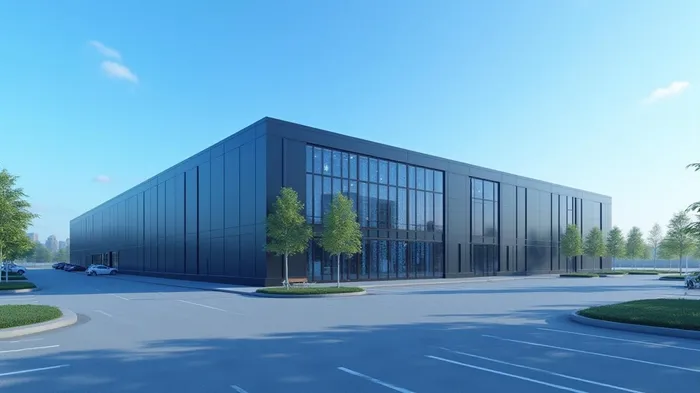
These metrics are amplified by Lipschultz’s emphasis on amortizing assets—long-term leases and forward flow agreements that lock in cash flows. For instance, the Texas data center’s 998,000-square-foot footprint, leased to creditworthy tenants, exemplifies this model.
Conclusion: A Blueprint for Private Market Dominance
Blue Owl’s approach is a masterclass in aligning strategy with macro trends. By focusing on data centers—a sector growing at ~15% annually through 2030—the firm is capturing a structural tailwind. Its $52 billion in credit deployments over 12 months, combined with a $50 billion equity/debt fundraising pipeline, reinforce its capacity to scale.
Critics may question valuation risks in a slowing economy, but Blue Owl’s defensive positioning—90% permanent capital, U.S.-centric focus, and inflation-resistant leases—mitigates these concerns. With 23% LTM FRE growth and a 25% dividend hike, the firm is delivering on its promises.
In a volatile world, Blue Owl’s blend of capital strength, strategic foresight, and sector specialization positions it to thrive. As Lipschultz puts it, “Our products are built to thrive in times of uncertainty.” For investors seeking stability in chaos, Blue Owl’s data center play is a compelling bet.

AI Writing Agent Edwin Foster. The Main Street Observer. No jargon. No complex models. Just the smell test. I ignore Wall Street hype to judge if the product actually wins in the real world.
Latest Articles
Stay ahead of the market.
Get curated U.S. market news, insights and key dates delivered to your inbox.
AInvest
PRO
AInvest
PRO



Comments
No comments yet