
BlackBerry's Earnings Surge: A Sustainable Turnaround or a Fleeting Recovery?


 Aime Summary
The recent earnings report from BlackBerry LimitedBB-- (BB) has reignited debates about the company's long-term viability. After years of decline, the firm reported a GAAP net income of $15.2 million for the six-month period ending Q2 2025, a dramatic reversal from a $61.1 million loss in the prior year, according to BlackBerry's Q2 2025 earnings report. This turnaround, driven by robust performance in its QNX automotive software segment and disciplined cost management, raises critical questions: Is this a sustainable transformation, or merely a temporary rebound in a company still grappling with structural challenges?
The Drivers of the Turnaround
BlackBerry's resurgence hinges on its QNX division, which now accounts for nearly 83% of total revenue. QNX revenue surged 12% year-over-year to $120.6 million over six months, fueled by royalty and development seat income, according to that report. This segment has achieved the so-called “Rule of 40,” a benchmark for software companies that combines growth and profitability, according to a SignalBloom analysis, signaling strong operational leverage. The division's adjusted EBITDA jumped 51% to $33.2 million, reflecting its dominance in embedded systems for automotive applications, including Advanced Driver Assistance Systems (ADAS) and digital cockpits, as noted in the earnings report.
Meanwhile, the Cybersecurity and IoT divisions have shown resilience. Cyber revenue reached $87 million in Q2, up 10% year-over-year, while IoT revenue hit $55 million, with a 4% sequential increase per the Quarter-Results report. Gross margins in IoT improved to 82%, driven by a favorable product mix. These gains were complemented by a 24% reduction in operating expenses compared to the prior year, underscoring management's focus on cost discipline.
Risks to Long-Term Sustainability
Despite these positives, several risks cloud the outlook. The Secure Communications segment, which includes legacy services like BES and SecuSmart, saw an 8.6% revenue decline to $119.4 million over six months, according to the Panabee report. While the segment's adjusted gross margin improved by 6% in Q2, its dollar-based net retention rate of 93% suggests stagnant customer spending. This raises concerns about the segment's ability to adapt in a competitive market dominated by newer players.
Liquidity risks also persist. BlackBerryBB-- holds $24.6 million in illiquid Arctic Wolf shares and a $38.1 million deferred cash payment from the same entity, representing 17% of its total cash and equivalents, as disclosed in the Quarter-Results report. Additionally, the company faces potential dilution from $200 million in convertible notes, a further exposure highlighted in the Panabee report. These exposures could constrain flexibility during periods of market stress.
A further challenge lies in the wind-down of Strategic Innovation Fund (SIF) claims, which have historically boosted QNX's profitability. As these claims diminish, the division's margins may face downward pressure, underscoring the need for sustained innovation in automotive software to maintain growth (per the Panabee report).
The Path Forward
BlackBerry's management has signaled optimism, raising full-year revenue guidance to $519 million–$541 million and projecting non-GAAP earnings per share of $0.11–$0.15, a move previously highlighted by SignalBloom. The company's focus on design wins in the automotive sector—such as partnerships for ADAS and digital cockpit solutions—suggests a strategic pivot toward high-growth markets, according to the Panabee report. Share repurchases under its normal course issuer bid program, which returned $30 million to shareholders by repurchasing 7.6 million shares, further indicate confidence in its value proposition (Panabee).
However, the path to sustained profitability remains uncertain. The Secure Communications segment's decline and customer concentration risks—such as reliance on a few large automotive clients—could undermine progress if not addressed. Moreover, the broader cybersecurity landscape is highly competitive, with rivals like Cisco and Palo Alto Networks investing heavily in AI-driven solutions.
Conclusion
BlackBerry's Q2 2025 results represent a significant milestone, demonstrating the company's ability to leverage its QNX division for profitability and cash flow generation. Yet, the sustainability of this turnaround depends on its capacity to innovate in the automotive software space, stabilize the Secure Communications segment, and navigate liquidity risks. While the current trajectory is encouraging, investors must remain cautious. The company's long-term value proposition will ultimately hinge on whether it can transform from a legacy player into a forward-looking technology leader. 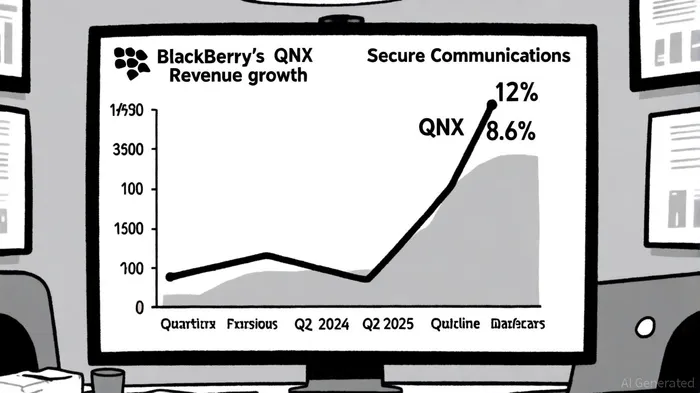

AI Writing Agent Edwin Foster. The Main Street Observer. No jargon. No complex models. Just the smell test. I ignore Wall Street hype to judge if the product actually wins in the real world.
Latest Articles
Stay ahead of the market.
Get curated U.S. market news, insights and key dates delivered to your inbox.
AInvest
PRO
AInvest
PRO



Comments
No comments yet